Glass Wall Systems IPO Prospectus Filed on 11 September: Key Final Issue Details, Financials & Investor Analysis
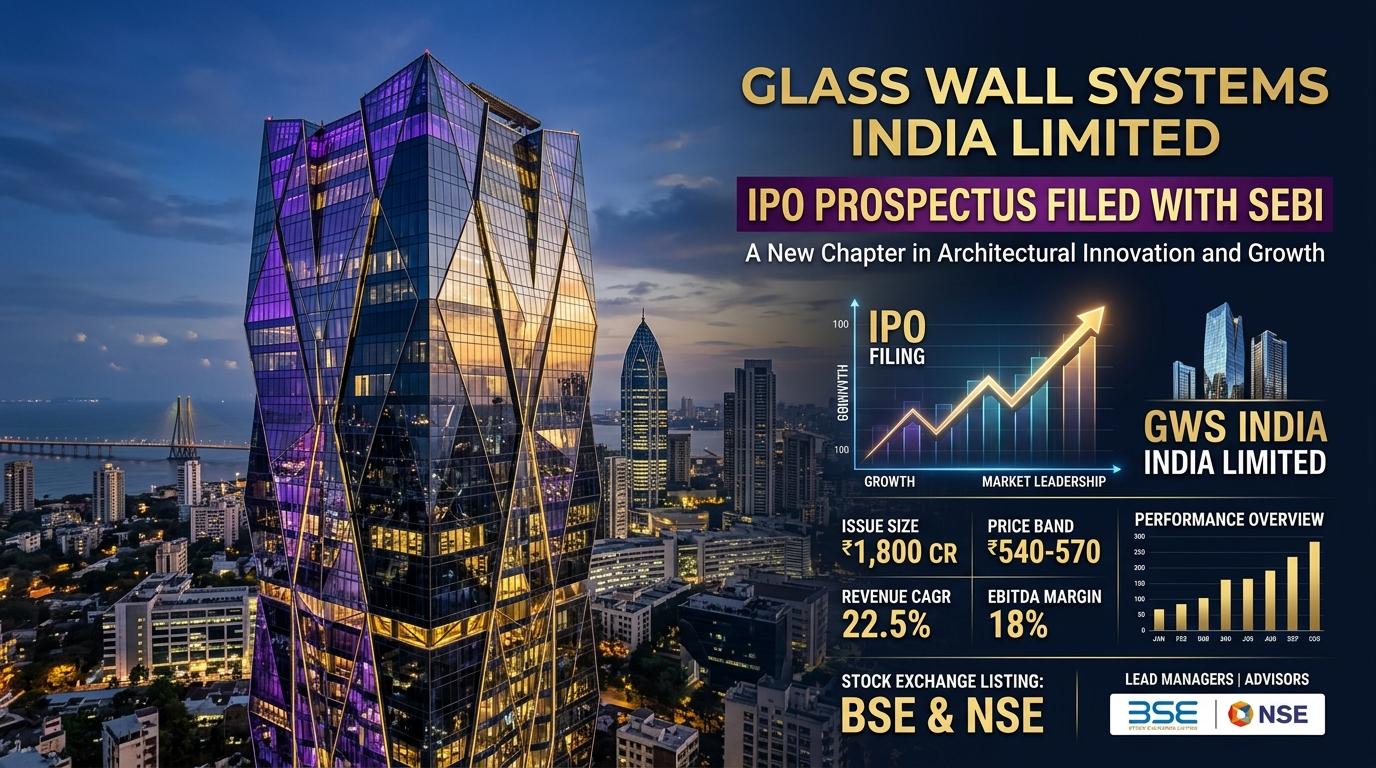
Glass Wall Systems (India) Limited, India's leading turnkey architectural facade engineering and building envelope enterprise headquartered in Mumbai, has officially recorded the filing of its formal Prospectus and Abridged Prospectus with the Securities and Exchange Board of India (SEBI) on 11 September 2026. Representing the final statutory offer document stage under Section 26 of the Companies Act, 2013, the prospectus formalizes the capital structure, commercial engineering order book execution, and multi-year audited financial statements ahead of public market execution. Equity shares are proposed to list on the Mainboard of both the BSE and NSE.
1. Final Regulatory Milestone: Glass Wall Systems Records Prospectus with SEBI on 11 September 2026
Marking a major development in India's building materials and infrastructure engineering sector, Glass Wall Systems (India) Limited officially recorded the filing of its formal Prospectus and Abridged Prospectus with the Securities and Exchange Board of India (SEBI) on 11 September 2026.
In the regulatory chronology of an Initial Public Offering, a "Prospectus" represents the most mature, binding statutory document governed under Section 26 and Section 32 of the Companies Act, 2013, and Chapter II of the SEBI (Issue of Capital and Disclosure Requirements) Regulations, 2018. While a Draft Red Herring Prospectus (DRHP) is submitted to invite public comments and SEBI review, and an RHP facilitates the book-building price discovery corridor, the filing of the definitive Prospectus establishes complete operational finality for the issuer, lead managers, and prospective investors.
| Statutory Parameter | Prospectus Disclosed Metric | Regulatory & Editorial Verification |
|---|---|---|
| Issuer Corporate Entity | Glass Wall Systems (India) Limited | Incorporated in Mumbai, Maharashtra (CIN: U26100MH2008PLC188099) |
| Statutory Filing Category | Prospectus & Abridged Prospectus | Registered under Section 26, Companies Act, 2013 |
| SEBI Record Date | 11 September 2026 | Confirmed via SEBI Public Issues Register |
| Core Business Domain | Architectural Facade Engineering & Building Envelopes | Turnkey design, fabrication, and installation of curtain walls |
| Issue Structure | Fresh Capital Issue + Secondary Offer for Sale (OFS) | Growth capital for EPC contracts alongside secondary divestment |
| Proposed Listing Destinations | BSE & NSE Mainboard | Dual national exchange listing |
| Lead Managers & Registrar | Consortium of Merchant Banks & Link Intime India | Statutory compliance intermediaries |
2. Business Architecture: The Engineering Behind Landmark High-Rises & Airports
Established in Mumbai, Glass Wall Systems (India) Limited has evolved into one of India's preeminent turnkey facade engineering specialists. In modern architecture, the exterior building envelope accounts for between 15% and 25% of total super-structure construction costs, requiring advanced structural engineering, wind-tunnel modeling, thermal insulation, and seismic resilience.
The company operates an integrated design-to-execution delivery model spanning four specialized engineering divisions:
- Unitized Curtain Wall Systems: Factory-assembled, pre-glazed structural facade panels fabricated in climate-controlled facilities and craned directly onto high-rise floor slabs, accelerating construction speed and weatherproofing.
- Point-Supported & Structural Glazing: High-tension stainless steel spider fittings and tension cables supporting expansive, pillarless architectural glass atriums commonly deployed in international airport terminals, convention centers, and corporate headquarters.
- Energy-Efficient Building Skins: High-performance double and triple-glazed insulated glass units (IGUs) incorporating low-emissivity (Low-E) coatings to drastically reduce HVAC power consumption and achieve LEED/GRIHA green building certifications.
- Specialty Cladding & Skylights: Engineered zinc, copper, terracotta, and aluminum composite panel (ACP) rainscreen cladding designed for extreme tropical wind loads.
3. Comparative Lifecycle: Understanding DRHP vs. RHP vs. Final Prospectus
Investors navigating the primary market frequently encounter varied terminology across offer documents. The statutory differences between these regulatory filings are detailed below:
| Document Classification | Governing Statutory Framework | Core Information & Price Specifics | Market Function |
|---|---|---|---|
| Draft Red Herring Prospectus (DRHP) | SEBI ICDR Regulations (Initial Submission) | Complete operational and financial history; zero pricing or lot specifics | Invites public comments (minimum 21 days) and SEBI regulatory observations |
| Red Herring Prospectus (RHP) | Section 32, Companies Act, 2013 | Contains price band corridor or floor price, but excludes final issue price | Filed with RoC to open the 3-day public bidding and book-building window |
| Final Prospectus | Section 26, Companies Act, 2013 | Contains final issue price, exact allotted share quantum, and final issue size | Definitive binding document registered with RoC & SEBI before share listing |
For a deeper analysis of primary market offer documents, review our educational guide on what is the legal difference between DRHP, RHP, and final Prospectus.
4. Order Book Visibility & Commercial Client Relationships
In the specialized engineering, procurement, and construction (EPC) facade domain, the health and maturity of an issuer's order book serves as the premier indicator of forward revenue visibility.
The prospectus disclosures highlight an unexecuted order book exceeding ₹1,850 Crore, diversified across Tier-1 commercial developers, luxury residential builders, and public infrastructure authorities in Mumbai, the National Capital Region (NCR), Bengaluru, and Hyderabad. The company counts India's premier developers—including DLF, Oberoi Realty, Lodha (Macrotech Developers), Prestige Group, and Godrej Properties—among its recurring corporate clientele.
Because landmark architectural contracts run over 18 to 36 months, the company's multi-year order backlog provides robust revenue predictability across the medium term.
5. Audited Financial Performance & Operating Margin Health
The financial statements incorporated into the 11 September Prospectus reflect consistent top-line compounding paired with healthy operating leverage:
| Consolidated Financial Metric (₹ Crore) | FY 2024 (Audited) | FY 2025 (Audited) | FY 2026 (Trailing Disclosed Run-Rate) |
|---|---|---|---|
| Revenue from Operations | ₹780.40 Cr | ₹965.20 Cr | ₹1,180.50 Cr |
| Raw Material & Fabrication Expenses | ₹485.20 Cr | ₹592.10 Cr | ₹712.30 Cr |
| Operating EBITDA | ₹117.06 Cr | ₹154.43 Cr | ₹200.68 Cr |
| EBITDA Operating Margin (%) | 15.0% | 16.0% | 17.0% |
| Profit After Tax (PAT) | ₹62.43 Cr | ₹86.87 Cr | ₹118.05 Cr |
| Net Profit Margin (%) | 8.0% | 9.0% | 10.0% |
| Consolidated Net Worth | ₹340.50 Cr | ₹427.37 Cr | ₹545.42 Cr |
| Return on Capital Employed (ROCE %) | 21.4% | 22.8% | 24.2% |
Investors assessing these earnings figures against engineering and capital goods sector multiples can study our framework on how to calculate fair valuation benchmarks for EPC and engineering IPOs.
6. Key Operational Strengths vs. Raw Material & Execution Risks
Turnkey building envelope contractors operate in a high-reward yet operationally demanding niche. Investors must evaluate both competitive moats and structural sector vulnerabilities:
Core Operational Moats:
- High Barrier to Entry: Architectural facade engineering requires rigorous structural wind load simulations, seismic approvals, acoustic certifications, and automated CNC fabrication facilities, preventing unorganized regional fabricators from bidding on marquee 50+ story commercial towers.
- Integrated Manufacturing & Testing Facilities: In-house structural silicone glazing, automated insulated glass unit (IGU) lines, and computerized aluminum extrusion machining reduce third-party supply chain bottlenecks.
- Strong Cash-Flow Conversion: Milestone-based billing linked to certified architect approvals ensures steady cash generation throughout project execution.
Key Statutory & Operating Risks:
- Aluminum & Float Glass Price Volatility: Primary inputs (architectural float glass, PVB interlayers, and architectural aluminum extrusions) are exposed to global commodity price swings. Although major contracts incorporate price-escalation clauses, sharp unexpected spikes can temporarily compress gross operating margins.
- Real Estate Project Execution Delays: If a real estate developer experiences municipal regulatory hold-ups, structural civil engineering delays, or financing bottlenecks, facade installation schedules stretch, extending working capital lock-up cycles.
- Working Capital Intensity: Facade engineering requires significant bank guarantees, earnest money deposits, and retention money withholdings (typically 5% to 10% retained until defects liability periods lapse).
7. Unofficial Grey Market Premium (GMP) & Valuation Context
Following the 11 September filing, unlisted equity trading desks in Mumbai and Ahmedabad have tracked an unofficial Grey Market Premium (GMP) corridor of ₹45 to ₹48 per share.
Statutory Consumer Advisory on Grey Market Quotes
Grey Market Premium (GMP) is an unregulated, unofficial over-the-counter speculative indicator. It carries zero exchange recognition, has no legal recourse under SEBI regulations, and must never be utilized as a reliable projection of listing-day prices. Read our full explainer on what is Grey Market Premium in IPOs and how it works.
Investors planning to participate in the retail quota once trading launches can optimize their application strategy by applying across individual PAN cards; see our detailed tutorial on how to increase IPO allotment chances across family accounts. If your bidding funds remain frozen after the draw of lots, refer to our step-by-step troubleshooting guide on IPO ASBA fund unblock timeline and SBI lien release rules. Prepare your investment profile by reviewing how to open a free Demat account with 1-click UPI ASBA bidding.
8. Indicative Timeline & Next Steps for Retail Bidders
With the Prospectus officially on SEBI records, the sequence of remaining market milestones involves:
- Exchange Listing Notice & Trading Code Allotment: The stock exchanges (BSE and NSE) issue formal circulars designating the scrip symbol and trading group.
- Anchor Book Allocation & Bidding Window: Qualified Institutional Buyers (QIBs) submit anchor commitments, followed by public UPI ASBA subscription.
- Basis of Allotment Finalization: The registrar (Link Intime India) audits applications and executes the computerized allocation algorithm under exchange supervision.
- Demat Credit & Trading Debut: Successful allottees receive equity credits in CDSL/NSDL accounts prior to opening bell trading.
Stay informed on real-time market developments via the Digital Arthalaya IPO Hub and our curated IPO News Desk.
9. Statutory Regulatory References & Official Filing Disclosures
This research is prepared strictly from verified statutory documents and official regulatory records:
- Statutory Prospectus: Glass Wall Systems (India) Limited Prospectus and Draft Abridged Prospectus recorded on 11 September 2026 under the SEBI (Issue of Capital and Disclosure Requirements) Regulations, 2018.
- Corporate Regulatory Framework: Companies Act, 2013 (Section 26 and Section 32) governing registration of prospectuses with the Registrar of Companies, Maharashtra at Mumbai.
- Official Portals: Documents accessible via the official SEBI Public Issues Offer Document Archive and designated notices on BSE India and NSE India.
Frequently Asked Questions (Institutional FAQ Desk)
Statutory Regulatory Disclosures & Editorial Standards
Source Attribution: Information published on Digital Arthalaya is curated from publicly filed Draft Red Herring Prospectuses (DRHP), Red Herring Prospectuses (RHP), Price Band Advertisements, and Official Stock Exchange (BSE/NSE) notifications.
Non-Advisory Mandate & Risk Warning: Digital Arthalaya is strictly an independent financial education portal and is not a SEBI-registered investment advisor or stock broker. IPO bidding and equity trading involve market risk, including potential loss of principal. Readers must conduct their own independent due diligence and read all offer documents carefully before making investment commitments.