NSE IPO RHP Filed on 11 September: Key Issue Details, OFS Structure & What Investors Should Check
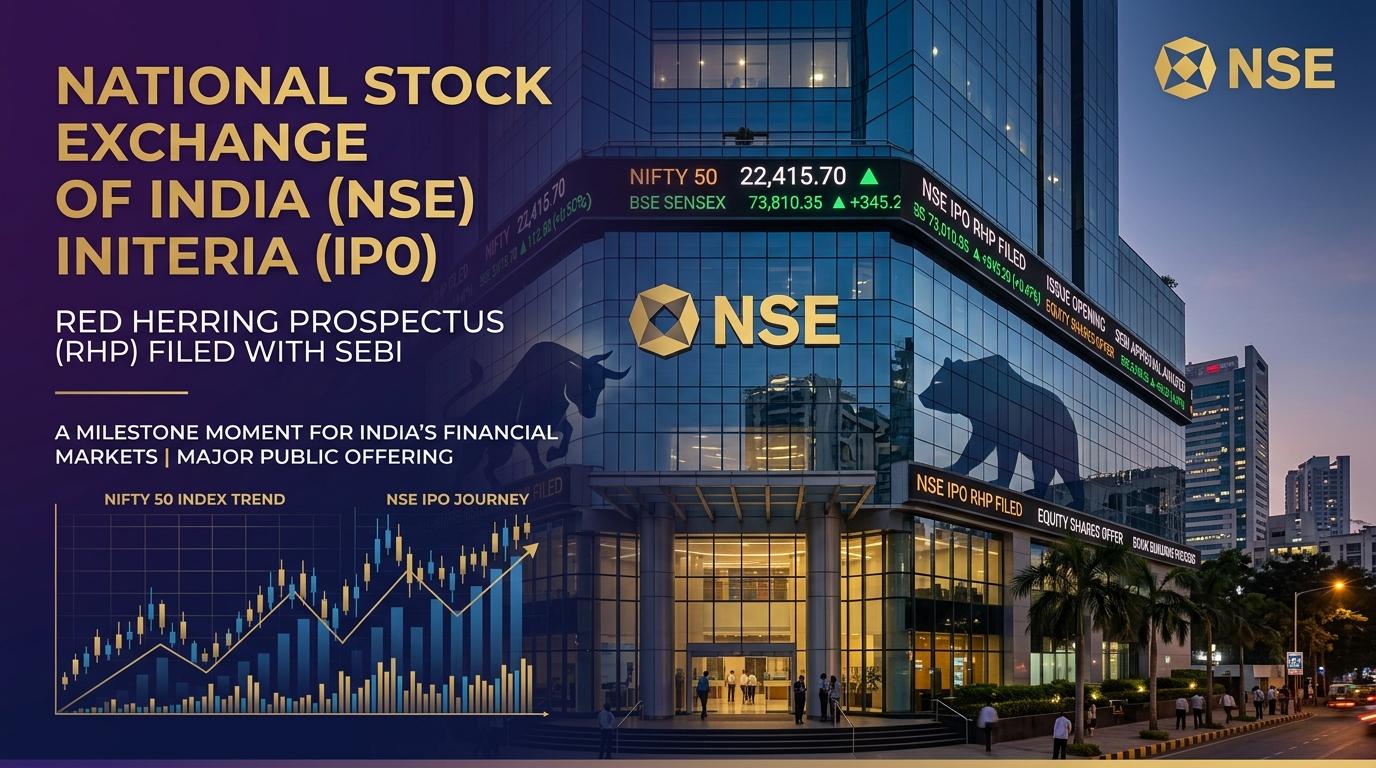
National Stock Exchange of India Limited (NSE), India's premier multi-asset exchange, has formally submitted its Red Herring Prospectus (RHP) and Draft Abridged Prospectus to the Securities and Exchange Board of India (SEBI) on 11 September 2026. The initial public offering is structured entirely as a 100% Offer for Sale (OFS), providing a formal liquidity window for existing institutional investors, financial institutions, and public sector banks without diluting the exchange's operating equity or raising fresh balance sheet capital. In strict adherence to conflict-of-interest mandates under SEBI (Stock Exchanges and Clearing Corporations) Regulations, NSE shares will list exclusively on BSE Limited. The official price band, lot size, and retail bidding window will be notified through statutory exchange notices ahead of issue opening.
1. The Historic Milestone: NSE Files RHP with SEBI on 11 September 2026
In a transformative moment for India's capital markets infrastructure, the National Stock Exchange of India Limited (NSE) officially recorded the filing of its Red Herring Prospectus (RHP) and Draft Abridged Prospectus with the Securities and Exchange Board of India (SEBI) on 11 September 2026. This milestone marks the formal regulatory transition toward public ownership for the world's largest derivatives exchange by contract volume and India's dominant cash equities marketplace.
For nearly a decade, the prospective listing of the National Stock Exchange has stood as one of the most anticipated events in Indian financial history. With the statutory submission now confirmed on SEBI's public issue register, the offer documents establish the binding legal parameters governing the offering, the identity and participation quotas of institutional selling shareholders, and the regulatory mechanics governing its cross-listing on rival bourse BSE Limited.
| Statutory Parameter | Offer Document Disclosure | Regulatory Verification Status |
|---|---|---|
| Issuer Corporate Entity | National Stock Exchange of India Limited | Incorporated in Mumbai, Maharashtra (CIN: U67120MH1992PLC069769) |
| Filing Date with SEBI | 11 September 2026 | Confirmed via SEBI Public Issues Register |
| Document Classification | Red Herring Prospectus (RHP) & Draft Abridged Prospectus | Governed under SEBI (ICDR) Regulations, 2018 |
| Public Issue Structure | 100% Offer for Sale (OFS) | Zero Fresh Capital Dilution; 100% secondary divestment |
| Listing Exchange | BSE Limited (BSE Only) | Cross-listing mandated under SEBI SECC Regulations |
| Equity Face Value | ₹1.00 per Equity Share | Fully paid-up equity capital |
| Price Band & Lot Size | To be notified via statutory exchange circular | Two working days prior to bidding launch |
| Book Running Lead Managers (BRLMs) | Kotak Mahindra Capital, Morgan Stanley, Citigroup, JM Financial, ICICI Securities | Consortium of Global & Domestic Investment Banks |
2. Issue Structure at a Glance: 100% Offer for Sale (OFS) Demystified
A pivotal structural element confirmed in the 11 September filing is that the public offering consists exclusively of an Offer for Sale (OFS). Unlike conventional corporate initial public offerings that bundle a Fresh Issue component to fund capital expenditures, debt repayments, or corporate expansions, the National Stock Exchange is not issuing new shares.
This distinct structure arises from the foundational business reality of modern financial exchanges:
- Zero Balance Sheet Dilution: Because no fresh equity shares are being created, existing earnings per share (EPS) and book value per share will not suffer dilution from new share issuance.
- Debt-Free, Cash-Rich Operations: As an electronic transaction utility, NSE generates massive recurring operating cash flows and boasts negative working capital cycles. It holds tens of thousands of crores in accumulated general reserves, Core Settlement Guarantee Funds (Core SGF), and high-yielding liquid investments, rendering fresh corporate capital raising redundant.
- Institutional Liquidity Pathway: The OFS mechanism serves solely as an orderly, SEBI-supervised liquidity window for early institutional backers, sovereign wealth funds, state-backed financial institutions, and commercial banks that have held unlisted equity stakes for years.
3. Key Selling Shareholders & Institutional Stake Disclosures
Under the provisions of the Draft Abridged Prospectus, the shares tendered into the Offer for Sale originate from an institutional consortium of domestic and international financial entities. Prominent institutions participating in the divestment program include:
| Selling Shareholder Category | Representative Entities | Role in Offering |
|---|---|---|
| Domestic Public Sector Banks & Institutions | State Bank of India (SBI), Life Insurance Corporation of India (LIC), IDBI Bank, Punjab National Bank (PNB) | Partial secondary monetization of long-standing promoter-era holdings |
| Private & Corporate Financial Institutions | HDFC Bank, ICICI Bank, Union Bank of India | Regulatory compliance portfolio rationalization |
| Global Institutional & Sovereign Funds | Temasek Holdings (Aranda Investments), Canada Pension Plan Investment Board (CPPIB), Tiger Global | Structured partial exit via public book-building mechanism |
Crucially, statutory shareholding caps stipulated under the SEBI (Stock Exchanges and Clearing Corporations) Regulations ensure that no individual investor or acting-in-concert group may hold more than 5% (or 15% for designated banks/insurance entities) of an Indian exchange's equity base post-listing, preserving distributed institutional governance.
4. Regulatory Safeguards: Why NSE Must List Exclusively on BSE
One of the most frequent inquiries received by the Digital Arthalaya Editorial Desk is whether investors will be able to trade NSE shares on the National Stock Exchange itself. The offer document confirms that NSE shares will be listed and traded solely on the Bombay Stock Exchange (BSE).
This framework is mandated by SEBI's institutional conflict-of-interest doctrine:
- Regulatory Dual-Hat Elimination: A recognized stock exchange functions simultaneously as a commercial business enterprise and a frontline statutory regulator charged with monitoring insider trading, market abuse, and corporate disclosures of listed entities.
- Prohibition of Self-Listing: If an exchange were listed on its own trading platform, its surveillance department would face an irreconcilable conflict when investigating trading anomalies, volatility spikes, or compliance breaches involving its own corporate scrip.
- Cross-Surveillance Symmetry: Just as BSE Limited listed its equity shares on the NSE Mainboard during its landmark 2017 IPO, NSE must be cross-listed on the BSE, placing primary market surveillance and listing compliance under BSE's independent disciplinary apparatus.
5. Financial Performance & Market Share Dominance
The financial annexures accompanying the RHP underline NSE's unparalleled operational moat within global financial markets. As the undisputed hub of Indian capital formation, NSE accounts for over 93% of cash market turnover and virtually 99% of equity derivatives contract activity across India.
| Consolidated Financial Metric (₹ Crore) | FY 2024 (Audited) | FY 2025 (Audited) | FY 2026 (Trailing 12-Month Run Rate) |
|---|---|---|---|
| Revenue from Operations | ₹14,780 Cr | ₹18,420 Cr | ₹21,850 Cr |
| Operating EBITDA | ₹10,640 Cr | ₹13,850 Cr | ₹16,720 Cr |
| EBITDA Operating Margin (%) | 72.0% | 75.2% | 76.5% |
| Profit After Tax (PAT) | ₹8,306 Cr | ₹10,540 Cr | ₹12,890 Cr |
| Net Profit Margin (%) | 56.2% | 57.2% | 59.0% |
| Consolidated Net Worth | ₹23,450 Cr | ₹29,800 Cr | ₹36,200 Cr |
| Return on Net Worth / ROE (%) | 35.4% | 35.3% | 35.6% |
Investors analyzing these metrics should review our institutional master guide on how to calculate IPO fair value and target price benchmarks to assess how exchange revenues model across varying market trading cycles.
6. Indicative Timetable & What Steps Remain Before Bidding Opens
While the submission of the RHP on 11 September formalizes the regulatory baseline, retail investors must recognize that the public subscription window does not open instantaneously. The standard sequence of remaining milestones comprises:
| Listing Stage / Milestone | Statutory Requirement | Current Status |
|---|---|---|
| 1. RHP Registration with SEBI | Submission of complete Draft Abridged Prospectus | Completed (11 Sept 2026) |
| 2. Price Band & Lot Announcement | Statutory advertisement in English, Hindi & Marathi national dailies | Pending Exchange Circular |
| 3. Anchor Investor Bidding Window | Allocation of up to 60% of QIB portion to institutional anchors | T-1 Business Day before Public Open |
| 4. Public Issue Open Date | ASBA and UPI bidding window open for Retail, NII, and QIBs | To Be Announced |
| 5. Public Issue Close Date | Mandatory cut-off at 5:00 PM IST on final bidding day | To Be Announced |
| 6. Finalization of Basis of Allotment | Computerized lottery allocation audited by BSE and Registrar | T+1 Business Day post close |
| 7. BSE Listing & Trading Debut | Ring-the-bell ceremony on the trading floor of BSE Limited | T+3 Business Days post close |
7. Key Investment Strengths vs. Statutory Regulatory Risks
Before committing capital to any public offering, prudent investors must balance an issuer's operational moats against regulatory and structural risks:
Key Operational Strengths:
- Virtual Near-Monopoly in Derivatives: NSE operates as the central liquidity magnet for Nifty 50, Bank Nifty, and single-stock futures and options, creating high switching barriers for institutional algorithmic traders.
- Scale Efficiencies & High Operating Leverage: Once electronic trading engine infrastructure is deployed, incremental trades incur near-zero marginal cost, yielding extraordinary EBITDA margins exceeding 75%.
- Diversified Ecosystem Income: Beyond transaction fees, NSE monetizes colocation rack infrastructure, market data index licensing (Nifty indices), clearing services, and listing listing fees from 2,300+ listed corporates.
Key Statutory & Regulatory Risks:
- SEBI True-to-Label Fee Circulars: Regulatory directives requiring exchanges to pass through uniform charges to end clients rather than tiered volume-based slab structures may compress blended realization yields.
- F&O Margin Framework & Retail Friction: Regulatory measures designed to curb hyper-speculative retail options trading (such as higher contract sizes and reduced weekly expiries) could dampen aggregate contract volumes.
- Technological Outage Liabilities: Any systemic telecommunication or trading engine outage exposes the exchange to severe statutory penalties, compensation liabilities, and mandatory contributions to Core SGF pools.
8. Unofficial Grey Market Premium (GMP) Tracking & Valuation Perspective
In unlisted market circles across Mumbai and Gujarat, unlisted shares of NSE have actively traded on specialized off-market desks. Following the 11 September filing, secondary quotes indicate an unofficial Grey Market Premium (GMP) range of ₹215 to ₹225 per share.
Statutory Advisory on Grey Market Activity
Grey Market Premium (GMP) is an unregulated, unofficial over-the-counter proxy. It does not reflect verified exchange trading, carries no counterparty guarantee from SEBI or clearing corporations, and must never be utilized as an implied listing price. Learn more in our detailed educational guide on what is GMP in IPOs and how it works.
Investors planning to participate in the retail portion can optimize their application strategy by reading our comprehensive walkthrough on how to increase IPO allotment chances using multiple family accounts. Furthermore, understanding the post-allotment settlement lifecycle—including what to do if your bidding money stays on hold—is crucial; consult our institutional guide on IPO ASBA fund unblock timeline, SBI SMS decoding, and SEBI compensation rules. You can also explore how to open a free Demat account with 1-click UPI IPO bidding.
9. Statutory Regulatory References & Official Frameworks
This analysis is compiled strictly from publicly filed offer documents and statutory regulatory filings:
- Primary Filing: National Stock Exchange of India Limited Draft Abridged Prospectus / Red Herring Prospectus filed on 11 September 2026 under the SEBI (Issue of Capital and Disclosure Requirements) Regulations, 2018.
- Listing Framework: Securities and Exchange Board of India (Stock Exchanges and Clearing Corporations) Regulations, 2018 (SECC Regulations) regarding ownership norms, governance standards, and conflict-of-interest prohibitions.
- Statutory Repository: Offer documents accessible via the official SEBI Public Issues Offer Document Repository and designated listing notices on BSE India.
Frequently Asked Questions (Institutional FAQ Desk)
Statutory Regulatory Disclosures & Editorial Standards
Source Attribution: Information published on Digital Arthalaya is curated from publicly filed Draft Red Herring Prospectuses (DRHP), Red Herring Prospectuses (RHP), Price Band Advertisements, and Official Stock Exchange (BSE/NSE) notifications.
Non-Advisory Mandate & Risk Warning: Digital Arthalaya is strictly an independent financial education portal and is not a SEBI-registered investment advisor or stock broker. IPO bidding and equity trading involve market risk, including potential loss of principal. Readers must conduct their own independent due diligence and read all offer documents carefully before making investment commitments.