History of Indian Share Market: 1875 to 2026 Evolution | Digital Arthalaya
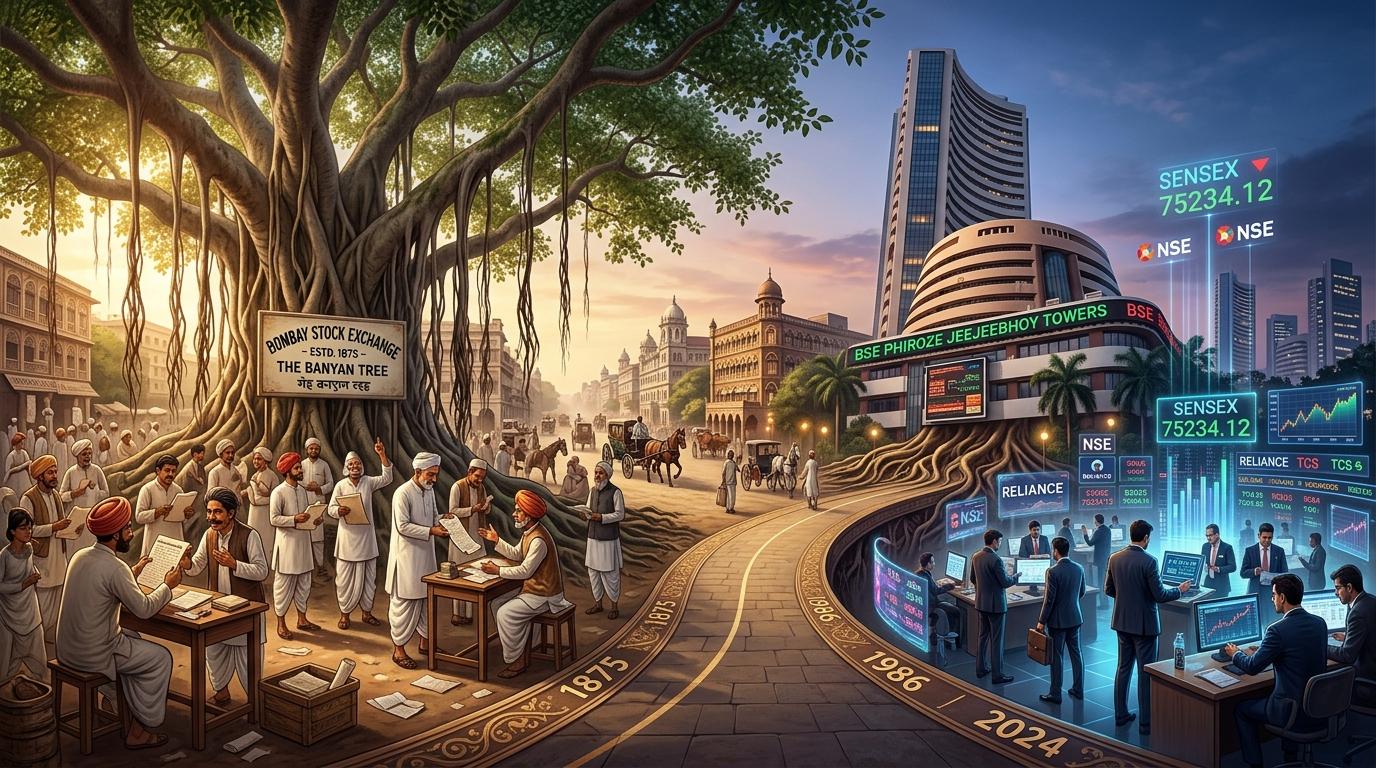
The Indian stock market represents a 170-year evolution from informal 1850s gatherings of cotton merchants under a banyan tree at Horniman Circle to Dalal Street's modern T+1 electronic powerhouse. Crucial epochal milestones: The founding of BSE (Asia's oldest exchange) in 1875 by Premchand Roychand; the 1992 Harshad Mehta crisis that dismantled the Controller of Capital Issues and enacted the statutory SEBI Act; the launch of NSE's satellite-linked electronic screen trading in 1994; and the Depositories Act, 1996 establishing NSDL and CDSL to eliminate physical paper certificates. Today, paperless KYC, UPI ASBA bidding, and ₹22,000+ Crore monthly SIP flows anchor India's $5+ Trillion market capitalization.
Today, executing an equity transaction on the Indian stock market takes fewer than two milliseconds. Armed with a 5G mobile smartphone, paperless DigiLocker e-KYC, instant UPI 2.0 ASBA IPO bidding, and electronic central depositories (CDSL and NSDL), tens of millions of Indian retail and institutional investors trade daily across the world's fastest-growing major economy. India's premier exchanges—the National Stock Exchange of India (NSE) and the Bombay Stock Exchange (BSE)—settle hundreds of billions of dollars in equities, exchange-traded funds (ETFs), and derivatives under a globally admired T+1 rolling settlement mechanism, with pilots already underway for instantaneous T+0 settlement.
However, modern India's capital market architecture did not emerge overnight. It is the product of more than 170 years of dramatic, volatile, and transformative financial evolution. The journey spans informal gatherings of nineteenth-century cotton merchants under the shade of a banyan tree, the birth of Asia's first organized stock exchange, the physical chaos of open-outcry trading rings, the systemic shock of the 1992 securities scam, the pioneering launch of satellite-linked electronic screen trading, the complete elimination of physical paper certificates, and the rise of a domestic mutual fund SIP super-force. This comprehensive guide chronicles the complete epochal history of the Indian share market and analyzes the landmark institutional reforms that forged today's financial powerhouse.
1. The 1850s: The Cotton Boom & The Banyan Tree at Horniman Circle
The origins of organized securities trading in India trace back to the mid-nineteenth century in the port city of Bombay (now Mumbai). During this period, the British East India Company and private commercial ventures issued loan bonds, municipal securities, and shares in early joint-stock banks and shipping companies.
The initial catalyst for equity trading was the American Civil War (1861–1865). As the Union naval blockade severed the supply of American cotton to the textile mills of Lancashire in England, Britain turned almost exclusively to India to meet its raw cotton requirements. Raw cotton prices in Bombay surged to unprecedented heights, flooding the merchant community with astronomical wealth. Hundreds of joint-stock companies—ranging from cotton pressing factories and shipping lines to speculative reclamation companies (such as the Back Bay Reclamation Scheme)—were launched overnight.
In the 1850s, an informal fraternity of five enterprising stockbrokers—including four Gujarati merchants and one Parsi merchant—began assembling daily under the sprawling shade of a banyan tree situated in front of the Town Hall at Horniman Circle (then known as Bombay Greens). As the volume of speculation swelled with the cotton boom, the gathering of brokers expanded into dozens, then hundreds. The group relocated frequently from Horniman Circle to the junction of Meadows Street and Rampart Row, before permanently settling in 1874 on an unpaved lane in the Fort commercial district that soon became universally known as Dalal Street (literally "Broker Street").
Birth of Asia's Oldest Stock Exchange (July 9, 1875)
Following the abrupt end of the American Civil War in 1865, cotton prices collapsed, triggering widespread bankruptcies in Bombay. Recognizing the urgent need for structured trading rules, standardized broker ethics, and counterparty dispute resolution, merchant-financier Premchand Roychand (the "Cotton King" and primary benefactor of Mumbai University's Rajabai Clock Tower) mobilized the merchant community. On July 9, 1875, 318 brokers paid an entrance fee of ₹1 each to formally incorporate The Native Share & Stock Brokers' Association. This historic assembly became the Bombay Stock Exchange (BSE)—the first formal stock exchange established anywhere in Asia.
2. The Open Outcry & Badla Era: Shouting, Hand Signals, and Paper (1875–1992)
For more than a century following its formalization, trading on the BSE and regional exchanges (including the Calcutta Stock Exchange established in 1908 and Madras Stock Exchange in 1937) operated through a colorful, chaotic, and high-friction operational architecture known as the Open Outcry system:
A. The Mechanics of the Trading Ring
Trading occurred inside packed, physical "trading rings" on Dalal Street. Floor brokers and their authorized representatives (known as jobbers) gathered in specialized circular pits designated for specific equities (such as Tata Steel, Century Textiles, or Reliance Industries). To execute trades, brokers shouted buy and sell prices simultaneously at the top of their lungs while signaling order sizes and quotes using intricate non-verbal hand gestures (known traditionally as Sodi and Kodi). Once two floor participants agreed upon a price, the transaction was scribbled into tiny pocket notebooks called Sauda books for end-of-day reconciliation.
B. The Badla Financing System
Because modern institutional clearing houses and standardized cash-settled futures contracts did not exist, the Indian market devised an indigenous financing and carry-forward mechanism called Badla. Under the Badla framework:
- Trading accounts settled on a rolling 14-day settlement cycle.
- If a speculative trader did not possess the full cash to take delivery of shares, or did not own the underlying shares to fulfill a sale, they could "carry forward" the settlement obligation to the subsequent 14-day settlement cycle.
- This deferral required paying a financing interest fee (known as the Badla rate) to wealthy third-party financiers who stepped in to fund the trade.
While Badla provided immense liquidity to the exchange, it introduced dangerous leverage into the banking system, enabling speculative broker syndicates to build colossal leveraged positions with minimal upfront capital.
C. The Friction and Perils of Physical Paper Certificates
Trade execution in the trading ring took seconds, but completing the post-trade settlement was an arduous operational nightmare that frequently took six to eight weeks. Investors possessed tangible paper share certificates that had to be physically delivered along with signed Transfer Deeds bearing government revenue stamps. The structural risks of paper certificates crippled early retail participation:
- Bad Deliveries: If an investor's physical signature on the transfer deed deviated even slightly from the specimen signature filed with the company's registrar decades earlier, the transfer was rejected as a "bad delivery," freezing the investor's capital for months in tedious clerical arbitration.
- Counterfeiting and Forgery: Criminal cartels routinely printed duplicate share certificates and forged transfer deeds of blue-chip companies, distributing them through unsuspecting retail brokers.
- Postal Theft and Physical Perils: Registered post packets carrying valuable share certificates were regularly intercepted and stolen in transit. Millions of certificates suffered water damage, termite destruction, or fire devastation inside domestic cupboards and broker basements.
3. The 1991 Economic Liberalization & The 1992 Harshad Mehta Crisis
The early 1990s represented the most pivotal turning point in modern Indian economic history. Faced with a catastrophic balance-of-payments crisis in 1991, Prime Minister P.V. Narasimha Rao and Finance Minister Dr. Manmohan Singh dismantled the restrictive License-Permit-Quota Raj, inaugurating an era of economic liberalization, foreign direct investment, and private sector deregulation.
A. Abolition of the Controller of Capital Issues (CCI)
Prior to 1992, public capital raising was governed by the archaic Capital Issues (Control) Act of 1947. Under this socialist-era framework, a government bureaucrat designated as the Controller of Capital Issues (CCI) determined the exact issue price at which companies were legally allowed to offer shares to the public. The CCI relied on conservative, historical net-asset-value formulas that severely underpriced corporate equity, creating massive speculative black-market premiums while depriving growing companies of market-clearing capital. In May 1992, the Indian Parliament repealed the Capital Issues (Control) Act, abolishing the CCI and ushering in the modern era of free pricing where companies and merchant bankers discover IPO valuations based on market demand.
B. The 1992 Securities Scam and Structural Fault Lines
However, before structural reforms could be fully institutionalized, the weaknesses of the manual paper-and-bank settlement mechanism were brutally laid bare in April 1992 by the Harshad Mehta Securities Scam. Mehta, a charismatic broker dubbed the "Big Bull," exploited manual loopholes in the inter-bank government securities market. By colluding with bank officials to issue uncollateralized, fraudulent Bank Receipts (BRs), Mehta siphoned thousands of crores in public treasury funds from major financial institutions (including the State Bank of India and National Housing Bank) directly into Dalal Street trading accounts.
Using this massive illicit liquidity, Mehta and his syndicate engineered violent, speculative price spikes in targeted equities—most notoriously pushing the share price of Associated Cement Companies (ACC) from ₹300 in 1991 to over ₹10,000 in early 1992. When investigative reporting by journalists Sucheta Dalal and Debashis Basu uncovered the uncollateralized Bank Receipts, inter-bank credit froze overnight. The BSE Sensex plunged precipitously from its April 1992 peak of 4,467 points, wiping out the life savings of hundreds of thousands of retail investors and triggering a nationwide banking investigation.
The Birth of Statutory SEBI (April 12, 1992)
The 1992 securities crisis proved beyond doubt that an opaque, self-regulatory broker club could no longer govern the nation's financial lifeblood. While the Securities and Exchange Board of India (SEBI) had been established as an administrative advisory committee in April 1988, it possessed zero statutory legal powers. On January 30, 1992, the President promulgated the SEBI Ordinance, which Parliament codified into law as the Securities and Exchange Board of India Act, 1992 (SEBI Act) on April 12, 1992. The landmark legislation granted SEBI sweeping, autonomous statutory authority to license intermediaries, inspect broker books, penalize insider trading, mandate corporate disclosure norms, and safeguard retail investor rights.
4. 1994: The Launch of the National Stock Exchange (NSE) & Satellite Screen Trading
While the establishment of statutory SEBI provided regulatory teeth, the operational infrastructure of Dalal Street remained monopolized by an entrenched guild of BSE broker-members who resisted modernization and transparency. To break this regional monopoly, the High Powered Committee on Establishment of New Stock Exchanges (chaired by M.J. Pherwani) recommended the creation of a brand-new, institutionally owned, nationwide electronic exchange.
The National Stock Exchange of India (NSE) was incorporated in November 1992, recognized as a stock exchange in April 1993, and inaugurated commercial trading in the wholesale debt market in June 1994. On November 3, 1994, the NSE commenced operations in the capital market (equities) segment, unleashing two historic technological breakthroughs that revolutionized Indian finance:
- The NEAT Electronic Order Book (National Exchange for Automated Trading): The NSE completely bypassed the physical trading ring. It introduced NEAT—a computerized, order-driven screen-based trading platform. On NEAT, buy and sell orders entered by brokers across the country matched automatically on strict price-time priority inside a centralized electronic matching engine, eliminating backroom manipulation and providing total price transparency.
- VSAT Satellite Telecommunications: In an era when Indian telephone lines were notoriously unreliable, the NSE partnered with the Department of Telecommunications to establish a private satellite network using Very Small Aperture Terminal (VSAT) dishes. A broker sitting in Coimbatore, Patna, Rajkot, or Guwahati could install a rooftop satellite dish and access identical, millisecond-level price discovery and liquidity as a member on Dalal Street. This single innovation transformed equity investing from a localized Mumbai club into a truly national phenomenon.
Faced with catastrophic market-share losses to the NSE, the Bombay Stock Exchange was forced to modernize. In 1995, under the leadership of newly appointed technocrats, the BSE abandoned the open-outcry ring and launched its own electronic screen trading software, the BOLT (BSE On-Line Trading) system, bringing the physical shouting era to a permanent close.
5. 1996: The Dematerialization Revolution (The Depositories Act, NSDL & CDSL)
The electronic trading revolution on the NSE exposed a dangerous operational bottleneck. While buy and sell orders were matched in milliseconds on computer screens, the settlement process remained tethered to the physical delivery of millions of paper share certificates. By 1995, trading floors and broker offices were buried under tons of physical paper. Over 15% to 20% of all secondary market deliveries were rejected as "bad deliveries" due to disputed signatures, postal theft, or counterfeit transfer deeds.
To eliminate this existential barrier to growth, the Government of India promulgated the Depositories Ordinance, which Parliament enacted as the Depositories Act, 1996 in August 1996. The legislation established the legal framework for dematerialization (Demat)—converting physical paper share certificates into fungible, electronic book-entry credits stored securely in computerized depository databases.
Under the visionary leadership of the Industrial Development Bank of India (IDBI), the Unit Trust of India (UTI), and the NSE, India's first central electronic depository—the National Securities Depository Limited (NSDL)—was inaugurated in November 1996. In February 1999, the BSE, along with leading public and private banks, established the Central Depository Services (India) Limited (CDSL).
Through phased SEBI mandates beginning in 1998, institutional investors, followed by retail participants, were prohibited from settling trades in paper certificates. The Demat revolution yielded monumental benefits:
- Complete Elimination of Bad Deliveries: Signature disputes, counterfeit certificates, and physical transit theft vanished instantly.
- Abolition of Stamp Duty on Transfers: The costly 0.50% physical stamp duty on share transfers was permanently abolished for electronic transactions.
- Instant Automated Corporate Benefits: Bonus shares and stock splits were credited directly to electronic Demat accounts on the ex-date, while cash dividends flowed electronically into linked bank accounts via NACH/ECS.
To understand the legal custody protections safeguarding your electronic assets today, review our comprehensive Demat Account Custody Guide and learn how to establish a verified account with our Step-by-Step Demat Opening Guide.
6. Comparative Matrix: 1980s Paper Era vs. 2026 Algorithmic Digital Era
The profound structural modernization of India's capital market across the last four decades is summarized in the institutional comparison table below:
| Operational Parameter | 1980s Paper & Outcry Era | 2026 Algorithmic Digital Era | Systemic Impact on Retail Investors |
|---|---|---|---|
| Trading Mechanism | Physical open-outcry shouting inside crowded trading rings; manual Sauda paper books. | 100% Automated Algorithmic Matching: Sub-second co-located exchange servers; mobile trading apps. | Guarantees identical millisecond execution price for retail and institutional orders nationwide. |
| Securities Custody | Physical paper certificates with signed transfer deeds; stored in domestic cupboards. | 100% Electronic Dematerialization: Encrypted book-entries at CDSL and NSDL under 16-digit BO-IDs. | Completely eliminated forged shares, bad deliveries, postal theft, and paper storage hazards. |
| Settlement Cycle | 14-day rolling account settlements or multi-month leveraged Badla carry-forwards. | T+1 Rolling Settlement: Universal next-day delivery; optional real-time T+0 settlement pilots. | Drastically minimized counterparty default risk; releases cash and shares to investors in 24 hours. |
| Retail Demat Base | Fewer than 1 million active paper share-owning investors, concentrated in Mumbai and Gujarat. | 160+ Million Registered Demat Accounts: Broadly distributed across Tier-1, Tier-2, and Tier-3 Indian cities. | Democratized wealth creation; over 20% of Indian households now participate directly or indirectly. |
| Brokerage Commission | 0.50% to 1.50% percentage turnover fees + physical transfer stamp duty charges. | Zero Delivery Brokerage: Flat ₹20 per trade on intraday/F&O on modern discount brokerages. | Saves retail investors tens of thousands of rupees annually in unnecessary frictional transaction costs. |
| Primary IPO Bidding | Physical paper forms, physical demand drafts, and 30-to-45-day blocked cash refund delays. | Instant 1-Click UPI ASBA Bidding: Funds remain earning bank interest; T+3 listing from issue close. | Eliminated lost refund cheques; allows transparent computerized allotment draws in under 48 hours. |
7. Risk Management & Settlement Evolution: From the Badla Ban to T+1 & T+0 (2001–2026)
Modern capital markets require ironclad clearing corporations and rigorous margining frameworks to prevent systemic collapse. Following the 1999–2000 dot-com bust and the 2001 Ketan Parekh securities crisis (which involved circular trading in technology stocks and cooperative bank failures), SEBI implemented a sequence of historic risk management reforms:
A. The Total Prohibition of Badla (July 2001)
Recognizing that informal carry-forward financing created uncontrollable counterparty risks, SEBI officially banned the Badla system across all Indian exchanges on July 2, 2001. To replace Badla with a globally compliant risk management tool, SEBI introduced formal, exchange-traded financial derivatives:
- Index Futures: Launched on the BSE and NSE in June 2000 (tracking the BSE Sensex and S&P CNX Nifty).
- Index Options & Stock Options: Introduced in June and July 2001.
- Single Stock Futures: Commenced in November 2001 with strict upfront margin collection and clearing corporation counterparty guarantees.
According to data from the Futures Industry Association (FIA), the National Stock Exchange of India has ranked continuously as the world's largest derivatives exchange by volume of contracts traded for multiple consecutive years, driven by massive liquidity in NIFTY 50 and BANK NIFTY options.
B. The Multi-Decade Settlement Acceleration (14-Day to T+1)
To reduce systemic counterparty exposure, SEBI orchestrated a relentless decades-long campaign to compress the equity settlement cycle:
- 1990s: 14-day settlement account periods with frequent rollover deferrals.
- July 2001: Transition to a uniform T+5 rolling settlement cycle across all listed scrips.
- April 2002: Compression to a T+3 rolling settlement cycle.
- April 2003: Transition to a T+2 rolling settlement cycle, which remained the global standard for two decades.
- January 2023: In a historic regulatory achievement, India became the first major global financial market (ahead of the United States and the European Union) to implement a universal T+1 rolling settlement cycle across all listed equities. Under T+1, an investor who buys shares on Monday receives electronic delivery in their Demat account by Tuesday afternoon.
- 2024–2026 (The T+0 Pilot): SEBI introduced a phased beta version of optional Same-Day (T+0) Settlement for select high-liquidity equities, enabling instantaneous trade clearing and same-day payout of funds and securities.
8. The SIP Super-Force & Financialization of Retail Savings
Historically, the Indian stock market suffered from extreme volatility due to its overwhelming dependence on Foreign Institutional Investors (FIIs / FPIs). Whenever the US Federal Reserve raised interest rates or global geopolitical crises emerged, foreign institutional funds pulled billions of dollars out of Indian equities, sending the Sensex and Nifty into freefall.
Over the last decade, this structural vulnerability has decoupled entirely. Driven by the JAM Trinity (Jan Dhan, Aadhaar, and Mobile connectivity), widespread financial literacy, and the user-friendly interfaces of mobile discount brokers, Indian household savings have undergone a historic shift away from physical unproductive assets (such as physical gold and real estate) into productive financial assets:
- The Monthly SIP Inflow Engine: Monthly domestic mutual fund inflows channeled via Systematic Investment Plans (SIPs) surged from ₹3,122 Crore in April 2016 to over ₹22,000+ to ₹24,000+ Crore every single month by 2026.
- The Domestic Institutional Liquidity Cushion: Indian domestic institutional investors (DIIs)—including mutual fund asset management companies, pension funds (NPS, EPFO), and Life Insurance Corporation (LIC)—now deploy massive domestic capital that routinely absorbs multi-billion-dollar foreign capital sell-offs, stabilizing domestic equity valuations.
- Milestone Market Capitalization: Propelled by resilient domestic earnings growth and retail investor confidence, the combined market capitalization of companies listed on the BSE and NSE crossed $5 Trillion, cementing India's rank among the top four largest equity markets on earth.
To master the foundational principles of long-term compounding in equities, consult our How to Invest in Stocks for Beginners Guide and compare modern investment applications using our Best Trading Apps in India Benchmark.
9. Chronological Watershed Milestones Timeline (1875 to 2026)
The definitive chronological timeline of India's capital market journey is outlined below:
| Year | Landmark Historical Milestone | Governing Entity / Catalyst | Systemic Regulatory Consequence |
|---|---|---|---|
| 1875 | Founding of The Native Share & Stock Brokers' Association (BSE). | Premchand Roychand and 318 founding brokers. | Established Asia's first formal stock exchange and standardized physical broker rules on Dalal Street. |
| 1956 | Enactment of the Securities Contracts (Regulation) Act (SCRA). | Parliament of India. | Granted central government statutory authority to recognize and supervise stock exchanges. |
| 1986 | Launch of the BSE SENSEX (Sensitivity Index). | Bombay Stock Exchange (BSE). | Created India's first stock market benchmark, using 1978–79 as the base year (Base Value: 100). |
| 1992 | Enactment of the SEBI Act, 1992; Abolition of the CCI. | Parliament of India / Harshad Mehta Scam. | Granted autonomous statutory powers to SEBI; established market-driven free IPO pricing. |
| 1994 | Commencement of Equity Trading on the National Stock Exchange (NSE). | NSE / Pherwani Committee Mandate. | Introduced NEAT electronic screen matching and VSAT satellite dishes, ending regional broker monopolies. |
| 1996 | Launch of NIFTY 50 Index; Inception of Dematerialization (NSDL). | NSE & Parliament (Depositories Act, 1996). | NIFTY 50 launched with base value of 1,000; NSDL launched, initiating the phase-out of paper share certificates. |
| 1999 | Establishment of Central Depository Services (India) Limited (CDSL). | BSE, Public Sector Banks, and SEBI. | Introduced competitive depository infrastructure, lowering electronic custody fees for retail investors. |
| 2000–2001 | Launch of Exchange-Traded Derivatives; Total Prohibition of Badla. | SEBI / L.C. Gupta Committee. | Banned indigenous carry-forward leverage; introduced cash-settled index futures, options, and stock derivatives. |
| 2008 | Introduction of ASBA (Application Supported by Blocked Amount). | SEBI Banking Directive. | Eliminated physical refund cheques; mandated that IPO bid funds remain earning interest in investor bank accounts. |
| 2019 | Integration of UPI 2.0 with ASBA IPO Bidding. | SEBI, NPCI, and Stock Exchanges. | Enabled paperless 1-click mobile IPO bidding, compressing retail application time to under 30 seconds. |
| 2023 | Universal Rollout of T+1 Rolling Settlement Cycle. | SEBI, NSE, BSE, CDSL, NSDL. | Made India the first major global economy to achieve universal next-day delivery of shares and cash payouts. |
| 2024–2026 | Launch of T+0 Settlement Beta; 160M+ Registered Demat Accounts. | SEBI & Depositories. | Initiated optional same-day trade settlement; domestic mutual fund SIPs exceed ₹22,000+ Crore monthly. |
10. Statutory Regulatory References & Official Frameworks
The structural evolution, intermediary registration, and investor protections of the Indian capital market are governed by statutory parliamentary enactments and official exchange archives:
- The Securities and Exchange Board of India Act, 1992 (SEBI Act): Foundational parliamentary statute conferring autonomous statutory authority to regulate market intermediaries, enforce transparency, and protect retail investor rights. Access the official statute at the SEBI Legal Portal.
- The Depositories Act, 1996: Principal legislation establishing the legal separation between depository participants and central depositories, mandating paperless electronic Demat custody at the India Code Legislative Database.
- Securities Contracts (Regulation) Act, 1956 (SCRA): Master legislation governing stock exchange licensing, listing contracts, and contract enforceability administered by SEBI.
- Bombay Stock Exchange (BSE India) Heritage Archives: Historical documentation of Dalal Street origins, the 1875 founding charter, and SENSEX benchmark history at BSE Heritage Portal.
- National Stock Exchange of India (NSE India) Milestones: Corporate archival records documenting the 1994 launch of NEAT screen trading, VSAT satellite networking, and NIFTY 50 index methodology at NSE Milestones.
- National Securities Depository Limited (NSDL) Overview: Official records documenting the transition from physical share certificates to electronic book-entry dematerialization at NSDL Portal.
Frequently Asked Questions (Institutional FAQ Desk)
Educational & Regulatory Disclosures
Source Attribution: This masterclass educational guide is produced strictly for investor awareness and capital markets literacy in alignment with SEBI Investor Education and Protection Fund (IEPF) guidelines.
Non-Advisory Mandate & Risk Warning: Digital Arthalaya is strictly an independent financial education portal and is not a SEBI-registered investment advisor or stock broker. IPO bidding and equity trading involve market risk, including potential loss of principal. Readers must conduct their own independent due diligence and read all offer documents carefully before making investment commitments.