What is a Demat Account? Process, Custody Safety & NSDL vs CDSL
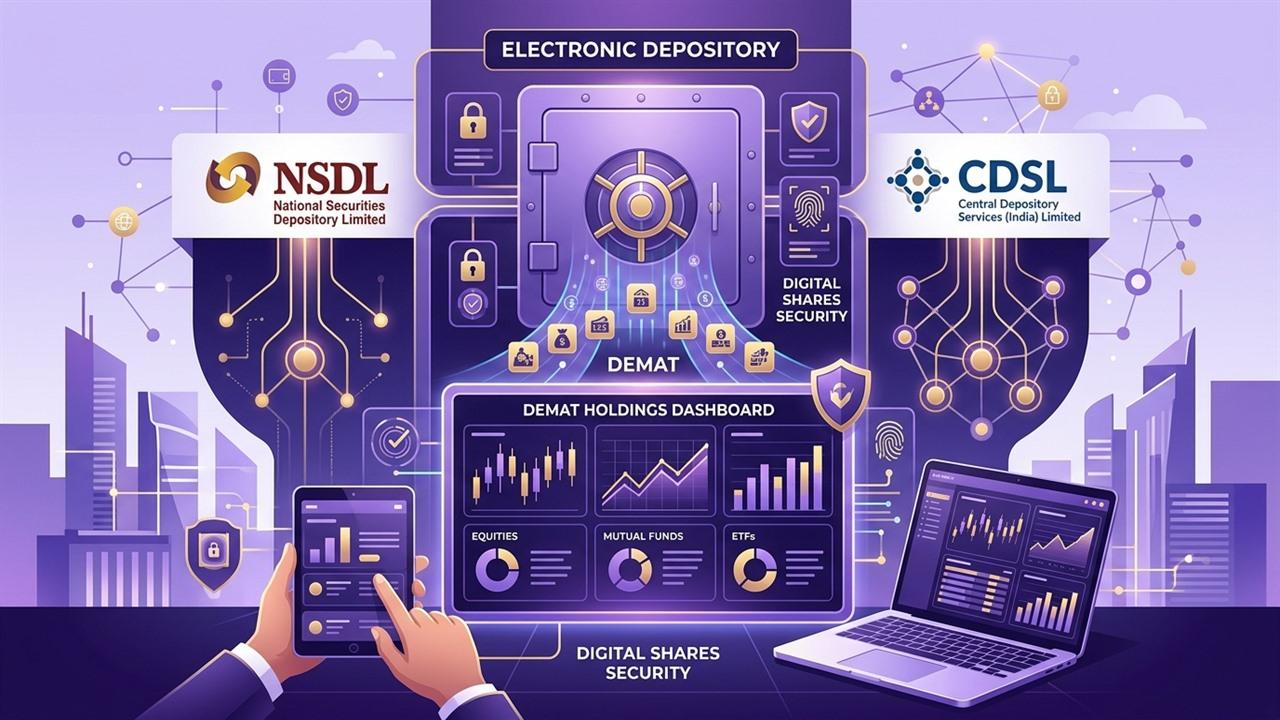
A Demat account (short for dematerialised account) is an electronic custody vault used to hold financial securities—such as equity shares, ETFs, mutual fund units, and government bonds—in digital format instead of physical paper certificates. Regulated by SEBI and operated by central depositories (NSDL and CDSL) through registered Depository Participants (DPs), it guarantees legal ownership, automated corporate actions, and seamless IPO allotments. Under Section 10 of the Depositories Act, 1996, your shares are held directly in the central depository under your unique 16-digit Beneficiary Owner ID (BO-ID), making them 100% immune from broker bankruptcy or insolvency.
Just as a savings bank account holds your liquid cash electronically and maintains an audited ledger of debits and credits, a Demat account serves as a secure electronic vault for your investment securities.
Prior to the mid-1990s, investing in the Indian stock market required handling physical paper share certificates. Buying or selling shares involved physical delivery, manual transfer deeds, stamp duties, and severe risks of theft, forgery, bad delivery, and transit loss. The introduction of the Depositories Act, 1996 transformed the Indian financial ecosystem by introducing electronic holding through dematerialisation. In this authoritative guide, we examine how electronic custody works, compare NSDL and CDSL, analyze the T+1 trade cycle, and detail the legal safeguards that protect your capital from intermediary default.
1. What Is a Demat Account? The Evolution from Paper to Pixels
A Demat account (short for dematerialised account) is an electronic account used to hold financial securities—such as equity shares, exchange-traded funds (ETFs), mutual fund units, government bonds, and sovereign gold bonds—in digital format.
Under the regulatory oversight of the Securities and Exchange Board of India (SEBI), physical share trading was phased out to eliminate counterparty settlement risk. Today, every public issue, secondary market equity purchase, and corporate restructuring takes place exclusively through digital book-entry transfers in registered depositories.
2. The Three Pillars of Investing: Bank vs Trading vs Demat Account
To understand modern investing, recognize that your brokerage setup is built on three interconnected pillars, each serving a distinct regulatory function:
| Account Type | Primary Function | What It Holds | Governing Authority | Where It Resides |
|---|---|---|---|---|
| Savings Bank Account | Stores liquid money and funds investments | Cash Balances (₹) | Reserve Bank of India (RBI) | Commercial Banks (SBI, HDFC, ICICI, etc.) |
| Trading Account | Routes buy/sell orders to stock exchanges | Software Interface & Margin | SEBI & Stock Exchanges (NSE/BSE) | Stockbroker (Upstox, Zerodha, Groww) |
| Demat Account | Holds securities in electronic custody | Equities, ETFs, Bonds, Mutual Funds | SEBI & Central Depositories | Central Depositories (CDSL or NSDL) |
3. How a Demat Account Operates in the T+1 Trade Settlement Cycle
When you purchase or sell listed shares on an exchange, the transaction flows through a regulated settlement architecture governed by the T+1 settlement cycle (completed within one working day):
- Order Placement (Day T): You submit a buy order on your broker's trading app. The system checks available funds in your linked bank account.
- Exchange Matching (Day T): The stock exchange (NSE or BSE) matches your order with a seller at the agreed market price.
- Clearing & Settlement (Day T+1): The Clearing Corporation (NSE Clearing Ltd or Indian Clearing Corporation Ltd) settles the trade, transferring cash from the buyer's broker to the seller's broker.
- Depository Credit (Day T+1 Evening): The central depository (CDSL/NSDL) debits the seller's Demat account and automatically credits the shares to your Demat account under your unique 16-digit Beneficiary Owner ID (BO-ID).
4. NSDL vs CDSL: Understanding India's Two Central Depositories
In India, Demat accounts are not hosted by stockbrokers; they are maintained by two central depositories registered and regulated by SEBI. While both provide identical legal security and regulatory protection, they differ in operational history and account formatting:
| Comparison Parameter | NSDL (National Securities Depository Ltd) | CDSL (Central Depository Services Ltd) |
|---|---|---|
| Year Established | 1996 (First Depository in India) | 1999 (Second Depository in India) |
| Primary Promoters | NSE, IDBI Bank, and Public Financial Institutions | BSE, State Bank of India, HDFC Bank, Standard Chartered |
| Exchange Association | Historically tied to National Stock Exchange (NSE) | Historically tied to Bombay Stock Exchange (BSE) |
| BO-ID Format (Account Number) | 16 Characters: Starts with 'IN' followed by 14 alphanumeric/numeric digits | 16 Digits: Purely numeric 16-digit string (e.g. 1208160012345678) |
| Stock Exchange Listing | Unlisted (Operates as closely-held institution) | Publicly Listed on NSE (Ticker: CDSL) |
| Online Self-Service Portal | Speed-e & IDeAS | Easiest & MyEasi |
Deciphering Your 16-Digit Demat Account Number
- For CDSL Accounts: The 16-digit number is split into two halves: the first 8 digits represent the DP ID (identifying your broker, such as Upstox or Zerodha), and the remaining 8 digits represent your individual Client ID. Combined, they form your BO ID (Beneficiary Owner ID).
- For NSDL Accounts: The identifier consists of an 8-character DP ID (starting with 'IN', e.g. IN300123) followed by an 8-digit numeric Client ID.
5. Depository Safety: What Happens to Your Shares if the Broker Defaults?
The most common fear among first-time investors is: "What happens to my hard-earned shares if my stockbroker shuts down, goes bankrupt, or gets banned by SEBI?"
Under Indian capital market law, your wealth is protected by an uncompromising statutory firewall:
- Legal Separation of Custody: Under Section 10 of the Depositories Act, 1996, the stockbroker is merely a Depository Participant (DP)—an agent facilitating account opening and order routing. The stockbroker never owns your shares. Your shares are held directly in the central depository (CDSL or NSDL) under your name as the Beneficiary Owner.
- Immunity from Creditor Liquidation: If a brokerage firm defaults or enters bankruptcy, its creditors cannot touch client securities. Your Demat account remains active and intact at the depository level.
- Instant Electronic Transfer: You can transfer all your holdings to another registered broker at any time using CDSL Easiest or NSDL Speed-e without needing approval from your defaulting broker.
6. Security Protocols: TPIN, DDPI & Demat Account Freezing
To eliminate unauthorized debits and broker misuse, SEBI has mandated multiple layers of cryptographic security:
1. Electronic Delivery Instruction Slip (EDIS) & TPIN
Whenever you sell equity delivery shares, your broker cannot debit your Demat account unless you authorize the transaction using a 6-digit TPIN generated directly by CDSL/NSDL, followed by an OTP sent to your registered mobile number and email. This ensures that even if someone compromises your broker login password, they cannot sell your long-term investments without your physical phone.
2. DDPI (Demat Debit and Pledge Instruction)
SEBI officially replaced the traditional, open-ended Power of Attorney (PoA) with the tightly regulated DDPI. A DDPI can only be used for two specific purposes: meeting exchange settlement obligations for trades you placed, and pledging shares for margin. Brokers are legally barred from using DDPI for off-market transfers or mutual fund debits.
3. Online Demat Freezing Facility
If you are traveling abroad, pausing investments, or suspect fraudulent activity, SEBI allows you to freeze your Demat account online via CDSL Easiest or NSDL Speed-e. When frozen, all debit transactions are blocked immediately until you electronically unfreeze the account using two-factor biometric or OTP authentication.
7. Corporate Actions & Demat: Dividends, Stock Splits, and Bonus Shares
Holding securities in Demat form automates all corporate actions without paperwork:
- Dividends: Cash dividends declared by listed corporations are not deposited into your Demat account. Instead, the company's registrar cross-references the Record Date with depository records and credits dividends directly into your primary savings bank account via NACH/ECS.
- Stock Splits & Bonus Shares: When a company announces a bonus issue or stock split, the additional equity shares are automatically credited into your Demat account within 2 to 4 working days of the ex-date.
To open an account in under five minutes with zero paperwork, consult our companion Open Free Demat Account Online Guide. To learn how to participate in primary market offerings, explore our guides on what is an IPO, applying via UPI ASBA, and bidding at Cut-Off Price.
8. Statutory Regulatory References & Official Frameworks
Demat custody, electronic trade settlement, and investor protection rights are governed by statutory regulatory frameworks:
- The Depositories Act, 1996: Principal parliamentary legislation establishing the legal separation between depository participants and central depositories at the India Code Legislative Database.
- SEBI (Depositories and Participants) Regulations, 2018: Master operating regulations governing depository licensing, risk mitigation, and client security protection at the SEBI Circulars Repository.
- Central Depository Services (India) Limited (CDSL): Official depository portal for managing e-Services, Demat freezing, and CAS at CDSL India.
- National Securities Depository Limited (NSDL): National electronic securities depository for checking Demat credits and Speed-e authorization at NSDL Portal.
Frequently Asked Questions (Institutional FAQ Desk)
Educational & Regulatory Disclosures
Source Attribution: This masterclass educational guide is produced strictly for investor awareness and capital markets literacy in alignment with SEBI Investor Education and Protection Fund (IEPF) guidelines.
Non-Advisory Mandate & Risk Warning: Digital Arthalaya is strictly an independent financial education portal and is not a SEBI-registered investment advisor or stock broker. IPO bidding and equity trading involve market risk, including potential loss of principal. Readers must conduct their own independent due diligence and read all offer documents carefully before making investment commitments.