10 Best Trading Apps in India: Speed, Brokerage & Charting Tested
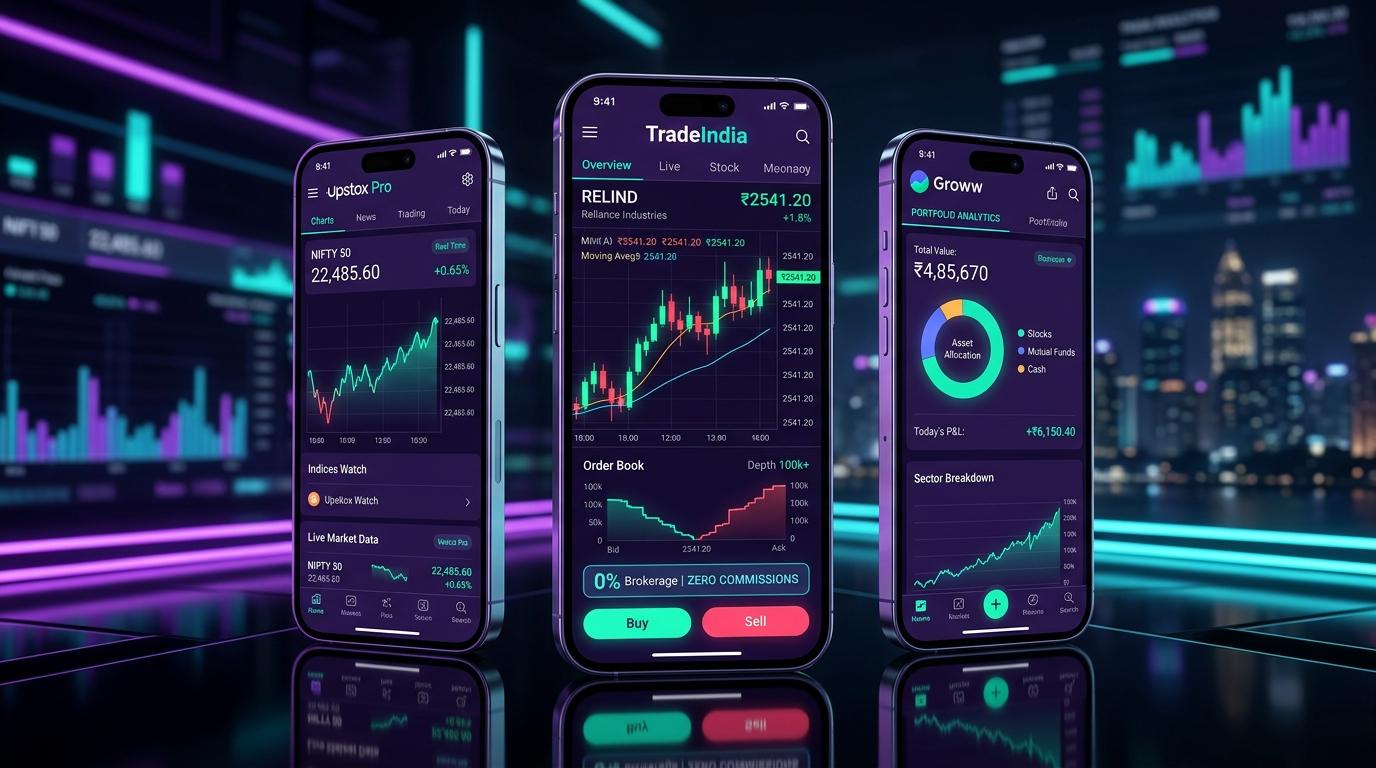
In India's mobile-first capital markets, selecting the right trading application is your most critical operational decision. Modern discount brokers operate on a flat-fee pricing model (₹0 on equity delivery with select platforms, and a maximum flat ₹20 per executed order on Intraday and F&O), saving up to 90% in transaction costs compared to legacy full-service bank brokers. Under SEBI regulations, all dematerialized shares are held directly with government-regulated central depositories (CDSL or NSDL) under your unique BO-ID, guaranteeing complete asset safety even during broker app outages. In our 2026 benchmark, Upstox Pro ranks as the top overall choice for active traders and IPO investors due to native TradingView charts, zero account opening fees, and instant UPI 2.0 mandate delivery.
The Indian capital market ecosystem has experienced an unprecedented technological transformation. Driven by nationwide 5G mobile connectivity, instant Unified Payments Interface (UPI 2.0) payment rails, Aadhaar-based paperless e-KYC protocols via DigiLocker, and modern exchange infrastructure on the National Stock Exchange (NSE) and Bombay Stock Exchange (BSE), retail stock market participation has surpassed 16 crore Demat accounts.
For any modern investor, swing trader, or active derivative market participant, your choice of mobile trading application is your primary execution terminal and gateway to financial markets. A poorly engineered, high-latency, or unreliable trading app can lead to severe slippage during volatile market hours, missed execution windows, and technical downtime during crucial macroeconomic events. In this comprehensive 2026 guide, we benchmark India's 10 leading stock trading applications across execution speed, brokerage charges, charting engines, and depository safety.
1. Core Evaluation Criteria: What Separates an Elite Trading App from an Average App?
To assess a trading application objectively, investors must look beyond app store marketing and evaluate four institutional pillars:
- Order Routing Latency & Server Resilience: The ability to process market orders in sub-second intervals during peak volatility (e.g. Budget Day, RBI policy announcements, and market opening bells at 9:15 AM) without application freeze or session timeouts.
- Charting Infrastructure: Native integration of TradingView v8 or ChartIQ, allowing traders to draw trendlines, apply 100+ technical indicators, and execute trades directly from the interactive candlestick chart.
- Brokerage & Fee Transparency: Capped flat-fee execution (flat ₹20 or ₹0 delivery) with zero hidden markups on exchange turnover fees, compliant with SEBI's True-to-Label mandate.
- Derivatives & IPO Modules: Built-in Option Chains with real-time Greeks (Delta, Theta, Gamma, Vega), Put-Call Ratio (PCR), and instant UPI 2.0 mandate blocking for Mainboard and SME public issues.
2. Master Benchmark Table: Top 10 Stock Trading Apps in India (2026)
The comparative matrix below benchmarks the 10 leading stock trading applications across regulatory client rankings, fees, charting capabilities, and target user profiles:
| Trading Application | NSE Active Rank | Equity Delivery Fee | Intraday & F&O Brokerage | Annual Demat AMC | Charting Engine | Best Suited For |
|---|---|---|---|---|---|---|
| Upstox Pro (Recommended Partner) | #4 (~2.6M) | ₹20 or 2.5% | Flat ₹20 / order | ₹0 AMC Available (BSDA) | Native TradingView & ChartIQ | Active Traders, Chart Analysts & IPO Bidders |
| Zerodha Kite | #2 (~7.5M) | ₹0 (Free Delivery) | Flat ₹20 or 0.03% | ₹300 + GST / year | TradingView & ChartIQ | Minimalist Long-Term Buy-and-Hold Investors |
| Groww App | #1 (~12.5M) | ₹20 or 0.05% | Flat ₹20 or 0.05% | ₹0 (Lifetime Free) | TradingView Native | Absolute Beginners, Mutual Funds & Direct SIPs |
| Angel One SuperApp | #3 (~7.2M) | ₹0 (Free Delivery) | Flat ₹20 or 0.25% | ₹0 1st yr, then ₹20/mo | TradingView Engine | Advisory Seekers & Algorithmic API Developers |
| Dhan App | #7 (~800K) | ₹0 (Free Delivery) | Flat ₹20 / order | ₹0 (Lifetime Free) | Custom TradingView Console | Advanced F&O Scalpers & Webhook Traders |
| ICICI Direct Prime | #5 (~1.8M) | Variable % / Prepaid | ₹15 to ₹20 / order | ₹300 to ₹700 / year | ChartIQ / Advanced Pro | Bank 3-in-1 Integration & High-Volume HNIs |
| Kotak Neo | #6 (~1.1M) | ₹0 (Trade Free Youth) | ₹0 (Under 30) / ₹20 | ₹0 1st yr, then ₹300/yr | TradingView Charts | Youth Traders (<30 Yrs) & Bank Integration |
| HDFC Sky | #8 (~1.2M) | Flat ₹20 / order | Flat ₹20 / order | ₹0 1st yr, then ₹300/yr | TradingView Engine | HDFC Banking Clients Transitioning to Discount Model |
| Motilal Oswal (MO Investor) | #9 (~900K) | Percentage based | Percentage based | ₹0 1st yr, then ₹400/yr | Proprietary Charts | Institutional Research & Advisory Stock Pickers |
| Paytm Money | #10 (~700K) | ₹20 or 2.5% | Flat ₹20 / order | ₹0 (Zero AMC) | TradingView Charts | Casual Retail Traders & Digital Ecosystem Users |
3. In-Depth Profiles: The Top 4 Market Leaders Compared
The comparative table below details the advanced technological features across India's four most popular trading platforms:
| Technical Feature | Upstox Pro | Zerodha Kite | Groww App | Angel One SuperApp |
|---|---|---|---|---|
| Native TradingView Charts | Yes (Multi-Chart Layouts) | Yes (Dual Chart) | Yes (Basic Single) | Yes (Standard) |
| Live Option Greeks & PCR | Built-In Real-Time | External (Sensibull) | Basic Option Chain | Built-In Real-Time |
| GTT Conditional Orders | Yes (Valid 1 Year) | Yes (Valid 1 Year) | Yes (Valid 1 Year) | Yes (Valid 1 Year) |
| 1-Click UPI IPO Bidding | Yes (Fast Pre-Apply) | Yes (Standard) | Yes (Simplified) | Yes (Standard) |
| Direct Mutual Fund Platform | Integrated | Coin (Demat Form) | Groww Direct (Market Leader) | Integrated |
| Developer API for Algo Trading | Upstox API (Developer Friendly) | Kite Connect (₹2,000/mo) | Not Available | SmartAPI (Free Tier) |
4. Depository Safety: What Protects Your Shares If an App Crashes?
First-time stock market investors frequently worry about the safety of their capital if a mobile trading application encounters a server outage or the brokerage goes bankrupt. Under Indian securities law, your assets are protected by a strict regulatory firewall:
- Central Depository Custody: Stock trading apps do not store your shares on their private servers. When your buy order settles, the shares are deposited directly into your personal account at CDSL or NSDL under your 16-digit Beneficiary Owner ID (BO-ID).
- Immunity from Intermediary Liquidation: If a brokerage firm ceases operations, its corporate creditors cannot touch your shares. Your Demat holding remains intact at the depository level and can be transferred to another broker at any time.
- Emergency Call & Trade Desks: In the rare event of a mobile app technical failure during market hours, SEBI mandates that every broker provide dedicated telephone dealing desks where clients can execute emergency square-offs.
5. Step-by-Step: How to Open a Paperless Account in 5 Minutes
Modern mobile onboarding eliminates physical paperwork entirely. Follow these 5 steps to activate your account on Upstox:
- Mobile Authentication: Download the app or visit the Upstox Registration Portal and verify your 10-digit mobile number with an OTP.
- PAN Validation: Enter your PAN and date of birth to cross-verify your tax identification record.
- DigiLocker Identity Fetch: Authorize DigiLocker with your Aadhaar number to securely import verified address details without scanning physical documents.
- Penny-Drop Bank Linking: Enter your savings bank account number and IFSC code for automated ₹1 penny-drop name verification.
- Video IPV & Aadhaar e-Sign: Capture a live geo-tagged selfie for In-Person Verification and complete NSDL electronic signing via Aadhaar OTP.
Your Unique Client Code (UCC) is generated within 2 to 24 business hours, activating your account for equity trading and public issues.
6. The SEBI Reality Check: Equity Delivery vs Risky F&O Trading
While modern trading applications make derivative trading easily accessible with a single swipe, retail investors must heed official regulatory warnings:
According to an exhaustive empirical study conducted by SEBI, over 93% of individual retail traders in equity Futures & Options (F&O) incurred net financial losses, with the average loss exceeding ₹1.25 Lakhs per trader over three consecutive financial years. We strongly advise beginner investors to focus on disciplined equity delivery investing, index exchange-traded funds (ETFs), automated mutual fund SIPs, and primary market IPO bidding before committing capital to speculative derivatives.
To open your free account with Upstox, consult our Open Free Demat Account Guide. For head-to-head comparisons, see our Zerodha vs Groww vs Upstox Comparison, Discount vs Full-Service Broker Guide, and review the SEBI BSDA Zero AMC Rules.
7. Statutory Regulatory References & Official Frameworks
Mobile trading software security, active client monitoring, and investor protection standards are governed by statutory regulatory frameworks:
- National Stock Exchange (NSE India): Monthly active retail client numbers and broker compliance audit data at NSE India.
- Securities and Exchange Board of India (SEBI): Stockbroker registration directories, cybersecurity requirements, and retail derivatives study reports at SEBI Portal.
- Central Depository Services Limited (CDSL): Operating guidelines and bye-laws governing mobile trading app depository links and BO-ID security at CDSL India.
Frequently Asked Questions (Institutional FAQ Desk)
Educational & Regulatory Disclosures
Source Attribution: This masterclass educational guide is produced strictly for investor awareness and capital markets literacy in alignment with SEBI Investor Education and Protection Fund (IEPF) guidelines.
Non-Advisory Mandate & Risk Warning: Digital Arthalaya is strictly an independent financial education portal and is not a SEBI-registered investment advisor or stock broker. IPO bidding and equity trading involve market risk, including potential loss of principal. Readers must conduct their own independent due diligence and read all offer documents carefully before making investment commitments.