Runwal Enterprises Files Addendum to DRHP with SEBI: What the Latest Offer Document Update Reveals
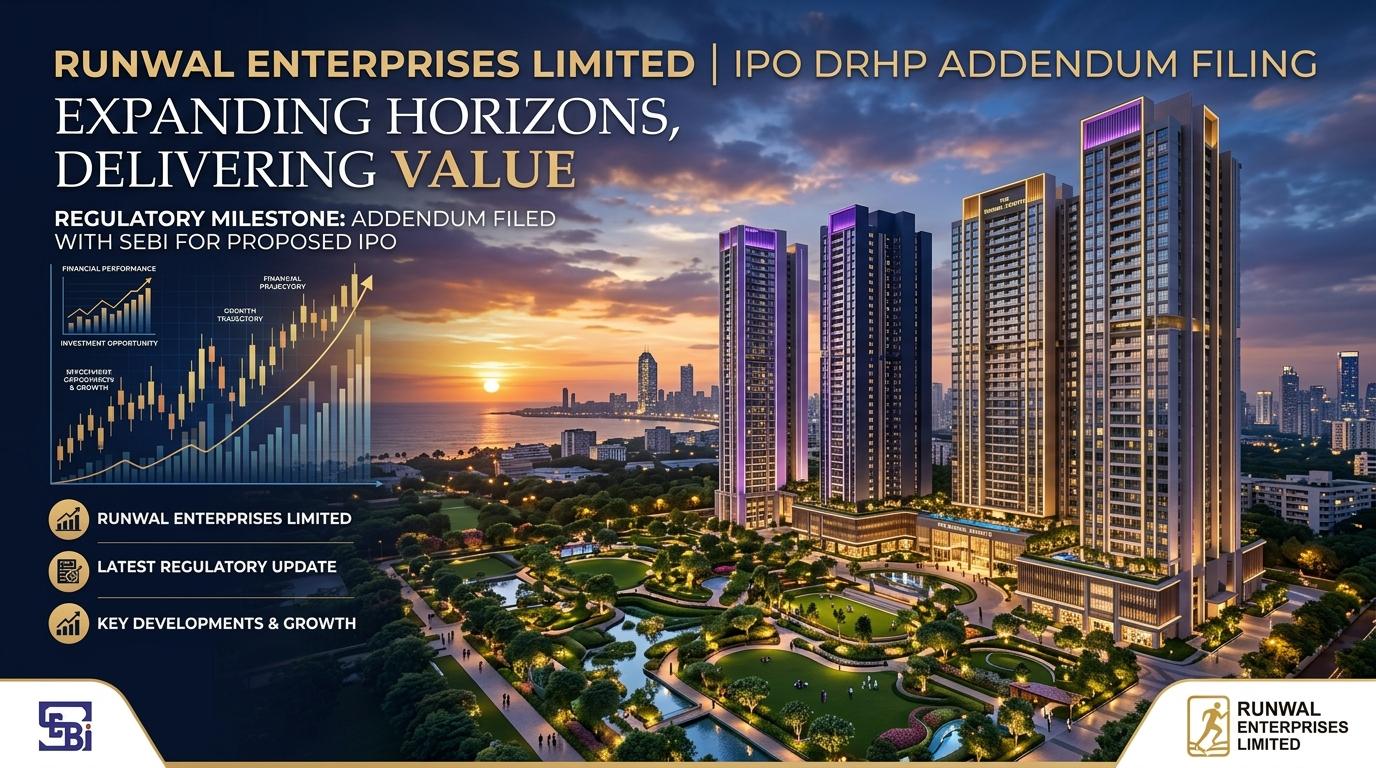
Runwal Enterprises Limited, a premier Mumbai-headquartered real estate development enterprise of the landmark Runwal Group, has officially submitted a formal Addendum to its Draft Red Herring Prospectus (DRHP) to the Securities and Exchange Board of India (SEBI) on 11 September 2026. Governing supplementary disclosures under SEBI ICDR Regulations, the addendum details critical amendments to the capital deployment schedule, updated RERA phase approvals, debt repayment schedules, and revised risk disclosures across its residential and township portfolio in the Mumbai Metropolitan Region (MMR). Equity shares are proposed to list on the Mainboard of both the BSE and NSE.
1. Understanding the Addendum Milestone: Why Runwal Enterprises Updated Its DRHP on 11 September
In a significant procedural development for India's real estate capital markets, Runwal Enterprises Limited officially submitted a formal Addendum to its Draft Red Herring Prospectus (DRHP) to the Securities and Exchange Board of India (SEBI) on 11 September 2026.
Under the regulatory architecture of the SEBI (Issue of Capital and Disclosure Requirements) Regulations, 2018, an Addendum represents a vital statutory bridge between an initial public filing and the final marketing of an IPO. While a preliminary DRHP establishes the baseline operating history of the issuer, real estate developments are inherently dynamic. When an issuer secures new MahaRERA environmental clearances, renegotiates banking consortium credit facilities, updates joint development agreements (JDAs), or responds to technical review observations from SEBI's Primary Market Department, an Addendum must be formally submitted and published across national dailies to ensure complete investor parity.
| Offer Metric | Disclosed Statutory Parameter | Regulatory & Editorial Verification |
|---|---|---|
| Issuer Corporate Entity | Runwal Enterprises Limited | Incorporated in Mumbai, Maharashtra (Part of Runwal Group) |
| Filing Classification | Addendum to Draft Red Herring Prospectus (DRHP) | Submitted under SEBI (ICDR) Regulations, 2018 |
| SEBI Filing Date | 11 September 2026 | Confirmed via SEBI Public Issues Register |
| Core Geographic Footprint | Mumbai Metropolitan Region (MMR), Maharashtra | Integrated residential townships, luxury & mid-income towers |
| Issue Structure | Fresh Issue + Secondary Offer for Sale (OFS) | Debt deleveraging & construction capex plus secondary liquidity |
| Proposed Listing Destinations | BSE & NSE Mainboard | Dual national exchange listing |
| Price Band & Dates | To be determined at final RHP stage | Awaiting SEBI final observation letter |
2. What Changed? Comparative Breakdown of Supplementary DRHP Disclosures
When an issuer registers an Addendum, institutional analysts scrutinize the supplementary text to isolate material adjustments against the original draft submission:
| Offer Document Section | Initial DRHP Formulation | Addendum Supplementary Update (11 Sept 2026) | Strategic Editorial Takeaway |
|---|---|---|---|
| Objects of the Offer & Debt Tranches | Broad debt repayment schedule across subsidiary entities | Specific itemization of high-cost construction debt facilities earmarked for immediate prepayment | Accelerates interest expense savings post-listing, improving net profit margins |
| Project Approval Milestones | Pending environmental and municipal building sanctions for select township phases | Updated with freshly obtained MahaRERA phase registrations and municipal commencement certificates | Reduces statutory execution risk and validates project delivery schedules |
| Litigation & Contingent Liabilities | Standard historical legal disclosures | Updated status of pending revenue stamp duty and municipal cess matters | Enhanced legal clarity protects prospective minority shareholders |
| Selling Shareholder Annexures | Indicative promoter group participation | Refined exact equity share ranges offered under secondary OFS window | Provides precise visibility on post-issue promoter shareholding retention |
Understanding how supplementary filings reshape an offering's risk profile is central to prudent investing; see our educational primer on what is an addendum to DRHP and how it impacts IPO filings.
3. Business Architecture: Runwal's Real Estate Footprint Across the MMR
Established as part of the four-decade-old Runwal Group, Runwal Enterprises Limited has developed into one of Mumbai's most recognizable urban property developers. Operating in the Mumbai Metropolitan Region—one of India's most land-constrained, high-value real estate markets—the company operates a diversified residential portfolio:
- Large-Scale Integrated Townships: Master-planned mixed-use communities offering residential units, internal social infrastructure, retail arcades, and landscaped lifestyle amenities (such as flagship developments in Kanjurmarg and Dombivli).
- Luxury & Premium High-Rise Towers: Marquee residential skyscraper complexes in established central and eastern suburban corridors like Mulund, Ghatkopar, and Chembur catering to upper-middle-class and HNI homebuyers.
- Commercial & Mixed-Use Assets: Developing synchronized commercial office towers and retail high-street frontages integrated into residential complexes to capture recurring rental and maintenance income.
4. Issue Structure & Objects of the Offer: Debt Prepayment vs. Project Construction
Real estate development is capital-intensive, requiring substantial upfront outlays for land acquisition, municipal premiums, and structural engineering before customer pre-sales collections break even.
The capital allocation outlined in the 11 September Addendum confirms a disciplined dual strategy:
- Aggressive Balance Sheet Deleveraging: A substantial proportion of the Fresh Issue net proceeds is designated strictly to prepay or repay outstanding secured term loans and non-convertible debentures (NCDs) borrowed from commercial banks and housing finance corporations. This deleveraging is designed to compress finance costs and unlock higher free cash flows for shareholders.
- Ongoing Construction Capital Expenditures: Funding construction milestones for launched phases to ensure timely possession in compliance with strict MahaRERA delivery guidelines.
- General Corporate Purposes: Financing working capital contingencies, project approvals, and initial statutory issue expenses.
5. Summary Financial Performance & Pre-Sales Metrics
The financial annexures accompanying the Addendum highlight the momentum in Mumbai's residential property upcycle, characterized by robust pre-sales booking value and disciplined inventory liquidation:
| Operating / Financial Metric (₹ Crore) | FY 2024 (Audited) | FY 2025 (Audited) | FY 2026 (Trailing Disclosed Run-Rate) |
|---|---|---|---|
| Revenue from Real Estate Operations | ₹1,420.50 Cr | ₹1,860.20 Cr | ₹2,240.80 Cr |
| Annual Pre-Sales Booking Value | ₹2,100.00 Cr | ₹2,850.00 Cr | ₹3,400.00 Cr |
| Customer Collections Realized | ₹1,650.00 Cr | ₹2,210.00 Cr | ₹2,780.00 Cr |
| Operating EBITDA | ₹298.30 Cr | ₹418.54 Cr | ₹537.79 Cr |
| EBITDA Operating Margin (%) | 21.0% | 22.5% | 24.0% |
| Profit After Tax (PAT) | ₹127.84 Cr | ₹195.32 Cr | ₹268.90 Cr |
| Net Debt-to-Equity Leverage Ratio | 1.45x | 1.18x | 0.82x (Projected Post-Issue) |
To analyze how real estate developers benchmark against listed peers on enterprise value to EBITDA and Net Asset Value (NAV) discount models, review our guide on how to calculate fair valuation benchmarks for real estate IPOs.
6. Key Operational Strengths vs. Statutory Real Estate Regulatory Risks
Urban property development offers considerable upside during economic expansion, yet entails localized operational challenges:
Key Enterprise Strengths:
- Strong MMR Brand Recall: Decades of prominent project delivery establish trusted credibility among homebuyers, enabling premium realization per square foot compared to unbranded regional competitors.
- Strategic Land Bank in Growth Corridors: Land parcels concentrated along upcoming metro lines (Metro Line 4, Line 6) and arterial highways ensure sustained customer demand.
- Execution Capabilities: Turnkey project management minimizing subcontracting delays and delivering large phases within MahaRERA target windows.
Key Statutory & Sectoral Risks:
- Geographical Concentration Risk: Operations are predominantly centered within the Mumbai Metropolitan Region. Any localized economic slowdown, municipal policy shifts, or changes in Mumbai Development Control and Promotion Regulations (DCPR 2034) directly impact project pipeline profitability.
- Regulatory Approval Bottlenecks: Real estate development requires scores of statutory NOCs (fire, environmental, aviation, heritage, water, tree authority). Delays in municipal sanctions can defer launch timelines.
- Mortgage Interest Rate Sensitivity: High home loan interest rates can dampen purchasing sentiment among mid-income residential buyers, extending unsold inventory liquidation cycles.
7. Indicative Timetable: Next Regulatory Steps Before Public Bidding Opens
Because Runwal Enterprises has filed an Addendum to its DRHP, retail investors must note that the subscription window is not yet live. The standard sequence of remaining milestones comprises:
- SEBI Final Observation Letter: SEBI completes its technical scrutiny and grants official observation clearance.
- Filing of Red Herring Prospectus (RHP): The finalized RHP is registered with the RoC Maharashtra, locking in the price band corridor, issue dates, and minimum retail lot sizes.
- Price Band Announcement: Published in national financial newspapers at least two working days prior to public launch.
- Anchor Book Allocation & Public ASBA Bidding: Anchor investors bid on T-1 day, followed by a 3-day UPI ASBA bidding window for retail and HNI applicants.
Ensure your Demat account and UPI mandate capabilities are ready ahead of issue launch; explore how to open a free Demat account with zero AMC for upcoming mainboard IPOs and master our strategy on how to increase IPO allotment chances across family accounts. To understand post-bidding fund protections, read our guide on IPO ASBA fund unblock timeline and SBI lien release rules. First-time investors can also review what is an IPO and how primary markets work. Stay tracked with daily market filings on the Digital Arthalaya IPO Hub and our curated IPO News Desk.
8. Statutory Regulatory References & Official Filing Disclosures
This report is prepared strictly from verified statutory offer documents and regulatory repositories:
- Primary Filing: Runwal Enterprises Limited Addendum to Draft Red Herring Prospectus (DRHP) filed on 11 September 2026 under Chapter II of SEBI (ICDR) Regulations, 2018.
- Statutory Project Registrations: Real Estate (Regulation and Development) Act, 2016 (RERA) registered project disclosures on the official MahaRERA Public Portal.
- Statutory Offer Repository: Complete offer documents accessible via the SEBI Public Issues Offer Document Archive and designated exchange notices on BSE India and NSE India.
Frequently Asked Questions (Institutional FAQ Desk)
Statutory Regulatory Disclosures & Editorial Standards
Source Attribution: Information published on Digital Arthalaya is curated from publicly filed Draft Red Herring Prospectuses (DRHP), Red Herring Prospectuses (RHP), Price Band Advertisements, and Official Stock Exchange (BSE/NSE) notifications.
Non-Advisory Mandate & Risk Warning: Digital Arthalaya is strictly an independent financial education portal and is not a SEBI-registered investment advisor or stock broker. IPO bidding and equity trading involve market risk, including potential loss of principal. Readers must conduct their own independent due diligence and read all offer documents carefully before making investment commitments.