Discount Broker vs Full-Service Broker: Differences, Fees & Safety
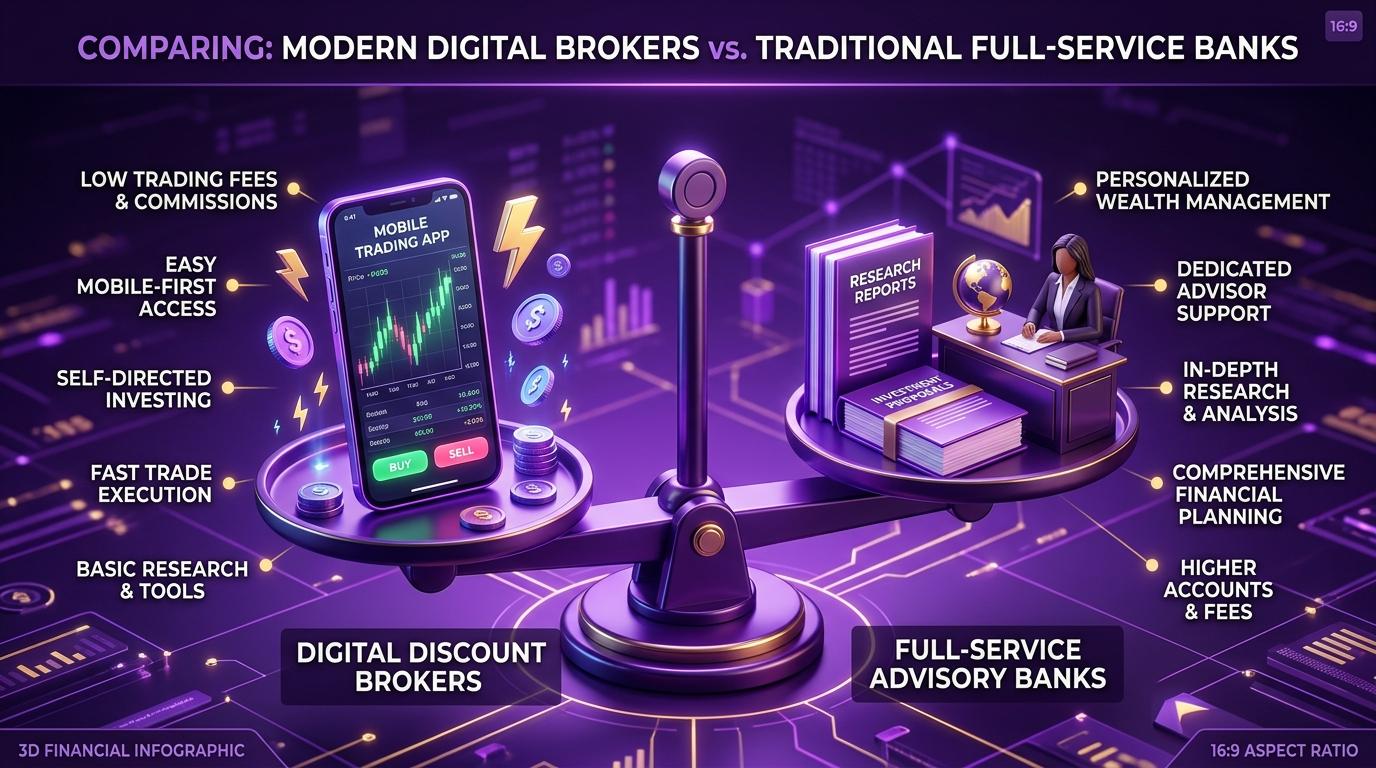
In India's capital markets, intermediaries operate under two competing paradigms: Discount Brokers and Full-Service (Traditional / Bank-backed) Brokers. Discount brokers (such as Upstox and Zerodha) charge a flat fee of maximum ₹20 per executed trade with zero brokerage on long-term equity delivery, focusing purely on execution technology. Full-service brokers (such as ICICI Direct and HDFC Securities) levy a percentage commission on turnover (0.20% to 0.50%), offering dedicated Relationship Managers, in-house research, and physical branch networks. Both models offer identical statutory security under SEBI regulations, as client shares are deposited directly in central depositories (CDSL or NSDL) under the investor's unique BO-ID.
When embarking on your investment journey in the Indian capital markets, the first and most critical financial decision is selecting the right stockbroking partner to host your Demat and Trading Account. In India's financial ecosystem, intermediaries are broadly divided into two competing paradigms: Discount Brokers and Full-Service (Traditional / Bank-backed) Brokers.
While traditional full-service brokerages charge a percentage-based commission on every transaction (frequently ranging from 0.20% to 0.50% of your total turnover), modern discount brokers operate on a disruptive Flat ₹20 per trade model with zero brokerage on long-term equity delivery. Over a 5-year to 10-year investment horizon, paying high percentage brokerage fees acts as a severe drag on your compounding returns. In this comprehensive 2026 guide, we provide an exhaustive comparison of both models, break down fee structures, analyze platform technology, and provide an objective decision framework.
1. What is a Full-Service Broker? Advisory, Physical Branches & 3-in-1 Accounts
A Full-Service Broker (such as ICICI Direct, HDFC Securities, Kotak Securities, Motilal Oswal, and Sharekhan) is a comprehensive advisory financial institution offering a full spectrum of wealth management services:
- Dedicated Relationship Managers (RMs): A personal broker advisor assigned to your account who provides telephone trade recommendations, daily morning bells, and portfolio rebalancing suggestions.
- In-House Fundamental & Technical Research: Institutional equity research reports, company valuation models, target price revisions, and macroeconomic sector analyses published by dedicated research teams.
- Physical Branch Network: Hundreds of walk-in branch offices across Tier-1, Tier-2, and Tier-3 cities where clients can submit physical Demat modification forms or consult managers in person.
- Integrated 3-in-1 Banking Ecosystem: Direct linkage between your bank savings account, trading account, and Demat account under a single banking brand (e.g. HDFC Bank + HDFC Securities).
2. What is a Discount Broker? Disruptive Flat ₹20 Pricing & Technology Focus
A Discount Broker (such as Upstox, Zerodha, Groww, and Angel One) is a technology-first fintech brokerage that pioneered the low-cost revolution in Indian stock markets:
- Disruptive Flat ₹20 Pricing Model: Eliminates percentage turnover commissions, charging a flat maximum of ₹20 per trade across Intraday, Futures, and Options, and often ₹0 on long-term Equity Delivery.
- State-of-the-Art Trading Technology: Ultra-fast mobile and web applications with integrated TradingView charts, custom screener tools, Option Greeks chains, and open Developer APIs for automated algorithmic trading.
- 100% Digital & Paperless Onboarding: Complete Aadhaar e-KYC account opening within 5 minutes without printing a single physical form.
- Zero Advisory Bias (No Conflicted Stock Tips): Because discount brokers do not employ sales advisors pushing daily trading churn, investors make objective, independent financial decisions.
3. The Compounding Math: Flat ₹20 vs 0.50% Percentage Brokerage (Case Study)
The mathematical difference in trading costs between discount and full-service models is staggering, as illustrated in this real-world turnover case study:
| Trade Order Turnover Value | Full-Service Broker (0.50% Brokerage) | Discount Broker (Flat ₹20 / ₹0 Delivery) | Direct Capital Saved Per Trade |
|---|---|---|---|
| ₹50,000 Order | ₹250 + GST (₹295.00) | ₹20 + GST (₹23.60) | ₹271.40 Saved |
| ₹1,00,000 Order | ₹500 + GST (₹590.00) | ₹20 + GST (₹23.60) | ₹566.40 Saved |
| ₹2,50,000 Order | ₹1,250 + GST (₹1,475.00) | ₹20 + GST (₹23.60) | ₹1,451.40 Saved |
| ₹5,00,000 Order | ₹2,500 + GST (₹2,950.00) | ₹20 + GST (₹23.60) | ₹2,926.40 Saved |
| ₹10,00,000 Order | ₹5,000 + GST (₹5,900.00) | ₹20 + GST (₹23.60) | ₹5,876.40 Saved |
If an active retail investor executes 20 delivery trades of ₹5,00,000 each per year, they pay over ₹58,000+ in avoidable brokerage fees to a full-service broker—capital that could have remained in their portfolio compounding over time.
4. Master Head-to-Head Comparison Matrix (10 Critical Parameters)
The institutional benchmark below compares Discount Brokers against Full-Service Brokers across all key operational metrics:
| Comparison Parameter | Discount Broker (e.g. Upstox / Zerodha) | Full-Service Broker (e.g. ICICI Direct / HDFC Sec) |
|---|---|---|
| 1. Equity Delivery Brokerage | Flat ₹0 to ₹20 per executed order | 0.25% to 0.50% of total transaction value |
| 2. Equity Intraday Brokerage | Flat ₹20 or 0.05% (whichever is lower) | 0.025% to 0.05% on total turnover |
| 3. Futures & Options (F&O) | Flat ₹20 per executed order | ₹50 to ₹100 per lot or 0.05% on turnover |
| 4. Annual Maintenance Charges (AMC) | ₹0 (BSDA / Lifetime Plans) to ₹300/yr | ₹300 to ₹900 + GST annually |
| 5. Research Reports & Advisory | Self-directed (Screeners & Charting only) | In-house equity research desks & stock tips |
| 6. Relationship Manager (RM) | No dedicated RM (Digital ticket support) | Dedicated personal broker advisor |
| 7. Physical Branch Presence | 100% digital / Zero walk-in branches | Extensive physical nationwide branch network |
| 8. Banking Integration | Instant UPI 2.0 & Net Banking transfer | Seamless 3-in-1 Bank Demat Trading Account |
| 9. Trading App Technology | High-speed TradingView & low latency | Comprehensive but often slower interfaces |
| 10. Primary Target Investor | Self-directed investors, traders & IPO bidders | HNI clients, busy executives & senior citizens |
5. Depository Safety: Are Full-Service Bank Brokers Safer Than Discount Brokers?
A common misconception among beginner investors is that bank-backed full-service brokers are safer than discount fintech brokers. Under Indian capital market law, this belief is entirely unfounded:
- Depository Segregation (CDSL & NSDL): When you purchase equity shares through any broker—whether Upstox, Zerodha, or ICICI Direct—the shares are never held on the broker's corporate balance sheet. They are deposited directly into your personal Demat account maintained by central depositories (CDSL or NSDL) under your PAN.
- Broker Insolvency Protection: Even if a stockbroker defaults or goes into liquidation, your shares remain 100% untouched and safe in the depository. You can simply transfer your holdings to another registered broker at any time.
- SEBI Investor Protection Fund (IPF): Recognized exchanges (NSE and BSE) maintain an Investor Protection Fund that compensates retail investors up to ₹25 Lakhs per client in the rare event of broker default.
6. Advisory Reality Check: Independent Investing vs Relationship Manager Tips
While full-service brokers highlight their advisory services, investors must recognize the inherent structural conflict of interest:
- Commission-Driven Churn: Relationship Managers and branch dealers are often evaluated on the trading volume they generate. This incentivizes frequent intraday or derivative trading recommendations, which generate high commission revenue for the broker but frequently erode retail investor capital.
- Independent Objective Research: Discount brokers operate purely as technology conduits. By pairing a discount broker with independent fundamental research or low-cost index funds, investors eliminate conflicting sales calls.
7. The Decision Blueprint: Which Brokerage Model Should You Choose?
Select your brokerage model based on your personal investing style:
- Choose a Discount Broker (e.g. Upstox) If:
- You are a self-directed retail investor, swing trader, or F&O derivatives participant who wants to minimize brokerage costs.
- You want modern mobile and web charting apps with real-time Option Greeks, technical indicators, and automated order types (GTT, Bracket Orders).
- You want to apply for IPOs with zero account opening and maintenance fees across family Demat accounts.
- Choose a Full-Service Broker If:
- You are a busy professional or senior citizen who demands phone-based trading and personal relationship manager support.
- You prefer walk-in branch support and physical paper submission for estate planning and physical share dematerialisation.
- You demand a unified 3-in-1 banking integration under your primary savings bank account.
- The Smart Hybrid Strategy: Many sophisticated investors maintain a full-service account to read institutional research reports, but execute their actual buy and sell orders through a discount broker like Upstox to save tens of thousands in brokerage fees.
To open your free account with Upstox in under 5 minutes, explore our Open Free Demat Account Guide. For head-to-head broker benchmarks, see our Zerodha vs Groww vs Upstox Comparison, and review your rights under the SEBI BSDA Zero AMC Rules.
8. Statutory Regulatory References & Official Frameworks
Broker licensing, depository custody, and uniform exchange fee mandates are governed by statutory regulatory frameworks:
- SEBI Master Circular for Stock Brokers & True-to-Label Mandate: Regulatory circular establishing uniform exchange transaction fee pass-through and client fund segregation at SEBI Portal.
- National Stock Exchange (NSE India) Investor Protection Fund: Framework governing investor default protection up to ₹25 Lakhs per client at NSE IPF.
- The Depositories Act, 1996: Foundational statutory law ensuring client securities are deposited directly in CDSL/NSDL and kept immune from intermediary insolvency at CDSL India.
Frequently Asked Questions (Institutional FAQ Desk)
Educational & Regulatory Disclosures
Source Attribution: This masterclass educational guide is produced strictly for investor awareness and capital markets literacy in alignment with SEBI Investor Education and Protection Fund (IEPF) guidelines.
Non-Advisory Mandate & Risk Warning: Digital Arthalaya is strictly an independent financial education portal and is not a SEBI-registered investment advisor or stock broker. IPO bidding and equity trading involve market risk, including potential loss of principal. Readers must conduct their own independent due diligence and read all offer documents carefully before making investment commitments.