What is SENSEX in Stock Market? Meaning, 30 Stocks, Calculation & How to Invest Explained
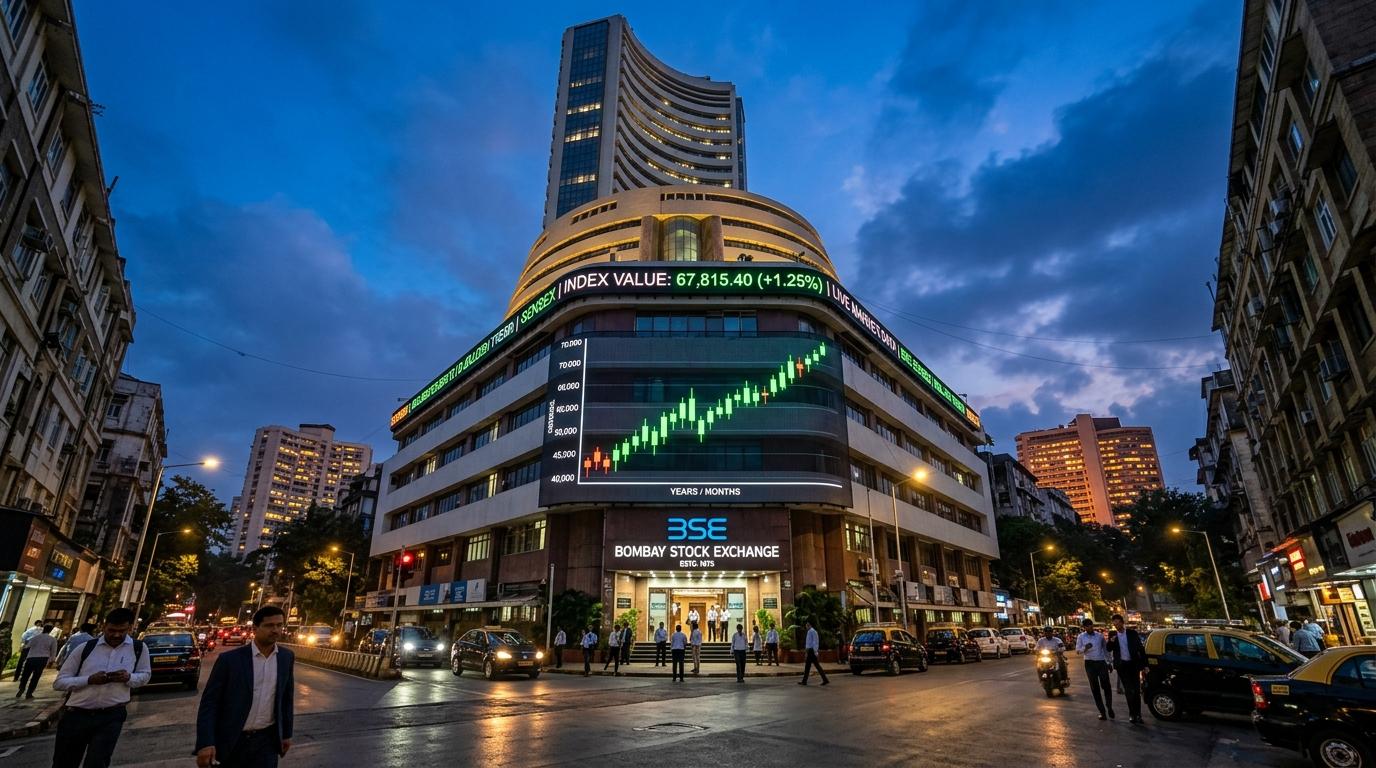
The S&P BSE SENSEX (short for Sensitive Index) is the benchmark stock market index of the Bombay Stock Exchange (BSE Limited)—Asia's oldest stock exchange founded in 1875. Composed of 30 of the largest, most liquid, and financially resilient blue-chip corporations in India across core economic sectors, SENSEX serves as the primary barometer of India's capital market health. Established with a base year of 1978–1979 and a base value of 100 points, it is calculated using the globally recognized Free-Float Market Capitalization methodology managed by Asia Index Private Limited. While retail investors cannot buy the index itself, they can gain fractional exposure to all 30 constituent companies through low-cost SENSEX Index Mutual Funds and Exchange Traded Funds (ETFs).
1. What is SENSEX? Core Definition & Historical Origin
Whenever financial news channels, newspapers, or digital apps report on the Indian economy, the headline almost universally begins with: "Sensex jumped 600 points today" or "Sensex fell 400 points amid global market volatility."
In simple terms, SENSEX—officially designated as the S&P BSE SENSEX—is the benchmark stock market index of the Bombay Stock Exchange (BSE Limited). It measures the collective price performance of 30 of the largest, most liquid, and financially sound companies listed on the BSE, representing a broad cross-section of the Indian industrial and service economy.
The term "Sensex" is a portmanteau of "Sensitive Index", originally coined in 1989 by the prominent Indian stock market analyst Deepak Mohoni. Over the past four decades, SENSEX has evolved into the definitive pulse of India's financial markets, reflecting national economic expansion, corporate earnings momentum, and foreign institutional capital flows.
Because the Bombay Stock Exchange is Asia's oldest stock exchange (founded under a banyan tree at Horniman Circle in 1875 by Premchand Roychand), SENSEX holds an iconic status as the longest-running continuous financial benchmark in the country.
2. What Does It Mean When SENSEX Goes Up or Down?
A common misconception among beginner investors is that if SENSEX rises by 500 points, every single stock listed in India went up. In reality, SENSEX tracks strictly 30 selected heavyweight companies.
Here is how points movement works in practice:
- Weighted Impact: The 30 companies do not contribute equally to the index. Each stock carries a specific percentage weight based on its Free-Float Market Capitalization. Mega-cap corporations like Reliance Industries, HDFC Bank, ICICI Bank, and Tata Consultancy Services (TCS) carry substantial individual weights (often 6% to 12% each), whereas smaller constituent companies carry weights of 1% to 2%.
- Net Balance of Buying vs Selling: If heavyweights like HDFC Bank and Reliance gain 3% during a trading session due to strong quarterly earnings, their upward momentum can pull the entire SENSEX up by several hundred points, even if a dozen smaller constituent stocks closed slightly in the red.
- Economic Sentiment Indicator: Because these 30 corporations operate across banking, IT, energy, automotive, pharmaceuticals, and consumer goods, when SENSEX rises sustainably over months, it signals broad institutional optimism regarding Indian corporate profit growth and macroeconomic stability.
3. How is SENSEX Calculated? The Free-Float Market Cap Formula
When SENSEX was originally launched, it was computed using the Full Market Capitalization methodology. However, on 1 September 2003, the BSE transitioned to the globally standardized Free-Float Market Capitalization methodology.
Full Market Cap vs Free-Float Market Cap
To understand the math, one must grasp what "free-float" means:
- Total Market Capitalization: The total market value of all shares issued by a company:
Total Market Cap = Total Outstanding Shares × Current Market Price per Share - Free-Float Market Capitalization: The market value of shares that are actually available for public trading on stock exchanges. It strictly excludes:
- Promoter and promoter group holdings
- Government-held stakes in public sector enterprises
- Strategic long-term foreign direct investments (FDI)
- Shares held by employee welfare trusts (ESOP lock-ins)
- Cross-holdings held by associate corporations
Free-Float Market Cap = Total Market Cap × Free-Float Factor (Investible Weight Factor)
The Mathematical Index Formula
SENSEX is calculated by comparing the aggregate free-float market value of its 30 stocks today against the base market value of the same basket in the base year (1978–79 = 100):
| Step Number | Calculation Stage | Mathematical Action / Methodology |
|---|---|---|
| Step 1 | Calculate Total Market Cap | Multiply total shares outstanding by the current market price for each of the 30 companies. |
| Step 2 | Determine Free-Float Factor | Identify the percentage of shares held by the public (e.g., if promoters own 55%, the free-float factor is 0.45). |
| Step 3 | Compute Free-Float Market Cap | Multiply each company's Total Market Cap by its individual Free-Float Factor. |
| Step 4 | Aggregate 30 Constituent Caps | Sum the free-float market capitalizations of all 30 stocks to obtain the Current Free-Float Market Cap. |
| Step 5 | Apply Base Index Formula | Sensex Value = (Current 30-Stock Free-Float Cap ÷ Base Market Capitalization) × 100 |
4. The SENSEX 30: How Are Companies Selected?
A company cannot simply pay a fee to enter SENSEX. The composition is governed by the independent Index Committee of Asia Index Private Limited (a wholly-owned subsidiary of BSE Limited), which applies strict quantitative rules:
- Exchange Listing Requirement: The company must be listed on BSE Limited with a minimum trading history of at least one full year (exceptions apply only to mega-cap public offerings like LIC or Hyundai India that satisfy fast-track capitalization thresholds).
- 100% Trading Frequency: The scrip must have been actively traded on 100% of the normal trading days over the preceding 12 calendar months, proving that investors can buy or sell without liquidity bottlenecks.
- Market Capitalization Rank: The stock must rank among the top 75 listed companies on the BSE based on average six-month free-float market capitalization.
- Turnover & Liquidity Rank: The company must rank among the top 100 companies by average daily trading turnover and demonstrate low impact cost (ensuring large institutional orders can execute without distorting prices).
- Balanced Sectoral Diversity: The index committee ensures that no single sector monopolizes the index, maintaining a balanced representation across banking, technology, FMCG, healthcare, energy, and infrastructure.
5. SENSEX vs NIFTY 50: What is the Difference?
Investors frequently wonder whether they should track SENSEX or NIFTY 50. Both are premier national benchmarks that exhibit a 98%+ historical return correlation, but key structural differences exist:
| Comparison Parameter | S&P BSE SENSEX | NIFTY 50 |
|---|---|---|
| Full Designation | S&P BSE Sensitive Index | National Stock Exchange Fifty |
| Parent Stock Exchange | Bombay Stock Exchange (BSE Limited) | National Stock Exchange (NSE India) |
| Number of Constituent Stocks | 30 Blue-Chip Companies | 50 Large-Cap Companies |
| Base Year & Base Value | 1978–1979 = 100 Points | 1995 = 1,000 Points |
| Calculation Methodology | Free-Float Market Capitalization | Free-Float Market Capitalization |
| Managing Authority | Asia Index Private Limited (BSE Subsidiary) | NSE Indices Limited (NSE Subsidiary) |
| Market Cap Representation | Represents ~40% to 45% of total Indian market cap | Represents ~55% to 60% of total Indian market cap |
| Reconstitution Schedule | Semi-annually in June and December | Semi-annually in March and September |
| Derivatives Popularity | Growing rapidly (Friday weekly contracts) | World's highest trading volumes (Thursday weekly contracts) |
6. Sectoral Representation: Which Industries Drive SENSEX?
The 30 constituent companies in SENSEX represent the economic engines of India. While individual corporate weights fluctuate daily based on market prices, the sector allocation typically breaks down as follows:
- Financial Services (~35% to 40%): Private banks, public sector lenders, housing finance companies, and insurance leaders (e.g., HDFC Bank, ICICI Bank, State Bank of India, Kotak Mahindra Bank, Axis Bank).
- Information Technology (~13% to 16%): Global software exporters and IT consulting giants (e.g., Tata Consultancy Services, Infosys, HCL Technologies, Tech Mahindra).
- Oil, Gas & Consumable Fuels (~10% to 13%): Integrated energy conglomerates and refining powerhouses (e.g., Reliance Industries).
- Fast-Moving Consumer Goods / FMCG (~8% to 10%): Household consumer staples, personal care, and tobacco majors (e.g., ITC, Hindustan Unilever, Nestlé India).
- Automobile & Auto Components (~6% to 8%): Commercial vehicle and passenger car manufacturers (e.g., Mahindra & Mahindra, Tata Motors, Maruti Suzuki).
- Construction & Capital Goods (~4% to 6%): Infrastructure and engineering leaders (e.g., Larsen & Toubro).
- Healthcare, Pharmaceuticals & Telecommunications: Sun Pharma, Bharti Airtel, and specialty industrial leaders.
7. Historical Milestones: From 100 Points to 80,000+
The journey of SENSEX is the financial mirror of India's transition from a closed, socialist economy to an economic powerhouse:
- 1978–1979 (Base 100): SENSEX is benchmarked at 100 points.
- July 1990 (1,000 Points): SENSEX crosses the four-digit mark for the first time, spurred by early domestic industrialization.
- February 2006 (10,000 Points): SENSEX hits 10,000 points, driven by massive foreign institutional inflows following India's post-1991 economic liberalization.
- October 2007 (20,000 Points): Powered by the global infrastructure and commodities supercycle.
- March 2014 (22,000 to 25,000 Points): Political stability and pro-growth economic reforms propel fresh market highs.
- January 2021 (50,000 Points): Despite the global pandemic disruptions, domestic retail investor participation and digital brokerages push SENSEX past 50,000.
- 2024–2026 (80,000+ Points): India emerges as the world's fastest-growing major economy, driven by manufacturing capex, digital infrastructure, and massive domestic SIP inflows crossing ₹20,000 Crore per month.
8. How Can a Beginner Invest in SENSEX?
You cannot buy SENSEX directly from an exchange because an index is an indicator. However, you can achieve identical financial returns through two primary vehicles:
Option 1: SENSEX Index Mutual Funds (Ideal for Salaried & Beginners)
- How It Works: An Asset Management Company (such as HDFC AMC, Nippon India AMC, or UTI AMC) pools capital from retail investors and buys all 30 SENSEX stocks in the exact same mathematical weight as the index.
- Automated SIP: You can set up an automated Systematic Investment Plan (SIP) for as little as ₹500 per month directly through your bank account.
- No Demat Required: Index mutual funds can be purchased directly in Statement of Account (SoA) format or held in Demat form.
- Low Cost: Because fund managers do not pick stocks actively, expense ratios for direct index funds are remarkably low (typically 0.10% to 0.20%).
Option 2: SENSEX Exchange Traded Funds / ETFs (Ideal for Demat Holders)
- How It Works: SENSEX ETFs (like ICICI Prudential SENSEX ETF or Nippon India ETF SENSEX) trade on the stock exchanges just like individual shares during market hours (9:15 AM to 3:30 PM).
- Real-Time Pricing: You can buy or sell 1 unit of a SENSEX ETF at real-time market prices through your stockbroker app.
- Lowest Expense Ratio: ETFs often carry microscopic expense ratios of 0.05% to 0.08%, maximizing long-term wealth compounding.
- Requirement: Requires an active Demat and Trading account.
9. Advantages vs Limitations of SENSEX Investing
Before deploying capital, investors should understand the strategic trade-offs of index investing:
Key Advantages
- Elimination of Individual Stock Risk: If one company faces a corporate governance issue or goes bankrupt, its weight in the index simply declines, and the stock is eventually replaced by a stronger performer. Your portfolio remains insulated.
- Self-Cleansing Mechanism: SENSEX automatically removes underperforming, dying businesses during semi-annual rebalancing and replaces them with thriving, high-growth corporations.
- Beats Inflation & Traditional Fixed Deposits: Over rolling 10-year to 15-year periods, SENSEX has historically delivered annualized compound returns of 12% to 14%, significantly outpacing inflation and bank FD rates.
Key Limitations
- Exclusion of High-Growth Mid-Caps: SENSEX focuses strictly on the top 30 mega-cap blue chips. Fast-growing mid-cap and small-cap companies that might grow 10x are excluded until they reach mega-cap status.
- Sector Concentration: Financial services (banks and NBFCs) carry nearly 35% to 40% of the index weight. When banking regulations tighten, SENSEX can experience prolonged consolidation.
Start Investing in SENSEX ETFs with Zero Delivery Brokerage
Open a free online Demat and trading account in 5 minutes. Build your wealth with SENSEX and NIFTY Index ETFs, blue-chip stocks, and 1-click UPI ASBA IPO applications.
10. Editorial Summary & Practical Roadmap for Investors
The S&P BSE SENSEX is far more than a fluctuating number on a news ticker; it is the mathematical heartbeat of the Indian economic story.
For any beginner seeking financial independence without the stress of analyzing corporate balance sheets, daily chart patterns, or speculative stock tips, investing systematically in a low-cost SENSEX Index Fund or ETF represents one of the most reliable, battle-tested wealth-generation strategies in modern finance.
Statutory Regulatory Disclosures & Editorial Disclaimer
Digital Arthalaya (digitalarthalaya.in) is an independent financial education and market research platform. This guide is published strictly for educational and informational purposes based on publicly available data from BSE Limited, Asia Index Private Limited, and the Securities and Exchange Board of India (SEBI).
This content does not constitute financial advice, an investment recommendation, an endorsement of any index product, or a solicitation to buy or sell securities. Past performance of SENSEX is not a guarantee of future returns. Equity investments are subject to market risks. Prospective investors should conduct independent analysis and consult a SEBI-registered financial advisor before making any financial commitments.
Frequently Asked Questions (Institutional FAQ Desk)
Educational & Regulatory Disclosures
Source Attribution: This masterclass educational guide is produced strictly for investor awareness and capital markets literacy in alignment with SEBI Investor Education and Protection Fund (IEPF) guidelines.
Non-Advisory Mandate & Risk Warning: Digital Arthalaya is strictly an independent financial education portal and is not a SEBI-registered investment advisor or stock broker. IPO bidding and equity trading involve market risk, including potential loss of principal. Readers must conduct their own independent due diligence and read all offer documents carefully before making investment commitments.