Vedanta Demerger Explained: 5 Entities, 1:1 Share Ratio, Business Breakdown & Investor Impact
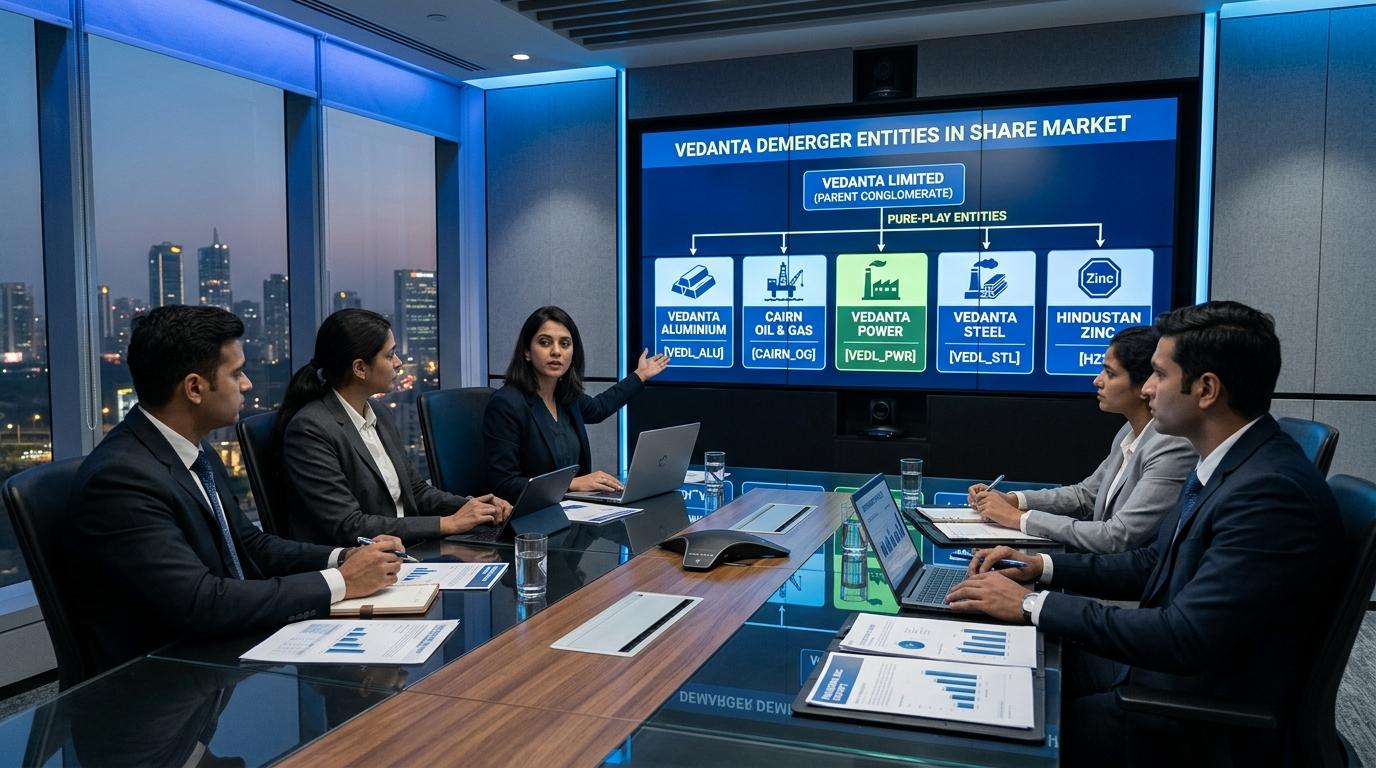
The Vedanta Limited demerger is one of the most consequential corporate restructuring events in Indian capital market history. Sanctioned by the National Company Law Tribunal (NCLT), Mumbai Bench, the court-approved scheme of arrangement unbundles the multi-commodity natural resources conglomerate into five distinct, separately listed pure-play corporations: Vedanta Aluminium, Vedanta Oil & Gas (Cairn), Vedanta Power, Vedanta Iron & Steel, and the residual parent entity Vedanta Limited (retaining its controlling ~64.9% stake in cash-cow Hindustan Zinc). Under the approved 1:1 share entitlement ratio, for every 1 equity share held in Vedanta Limited, an investor receives 1 additional equity share in each of the 4 newly demerged entities free of cost while retaining their original share. Under Section 47(viid) of the Indian Income Tax Act, this restructuring is completely tax-neutral for existing shareholders upon share receipt.
1. Why Did Vedanta Demerge? The Strategic Rationale
For over two decades, Vedanta Limited (NSE: VEDL / BSE: 500295) operated as a massive diversified natural resources conglomerate. Under a single listed corporate umbrella, it housed bauxite mining, alumina refining, primary aluminium smelting, offshore and onshore crude oil exploration, iron ore merchant mining, commercial steel manufacturing, thermal power generation, and zinc-lead-silver mining.
However, global capital markets historically assign a "Conglomerate Discount" (typically 15% to 30%) to multi-business conglomerates. Investors who were bullish on global crude oil prices hesitated to buy Vedanta because of debt in its power business. Similarly, global green-energy funds wanting exposure to lightweight aluminium for electric vehicles (EVs) were restricted from investing because the company simultaneously owned fossil-fuel assets and thermal power plants.
To unlock hidden shareholder value, eliminate this holding discount, and create pure-play corporate vehicles, the board of Vedanta Limited—backed by parent promoter Anil Agarwal's Vedanta Resources Limited (VRL)—formulated a comprehensive corporate restructuring scheme.
The restructuring was structured to accomplish four strategic objectives:
- Direct Market Valuation (Pure-Play Multipliers): Each business can now be benchmarked directly against specialized industry peers (e.g., Vedanta Aluminium against Hindalco and Nalco; Vedanta Oil & Gas against ONGC and Oil India).
- Ring-Fencing Business Debt: Segregates operational liabilities, ensuring that debt taken for a specific asset is serviced exclusively by the cash flows generated by that asset.
- Attracting Specialized Institutional Capital: Enables sovereign wealth funds, ESG-mandated global institutions, and sector-specific asset managers to invest directly in individual commodities.
- Enhanced Capital Allocation Agility: Provides individual management teams and boards with the autonomy to pursue targeted mergers, joint ventures, and capital expenditures without competing for capital within an unwieldy parent bureaucracy.
2. The 1:1 Share Entitlement Ratio: How It Works for Investors
The corporate restructuring was sanctioned by the National Company Law Tribunal (NCLT), Mumbai Bench under Sections 230–232 of the Companies Act, 2013, following clearances from the stock exchanges (NSE and BSE) and an NOC from the State Bank of India (SBI) led banking consortium.
The transaction is structured with a straightforward, shareholder-friendly 1:1 Share Entitlement Ratio:
The 1:1 Entitlement Rule: For every 1 equity share held in Vedanta Limited on the statutory Record Date, the shareholder automatically receives 1 fully paid-up equity share in each of the 4 newly demerged entities, while retaining their original 1 equity share in the residual parent company, Vedanta Limited.
Practical Portfolio Impact: If an investor held 100 shares of Vedanta Limited prior to the demerger, their revised portfolio automatically expands into 500 total equity shares across 5 independent listed corporations:
- 100 Shares of Vedanta Aluminium (Newly Listed)
- 100 Shares of Vedanta Oil & Gas (Newly Listed)
- 100 Shares of Vedanta Power (Newly Listed)
- 100 Shares of Vedanta Iron & Steel (Newly Listed)
- 100 Shares of Vedanta Limited (Residual Parent Entity)
| Demerged Entity | Core Operating Business | Flagship Production Assets & Capacities | Strategic Positioning & Moat |
|---|---|---|---|
| Vedanta Aluminium | Bauxite mining, Alumina refining & Aluminium smelting | Jharsuguda Smelter (1.8 MTPA), BALCO (Korba, Chhattisgarh), Lanjigarh Alumina Refinery | India's #1 primary aluminium producer; major supplier for EV lightweighting, aerospace & solar cables. |
| Vedanta Oil & Gas | Upstream crude oil exploration, drilling & natural gas production | Cairn Oil & Gas, Barmer Basin (Rajasthan), Ravva (KG Basin), Cambay Basin | Produces ~25% of India's domestic crude; lowest lifting production costs in the country. |
| Vedanta Power | Independent power producer (IPP), merchant power & renewables | Talwandi Sabo Power Limited / TSPL (1,980 MW supercritical plant in Punjab), Athena, Meenakshi | Long-term power purchase agreements (PPAs) delivering reliable, predictable utility cash flows. |
| Vedanta Iron & Steel | Merchant iron ore mining, pig iron & integrated steel manufacturing | ESL Steel (Bokaro 1.5 MTPA capacity), Goa & Karnataka merchant mines, Western Cluster (Liberia) | Fully integrated value chain supplying ductile iron pipes, TMT bars, wire rods, and global high-grade ore. |
| Vedanta Limited (Parent) | Zinc-Lead-Silver mining, copper processing & technology incubation | ~64.9% controlling equity stake in Hindustan Zinc Limited (HZL), Silvassa copper, display/tech ventures | The dividend cash-cow holding company; houses world-class low-cost zinc assets and high-tech incubator initiatives. |
3. Deep-Dive into the 5 Demerged Entities: Assets & Business Models
1. Vedanta Aluminium (The Industrial Powerhouse)
Vedanta Aluminium represents the largest single operational earnings contributor to the group. Housing the massive 1.8 MTPA smelter at Jharsuguda in Odisha and a 51% stake in Bharat Aluminium Company (BALCO), it commands over 40% of India's total primary aluminium market share.
- Backward Integration Moat: Expanding the Lanjigarh alumina refinery to 5 MTPA alongside captive operational coal and bauxite mine allocations dramatically reduces hot metal production costs, positioning it in the first quartile of the global aluminium cost curve.
- Growth Drivers: Global electric vehicle (EV) lightweighting, national electrical grid modernizations under the Revamped Distribution Sector Scheme (RDSS), and green aluminium export certifications.
2. Vedanta Oil & Gas (Cairn Oil & Gas)
Operating under the revered Cairn brand, this entity is India's largest private crude oil producer, contributing roughly one out of every four barrels of crude oil produced domestically.
- Core Assets: The world-class onshore Barmer Basin in Rajasthan (operating the Mangala, Bhagyam, and Aishwariya fields), supported by offshore assets in the Krishna-Godavari and Cambay basins.
- Economic Moat: Exceptional operating efficiency with an average gross operating cost of ~$7 to $8 per barrel. The company operates under long-term Production Sharing Contracts (PSCs) and revenue-sharing Open Acreage Licensing Policy (OALP) blocks across India.
3. Vedanta Power (Stable Utility Cash Flows)
Vedanta Power consolidates commercial thermal power generation into a distinct utility play.
- Flagship Assets: The 1,980 MW (3 × 660 MW) supercritical thermal power plant operated by Talwandi Sabo Power Limited in Mansa, Punjab, alongside newly acquired generation assets such as Athena Chhattisgarh (1,200 MW) and Meenakshi Energy (1,000 MW).
- Economic Moat: Insulated by long-term Power Purchase Agreements (PPAs) with state distribution utilities, providing predictable annuity-like EBITDA margins protected by coal price pass-through clauses.
4. Vedanta Iron & Steel (Integrated Ferrous Chain)
This entity combines upstream iron ore extraction with downstream value-added steel manufacturing.
- Core Assets: Electrosteel Steels Limited (ESL Steel), an integrated 1.5 MTPA steel plant in Bokaro, Jharkhand, currently undergoing expansion to 3.0 MTPA. In addition, it operates merchant iron ore mines in Goa and Karnataka, and controls the vast, high-grade Western Cluster iron ore deposits in Liberia.
- Growth Drivers: India's massive infrastructure and railway capex drives sustained demand for ESL's ductile iron pipes, wire rods, and structural steel sections.
5. Vedanta Limited (Residual Parent & Hindustan Zinc Anchor)
The continuing parent company remains a cash-flow titan primarily because it retains ownership of the group's crown jewel: a ~64.9% controlling equity stake in Hindustan Zinc Limited (HZL).
- Hindustan Zinc Moat: HZL is the world's second-largest integrated zinc producer and among the top global silver producers, boasting negative net debt and industry-leading operating profit margins exceeding 50%.
- Incubator Pipeline: Vedanta Limited will also incubate early-stage strategic ventures, including display glass manufacturing, copper cathode fabrication, and semiconductor electronics fabrication partnerships.
| Restructuring Phase | Corporate Action / Investor Status | Depository & Exchange Mechanics |
|---|---|---|
| 1. Pre-Demerger (Cum-Date) | Investor holds 100 Shares of Vedanta Limited | Shares trade on NSE and BSE under symbol VEDL. |
| 2. Ex-Demerger Date | Share price of VEDL adjusts downward |
Price discovery session reflects the removal of 4 unbundled divisions. |
| 3. Record Date | Registrar audits Demat accounts under PAN | Identifies eligible shareholders entitled to new share allocations. |
| 4. Direct Demat Credit | 400 New Shares credited to CDSL/NSDL accounts | 100 shares in each of the 4 new companies credited under temporary ISINs. |
| 5. Exchange Listing Day | Independent trading commences on NSE & BSE | All 4 new entities list as independent publicly traded stocks. |
4. Tax Implications for Shareholders: Is the Demerger Tax-Free?
Retail and institutional investors often worry that receiving hundreds of new shares will trigger an unexpected tax notice. Fortunately, Indian tax law provides clear protections for court-sanctioned schemes:
1. Immediate Exemption from Capital Gains Tax
Under Section 47(viid) of the Indian Income Tax Act, 1961, any issue of shares by a resulting company to the shareholders of a demerged company pursuant to an NCLT-sanctioned scheme of demerger is strictly exempt from capital gains tax. You do not pay any income tax upon receiving the new shares in your Demat account.
2. Apportionment of Cost of Acquisition (Section 49(2C))
When you eventually sell shares in any of the 5 companies in the future, how do you calculate your purchase cost?
- Under Section 49(2C) and 49(2D), your original purchase cost of Vedanta Limited is divided proportionately across the 5 companies based on the Net Book Value Ratio officially published by the company.
- Illustrative Example: Suppose you originally bought 100 shares of Vedanta Limited at ₹300 per share (Total Cost: ₹30,000). If the company certifies that the net asset value breaks down as 35% Aluminium, 20% Oil & Gas, 10% Power, 10% Steel, and 25% Residual Vedanta Limited:
- Your cost price for Vedanta Aluminium becomes: ₹105 per share (35% of ₹300)
- Your cost price for Vedanta Oil & Gas becomes: ₹60 per share (20% of ₹300)
- Your cost price for Vedanta Power becomes: ₹30 per share (10% of ₹300)
- Your cost price for Vedanta Steel becomes: ₹30 per share (10% of ₹300)
- Your cost price for Residual Vedanta Ltd becomes: ₹75 per share (25% of ₹300)
3. Grandfathered Holding Period for LTCG
Under Section 2(42A)(g) of the Income Tax Act, the holding period for the newly allotted demerged shares is calculated from the date you originally bought your parent Vedanta Limited shares, not from the date the new shares were credited. If you held your original Vedanta shares for more than 12 months, your newly allotted demerged shares are automatically classified as Long-Term Capital Assets from day one of listing.
5. What Happens to Vedanta’s High Dividend Yield?
Historically, retail and HNI investors purchased Vedanta Limited as a "dividend proxy", enjoying extraordinary dividend yields ranging between 10% and 18% per annum. These high payouts were driven by parent promoter Vedanta Resources Limited's (VRL) need to service its multibillion-dollar overseas dollar bond debt.
Post-demerger, the dividend dynamics will bifurcate across the five companies:
- Residual Vedanta Limited (The High-Dividend Anchor): Because it owns ~64.9% of cash-rich Hindustan Zinc, it will continue receiving thousands of crores in quarterly dividends from HZL. Investors seeking high ongoing dividend yields will primarily look to residual Vedanta Limited.
- Vedanta Aluminium & Steel (Capital Reinvestment Focus): Operating in aggressive capacity expansion phases, these entities are expected to reinvest a higher proportion of operating cash flows into brownfield smelting and mining expansions, resulting in moderate dividend yields but higher potential capital appreciation.
- Vedanta Power (Utility Payouts): Operating with steady PPA margins and low capex requirements, this entity will likely distribute predictable, moderate utility dividends.
6. Key Risks & Challenges Investors Must Monitor
While the demerger unlocks strategic focus, natural resources investing carries fundamental macroeconomic risks:
- Global Commodity Price Volatility: Metal and crude oil earnings are cyclical. Sharp drops in London Metal Exchange (LME) aluminium or zinc prices, or Brent crude dropping below $65/bbl, directly impact operating EBITDA margins.
- Promoter Debt & Pledge Overhang: The London-based holding company, Vedanta Resources Limited (VRL), holds significant debt maturities. Investors should monitor whether promoter share pledge levels decrease sustainably post-restructuring.
- Environmental & Regulatory Clearances: Mining operations in Goa, Odisha, and Liberia require continuous statutory environmental clearances and forest conservation approvals.
Track Demerged Shares & Blue-Chip Metals with Upstox
Open a free online Demat account in 5 minutes. Enjoy zero brokerage on equity delivery investments, automated corporate action credits, and 1-click IPO applications via UPI ASBA.
7. Editorial Summary & Recommended Investor Strategy
The Vedanta Limited demerger transitions a sprawling, debt-burdened conglomerate into a fleet of five agile, pure-play industrial leaders. For existing shareholders, the 1:1 entitlement ratio provides a rare opportunity to own a diversified, non-competing basket spanning aluminium, domestic crude oil, baseload power, commercial steel, and zinc.
Recommended Strategy:
- Do not panic-sell when the parent share price adjusts on the ex-demerger date; the full portfolio value will be realized once the newly allotted shares commence trading.
- Review your monthly Consolidated Account Statement (CAS) from CDSL or NSDL to verify the electronic credit of all four new ISINs.
- Retain the company's official cost-apportionment certificate for precise capital gains tax calculations when filing annual Income Tax Returns (ITR-2/ITR-3).
Statutory Regulatory Disclosures & Editorial Disclaimer
Digital Arthalaya (digitalarthalaya.in) is an independent financial education and market research platform. This analysis is published strictly for investor education and awareness based on publicly available regulatory filings submitted to the National Company Law Tribunal (NCLT), Securities and Exchange Board of India (SEBI), National Stock Exchange (NSE), and Bombay Stock Exchange (BSE).
This content does not constitute financial advice, a stock recommendation, or an endorsement of any corporate restructuring. Natural resource and commodity stocks are subject to high market volatility. Investors must conduct independent due diligence and consult a SEBI-registered investment advisor before making investment decisions.
Frequently Asked Questions (Institutional FAQ Desk)
Educational & Regulatory Disclosures
Source Attribution: This masterclass educational guide is produced strictly for investor awareness and capital markets literacy in alignment with SEBI Investor Education and Protection Fund (IEPF) guidelines.
Non-Advisory Mandate & Risk Warning: Digital Arthalaya is strictly an independent financial education portal and is not a SEBI-registered investment advisor or stock broker. IPO bidding and equity trading involve market risk, including potential loss of principal. Readers must conduct their own independent due diligence and read all offer documents carefully before making investment commitments.