Why Policybazaar (PB Fintech) Share Is Falling: ₹31,000 Cr Crash & IRDAI Commission Caps Explained
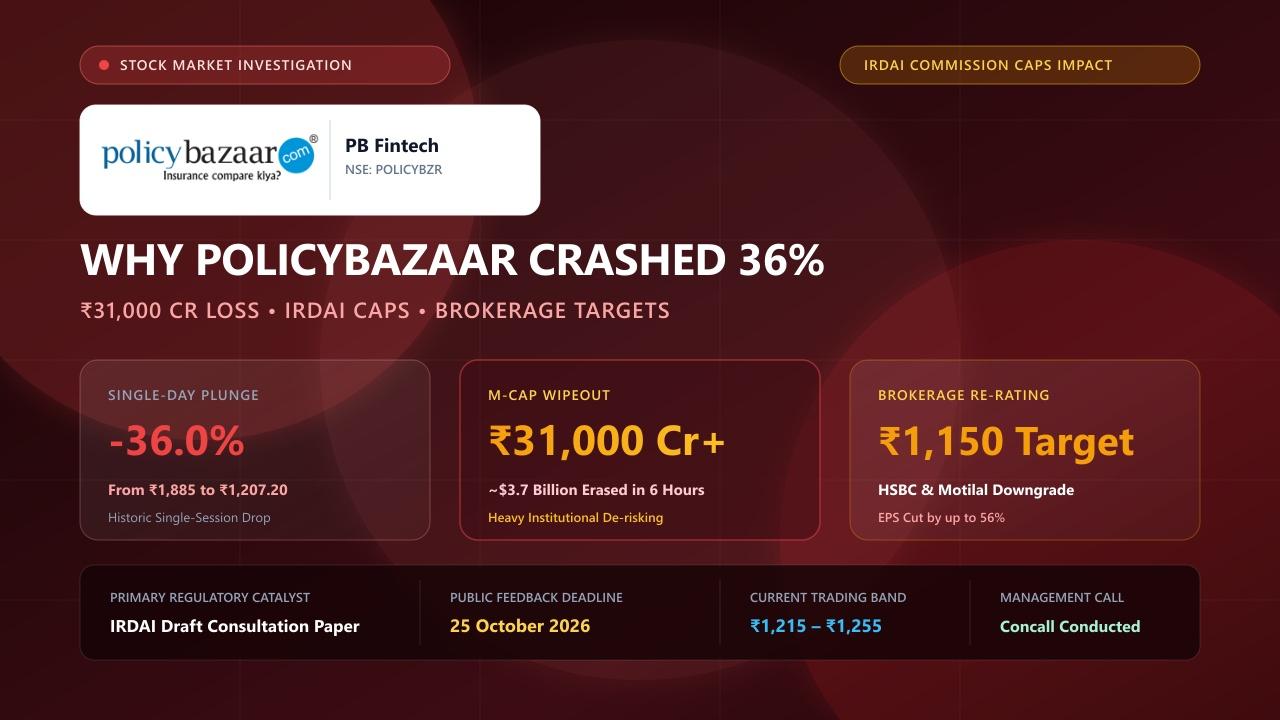
Shares of PB Fintech Limited (the parent enterprise of India's preeminent insurance aggregator Policybazaar and credit marketplace Paisabazaar) witnessed a historic 36% single-day crash on September 24, 2026, dropping precipitously from ~₹1,885 down to ₹1,207.20 and obliterating over ₹31,000 Crore in market capitalization. The panic sell-off was triggered by an unexpected draft Consultation Paper released by the Insurance Regulatory and Development Authority of India (IRDAI) on September 23, 2026, which proposes strict channel-wise and product-wise caps on distributor commissions across Life, Health, and General insurance. In response, marquee institutional brokerages HSBC and Motilal Oswal slashed target prices down to ₹1,150, estimating potential EPS hits of 17% to 56%. While management held an emergency analyst concall emphasizing that the proposals remain in the consultation phase until October 25, 2026, regulatory overhang and take-rate compression continue to weigh heavily on the stock.
Dalal Street was rocked by an unprecedented regulatory earthquake on September 24–25, 2026, as shares of PB Fintech Limited (NSE: POLICYBZR / BSE: 543390)—the holding company operating India's flagship financial marketplaces Policybazaar and Paisabazaar—plummeted by an astonishing 36% in a single trading session.
The stock, which had been trading near its 52-week peak at approximately ₹1,885, nosedived to an intra-day low before closing at ₹1,207.20, wiping out an eye-watering ₹31,000 Crore (~$3.7 Billion) in shareholder wealth in just over six hours of continuous market trading. The bloodbath spilled across the broader financial technology landscape, triggering panic selling among retail investors and prompt target-slashing across institutional brokerage desks.
Below is an in-depth forensic investigation into the primary regulatory shock, how commission ceilings attack Policybazaar's high-margin take-rates, institutional brokerage revisions, management concall commentary, and what investors should do next.
| Market Metric | Before Crash (23 Sep 2026) | Post-Crash Close (24-25 Sep 2026) | Net Impact / Percentage Change |
|---|---|---|---|
| PB Fintech Share Price | ₹1,885.50 | ₹1,207.20 | -36.0% (Crash of -₹678.30) |
| Total Market Capitalization | ~₹86,500 Crore | ~₹55,400 Crore | -₹31,100 Crore Wealth Wipeout |
| 52-Week High / Low Band | ₹1,960.00 / ₹1,120.00 | ₹1,960.00 / ₹1,180.00 | Sank to multi-month support lows |
| Estimated Forward P/E Multiple | ~95.0x | ~58.0x | Sharp multiple contraction |
| Price-to-Sales (P/S) Ratio | 11.8x | 7.4x | Compressed by ~37% |
| Primary Trigger Catalyst | Consensus Earnings Growth | IRDAI Draft Consultation Paper | Proposed statutory commission caps |
1. The Primary Shock: IRDAI's Draft Paper on Distribution Economics
The principal trigger behind the sell-off occurred after market hours on Wednesday, September 23, 2026, when the Insurance Regulatory and Development Authority of India (IRDAI) released a contentious Consultation Paper titled "Recalibrating the Economics of Insurance Distribution".
Under current regulatory mechanisms, insurance companies enjoy considerable discretion under aggregate Expense of Management (EoM) limits to reward digital aggregators and corporate agents. Platforms like Policybazaar command attractive "take-rates" (blended commissions, consumer acquisition allowances, technology integration fees, and volume-linked bonus payouts) that frequently range between 20% and 40% on first-year premiums for protection and health policies.
IRDAI's new consultation paper proposes a structural shift:
- Product-Wise Statutory Commission Caps: Establishing rigid upper ceilings on commissions payable across individual term life, retail health, and motor policies.
- Channel-Wise Uniformity: Eliminating preferential bilateral fee structures negotiated between private insurers and dominant digital web aggregators.
- Tightening Corporate Agency & EoM Headrooms: Lowering the overall promotional expenditure allowance for insurance underwriters, directly reducing the pool of capital available to pay external digital distributors.
Because the regulator is seeking to lower customer acquisition costs across the insurance value chain to pass on savings to policyholders, the direct loser in this regulatory equation is the intermediary distributor—Policybazaar.
2. How Policybazaar Makes Money: The Threat to Take-Rates
To understand why the market reacted so violently, one must examine the unit economics of PB Fintech's core operating engine:
- High-Margin Protection & Health Focus: Over 70% of Policybazaar's core insurance revenue is generated from individual retail term life and retail health insurance. These lines carry the highest distributor margins in the industry.
- The Operating Leverage Dilemma: Policybazaar's recent transition from operating losses to consolidated net profitability was predicated entirely on steady take-rates paired with diminishing marketing costs per policy sold. If IRDAI slashes blended take-rates by even 300 to 500 basis points, Policybazaar's incremental EBITDA margin evaporates.
- Volume Inelasticity: While regulators believe lower commissions could reduce consumer premiums and spark higher volume, online insurance penetration in India is driven by intensive customer advisory, tele-calling, and educational content. A reduction in distribution revenue makes customer acquisition unviable on marginal policies.
Trade & Invest in Indian Equities with Upstox
Navigate market volatility, hedging opportunities, and large-cap corrections with advanced trading charts and instant order execution on Upstox. Benefit from zero account opening fees, ₹0 delivery brokerage, and intelligent stop-loss tools.
3. Brokerage Bloodbath: Severe Target Price Slashes
Following the release of the consultation paper, top institutional equity research desks conducted emergency revisions, derating PB Fintech's forward valuation multiples and slashing earnings estimates:
| Brokerage House | Old Rating | New Rating | Previous Target (₹) | New Target Price (₹) | Core Rationale & Financial Impact |
|---|---|---|---|---|---|
| HSBC Global Research | Buy | Hold | ₹2,100 | ₹1,150 (-45%) | Projects 56% hit to FY28 EPS and 17% hit to FY29 EPS under commission caps |
| Motilal Oswal | Neutral | Neutral | ₹1,850 | ₹1,150 (-38%) | Estimates 30% drop in core online insurance revenue; 46% earnings hit in bear case |
| Kotak Institutional Equities | Reduce | Sell | ₹1,450 | ₹1,050 (-28%) | Regulatory ceiling disrupts high take-rate monetization and limits operating leverage |
| Jefferies India | Buy | Hold | ₹2,050 | ₹1,250 (-39%) | Recommends sidelines until October 25 public feedback produces regulatory clarity |
4. Secondary Headwinds: Expensive Multiples & Hospital Diversification
Beyond the immediate IRDAI shock, two underlying structural issues left PB Fintech acutely vulnerable to a sharp de-rating:
- Frothy Pre-Crash Valuations: Over the past 18 months, PB Fintech had gained over +120%, pricing in flawless execution. Trading at >85x forward EV/EBITDA, the stock possessed virtually no valuation cushion. When regulatory risks emerged, algorithmic trading desks and momentum funds engaged in aggressive de-risking.
- The ₹1,000 Crore Hospital Capital Allocation Drag: Institutional investors were already uneasy following PB Fintech's announcement to deploy over ₹1,000 Crore into owning and managing physical hospital beds to streamline health insurance claim settlements. Transitioning from an asset-light, 80% gross-margin digital platform into a capital-heavy healthcare operator diluted the company's valuation moat.
5. Emergency Analyst Concall: Key Takeaways from Management
To quell market anxiety, PB Fintech's executive leadership, led by Chairman & CEO Yashish Dahiya, hosted an emergency analyst conference call on September 24, 2026. Key management highlights included:
- Draft Status Emphasized: Management stressed that the IRDAI paper is merely a consultative document, not an enacted statutory law. The insurance industry has until October 25, 2026, to submit counter-representations.
- Insurers Rely on Digital Reach: Leadership argued that private life and general insurers cannot easily replace Policybazaar's digital distribution reach in Tier-2 and Tier-3 cities, meaning insurers will actively lobby for sustainable distribution incentives.
- Strong Balance Sheet Defense: PB Fintech maintains over ₹3,000 Crore in net cash and liquid investments, ensuring that operational survival is not at risk even under stressed regulatory environments.
- Paisabazaar Buffers Impact: The credit marketplace business (Paisabazaar) operates under RBI regulations rather than IRDAI, providing a diversified stream of digital lending revenues.
| Regulatory Milestone | Calendar Date | Core Directive / Process | Business Implication for PB Fintech |
|---|---|---|---|
| Draft Paper Release | 23 September 2026 | IRDAI issues consultation paper on commission recalibration | Sparked single-day 36% stock collapse |
| Public Feedback Deadline | 25 October 2026 | Insurers, brokers, and web aggregators submit formal comments | Stock will remain range-bound under regulatory overhang |
| Final Regulation Formulation | November – December 2026 | IRDAI finalizes binding statutory gazette notification | Determines final take-rate and margin impact |
| Implementation Phase | April 2027 (Expected) | Roll-out of new commission architecture across products | Financial modeling will reset based on enacted caps |
6. What Should Investors Do Now?
For market participants navigating this volatile correction, investment strategy depends heavily on time horizon and risk tolerance:
- For Existing Shareholders: Panic selling at current depressed levels (₹1,200–₹1,250) after a 36% drawdown may lock in losses at historical technical support. However, expectations of an immediate V-shaped recovery to ₹1,800 are unrealistic given that the IRDAI consultation remains open until late October.
- For Prospective Bottom-Fishers: PB Fintech remains the undisputed leader in India's under-penetrated insurance ecosystem with a fortress cash pile. Long-term accumulation should only be considered in small tranches near strong technical support at ₹1,100 to ₹1,150, keeping positions modest until IRDAI publishes its final framework.
Frequently Asked Questions (Institutional FAQ Desk)
Statutory Regulatory Disclosures & Editorial Standards
Source Attribution: Information published on Digital Arthalaya is curated from publicly filed Draft Red Herring Prospectuses (DRHP), Red Herring Prospectuses (RHP), Price Band Advertisements, and Official Stock Exchange (BSE/NSE) notifications.
Non-Advisory Mandate & Risk Warning: Digital Arthalaya is strictly an independent financial education portal and is not a SEBI-registered investment advisor or stock broker. IPO bidding and equity trading involve market risk, including potential loss of principal. Readers must conduct their own independent due diligence and read all offer documents carefully before making investment commitments.