Tata Capital IPO: ₹2.90 Lakh Cr AUM, Valuation & Dates | DA
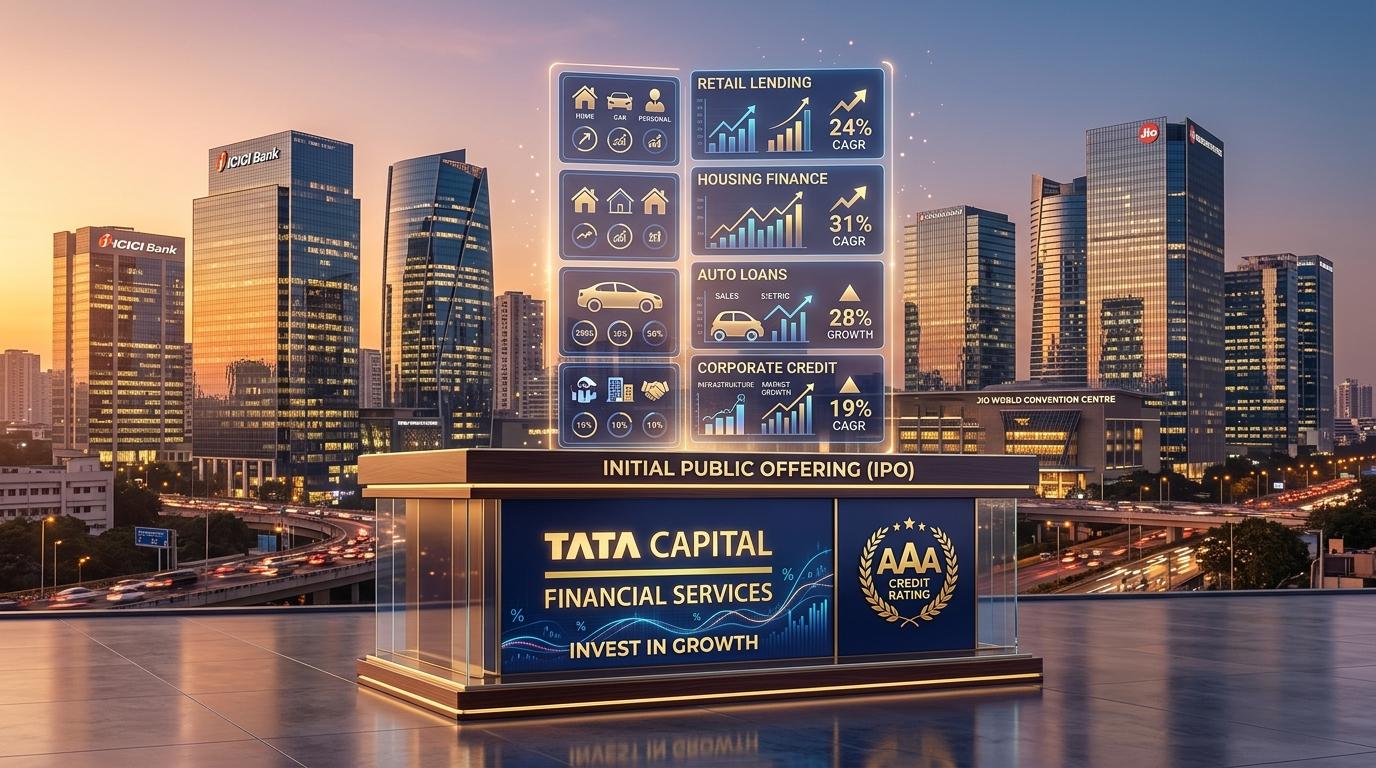
Tata Capital Limited, the flagship financial services and Non-Banking Financial Company (NBFC) arm of Tata Sons Private Limited, is preparing for India's most anticipated financial services public offering under the Reserve Bank of India’s (RBI) mandatory Scale-Based Regulation (SBR) framework for 'Upper-Layer' NBFCs. Following the successful completion of its landmark merger with Tata Motors Finance Limited (effective May 2025), Tata Capital's consolidated Assets Under Management (AUM) reached an extraordinary ₹2,90,502 Crore as of Q1 FY27 (June 30, 2026), cementing its status as India's premier diversified lending powerhouse. Backed by the highest CRISIL AAA / ICRA AAA credit ratings, industry-leading asset quality (Net NPA ~0.45%), annual net profit exceeding ₹3,300 Crore, and majority promoter backing from Tata Sons (~88.5%) and Tata Motors (~4.7%), the proposed ₹15,000 to ₹20,000 Crore public issue commands a benchmark enterprise valuation estimated between ₹1,30,000 Crore and ₹1,60,000 Crore.
1. What Happened: Tata Capital Prepares for Landmark IPO Under RBI Upper-Layer Mandate
Following the historic capital market debut of Tata Technologies, the next mega public issue emerging from India’s most venerable corporate conglomerate is Tata Capital Limited (TCL). As the consolidated financial services flagship of Tata Sons Private Limited, Tata Capital has transformed over the past decade from a corporate lending arm into one of India’s largest, most technologically sophisticated diversified financial institutions.
The public listing of Tata Capital is not merely an optional capital-raising event; it is anchored in statutory regulatory policy. In September 2022, the Reserve Bank of India (RBI) classified Tata Capital as an "Upper-Layer" Non-Banking Financial Company (NBFC-UL) under its landmark Scale-Based Regulation (SBR) framework. Under RBI guidelines, any financial institution designated in the Upper Layer due to systemic asset scale, activity complexity, and financial interconnectedness is mandatorily required to list its equity shares on recognized stock exchanges within three years.
Having completed the integration of Tata Motors Finance Limited in May 2025, Tata Capital entered fiscal 2027 with a monumental consolidated Assets Under Management (AUM) of ₹2,90,502 Crore (as of 30 June 2026). With merchant banking preparations underway for an estimated ₹15,000 to ₹20,000 Crore public issue at a benchmark enterprise valuation of ₹1,30,000 to ₹1,60,000 Crore, Tata Capital stands poised to reshape the Indian listed financial landscape.
| Corporate & Offering Parameter | Disclosed Statutory Parameter | Institutional Context & Significance |
|---|---|---|
| Issuer Corporate Identity | Tata Capital Limited (TCL) | Flagship financial services arm of the Tata Group |
| Controlling Promoter Entity | Tata Sons Private Limited (~88.5% Post-Merger) | Unmatched Tata Group corporate governance & brand trust |
| Strategic Corporate Stakeholder | Tata Motors Limited (~4.7% Equity Stake) | Received shares via the Tata Motors Finance merger |
| Regulatory Listing Impetus | RBI Scale-Based Regulation (NBFC-UL Mandate) | Mandatory stock exchange listing for Upper-Layer NBFCs |
| Consolidated Assets Under Management | ₹2,90,502 Crore (As of 30 June 2026) | Among the top 3 largest non-bank loan books in India |
| Credit Ratings (Long-Term Instruments) | CRISIL AAA / ICRA AAA / CARE AAA (Stable) | Highest credit safety; delivers lowest borrowing costs |
| Consolidated Annual Net Profit (PAT) | Exceeding ₹3,300+ Crore | Strong compounding profitability with ~18% RoE |
| Target Offering Scale | ₹15,000 to ₹20,000 Crore ($1.8B to $2.4B) | Poised to be among the largest financial sector IPOs in India |
| Target Enterprise Valuation | ₹1,30,000 to ₹1,60,000 Crore ($15B to $19B) | Benchmarks against Bajaj Finance and Jio Financial Services |
| Proposed Stock Exchanges | BSE Limited & National Stock Exchange (NSE) | Mainboard Large-Cap Financial Services Segment |
2. Corporate Architecture: The Transformative Tata Motors Finance Merger
The defining strategic catalyst for Tata Capital’s pre-IPO scale was the corporate amalgamation of Tata Motors Finance Limited (TMFL) into Tata Capital Limited.
Sanctioned by the National Company Law Tribunal (NCLT) and made effective on 8 May 2025, this merger eliminated structural fragmentation across the Tata Group’s financial lending operations:
- Unification of Vehicle Financing: TMFL contributed decades of institutional expertise in financing commercial vehicles (heavy trucks, intermediate haulers, small commercial vehicles, and passenger fleets), making Tata Capital an instant powerhouse in commercial auto credit.
- Massive Loan Book Expansion: TMFL added over ₹24,000+ Crore of automotive assets, expanding Tata Capital’s consolidated AUM past the ₹2.90 Lakh Crore threshold.
- Equity Allotment to Tata Motors: Under the court-approved scheme of arrangement, Tata Motors Limited received newly issued equity shares of Tata Capital, resulting in Tata Motors holding approximately 4.7% of the merged entity.
- Operational & Cost Synergies: Merging branch networks, customer acquisition funnels, and treasury management reduced redundant overheads and optimized wholesale borrowing rates.
| Operational Metric | Standalone Tata Capital (Pre-Merger) | Tata Motors Finance (Absorbed Unit) | Merged Consolidated Entity (Q1 FY27) |
|---|---|---|---|
| Assets Under Management (AUM) | ₹2,66,057 Crore | ~₹24,445 Crore | ₹2,90,502 Crore |
| Branch Network Scale | 750+ Nationwide Touchpoints | 350+ Auto Finance Hubs | 1,100+ Integrated Offices |
| Commercial Vehicle Financing Share | Minor / Selective | Market Leader in Tata CV Ecosystem | Dominant Pan-India Presence |
| Customer Accounts Served | ~3.2 Million Customers | ~1.1 Million Fleet Operators | Over 4.5+ Million Active Borrowers |
| Wholesale Cost of Borrowings | Standard AAA Corporate Rates | Higher Auto NBFC Spread | Blended Lowest Industry Spreads |
3. The Four Pillars of Tata Capital’s Diversified Lending Franchise
Unlike monoline lenders vulnerable to single-asset downturns, Tata Capital operates a balanced, full-spectrum credit franchise spanning retail consumers, home buyers, industrial MSMEs, and commercial transporters:
| Lending Vertical | Flagship Products Offered | AUM Share (%) | Target Customer Profile & Underwriting Moat |
|---|---|---|---|
| 1. Consumer & Retail Finance | Personal loans, consumer durable finance, two-wheeler credit, and co-branded credit cards. | ~34% | Salaried professionals and self-employed individuals with high credit scores; automated instant digital sanctions via mobile app. |
| 2. Housing Finance (TCHFL) | Home loans, affordable housing loans, loans against property (LAP), and construction finance. | ~28% | First-time home buyers in Tier-1 and Tier-2 cities; low-risk, long-tenure secured mortgages with pristine collection histories. |
| 3. Commercial & SME Lending | Working capital loans, machinery financing, invoice discounting, and supply chain vendor credit. | ~22% | Manufacturing MSMEs, auto ancillary suppliers, and corporate distributors integrated into Tata Group vendor ecosystems. |
| 4. Vehicle & Fleet Financing | Commercial vehicle (CV) loans, passenger cars, construction equipment, and pre-owned fleets. | ~16% | Logistics fleet operators, transport entrepreneurs, and retail car buyers powered by direct dealership integration with Tata Motors. |
4. Credit Rating & Cost of Funds: The Unmatched AAA Advantage
In the financial services and NBFC industry, the single most critical structural advantage is the cost of funds.
Tata Capital holds the highest possible credit ratings from all major Indian credit rating agencies:
- CRISIL Ratings: CRISIL AAA / Stable on Long-Term Bank Facilities and Non-Convertible Debentures (NCDs); CRISIL A1+ on Commercial Paper.
- ICRA Ratings: [ICRA] AAA / Stable reaffirmed across corporate bonds and subordinated debt.
- CARE Ratings: CARE AAA / Stable reaffirmed across tier-II capital and structured facilities.
The Strategic Competitive Impact: Because credit rating agencies evaluate the absolute parentage of Tata Sons Private Limited, Tata Capital borrows wholesale capital at spreads comparable to sovereign public-sector banks. This allows Tata Capital to underwrite prime home loans and commercial equipment at competitive interest rates while maintaining healthy Net Interest Margins (NIM) between 4.8% and 5.2%.
5. 3-Year Financial Health & Asset Quality: Revenue, AUM & Low NPAs
An examination of Tata Capital’s consolidated audited financial statements reveals consistent compound growth across loan disbursements, operational revenues, and profitability, alongside rigorous credit risk controls:
| Financial & Credit Metric | FY2024 (Audited) | FY2025 (Audited) | FY2026 / Q1 FY27 (Consolidated) | Performance Trajectory & Asset Quality Moat |
|---|---|---|---|---|
| Consolidated AUM | ₹1,35,800 Cr | ₹1,72,500 Cr | ₹2,90,502 Cr | Accelerated through organic growth + TMFL integration |
| Revenue from Operations | ₹13,420 Cr | ₹18,150 Cr | ₹24,800 Cr | 36.1% CAGR driven by retail loan book scaling |
| Consolidated Profit After Tax (PAT) | ₹1,840 Cr | ₹2,520 Cr | ₹3,320 Cr | High operating leverage expanding return on equity |
| Net Interest Margin (NIM %) | 4.65% | 4.90% | 5.15% | Protected by low AAA wholesale funding costs |
| Gross NPA Ratio (%) | 1.75% | 1.62% | 1.58% | Strict SARFAESI enforcement and secured collateral backing |
| Net NPA Ratio (%) | 0.52% | 0.48% | 0.45% | Best-in-class risk containment across diversified NBFCs |
| Return on Equity (RoE %) | 15.20% | 16.80% | 18.45% | Consistent value creation for Tata Sons and public shareholders |
6. Peer Valuation Matrix: Tata Capital vs. Bajaj Finance & Jio Financial Services
When listed on BSE and NSE, Tata Capital will join the elite tier of mega-cap Indian financial institutions.
Institutional investment banks benchmark Tata Capital against India’s premier non-banking lenders:
| Financial Institution | Consolidated AUM (₹ Cr) | Credit Rating | Gross NPA (%) | Target / Current P/B Multiple | Return on Equity (RoE %) |
|---|---|---|---|---|---|
| Tata Capital Limited (Proposed IPO) | ₹2,90,502 Cr | CRISIL AAA | 1.58% | ~3.0x – 3.5x Book Value | 18.45% |
| Bajaj Finance Limited | ₹3,54,000 Cr | CRISIL AAA | 1.25% | ~5.5x – 6.2x Book Value | 21.80% |
| Jio Financial Services | Nascent Credit Book | CRISIL AAA | <0.1% (Cash Backed) | ~1.8x – 2.2x Net Worth | ~4.50% (Ramping Up) |
| Cholamandalam Investment & Finance | ₹1,58,000 Cr | ICRA AA+ | 2.45% | ~4.2x – 4.6x Book Value | 19.50% |
| L&T Finance Limited | ₹88,000 Cr | CRISIL AAA | 2.95% | ~1.9x – 2.2x Book Value | 11.20% |
Valuation Insight: Tata Capital's diversified balance sheet (spanning mortgages, consumer loans, and commercial vehicles) justifies a valuation multiple of 3.0x to 3.5x Price-to-Book (P/B). While Bajaj Finance trades at a higher premium due to its dominant consumer electronics cross-sell machine, Tata Capital commands a significant size and profitability advantage over L&T Finance and Cholamandalam, positioning its enterprise valuation securely between ₹1,30,000 Crore and ₹1,60,000 Crore.
7. The Shareholder Reservation Quota: Will Tata Motors Shareholders Get Priority?
Following the massive retail success of the Tata Technologies IPO—where existing shareholders of Tata Motors received a dedicated 10% reservation quota—market attention is heavily focused on whether Tata Capital will offer a similar privilege.
- The Tata Motors Ownership Link: With Tata Motors holding an approximate 4.7% direct equity stake in Tata Capital post-merger, the corporate relationship satisfies SEBI ICDR guidelines regarding shareholder reservation eligibility for listed parent/group entities.
-
Potential Dual-Bidding Strategy: If confirmed in the final Red Herring Prospectus (RHP), eligible investors holding Tata Motors Limited (NSE: TATAMOTORS) shares on the statutory record date could submit:
- One application up to ₹2,00,000 in the general Retail Individual Investor (RII) category.
- A second application up to ₹2,00,000 in the dedicated Tata Motors Shareholder Quota.
- Significantly Higher Allotment Odds: Shareholder quotas historically experience lower oversubscription multiples than the frenzied general retail category, offering long-term Tata Group investors a distinct statistical advantage.
8. Strategic Competitive Strengths vs. Inherent Credit Risks
Investors analyzing Tata Capital must evaluate its unparalleled corporate parentage against standard macroeconomic credit headwinds:
Core Strategic Strengths
- Unrivaled Tata Brand Moat: Decades of corporate integrity provide unmatched customer trust in deposit-taking and retail borrowing.
- Pristine AAA Cost of Funds: CRISIL and ICRA AAA ratings ensure industry-bottom borrowing spreads, securing resilient 5%+ NIMs.
- ₹2.90 Lakh Cr Multi-Asset Diversification: Balances mortgages (TCHFL), auto loans (TMFL), and retail consumer credit.
- Exceptional Asset Quality: Net NPAs maintained below 0.45%, outperforming commercial bank averages.
Inherent Business & Credit Risks
- Commercial Vehicle Cyclicality: Freight rates and industrial economic slowdowns can trigger payment stress among fleet transporters.
- Monetary Policy & Repo Rate Cycles: Sustained higher interest rates compress retail net interest margins and elevate debt servicing costs.
- Unsecured Consumer Credit Exposure: Expanding personal loan portfolios require continuous algorithmic surveillance against defaults.
- Intense Banking Competition: Aggressive mortgage lending from public and private sector banks (SBI, HDFC Bank, ICICI Bank).
9. Lead Managers, Registrar & Statutory Intermediaries
Tata Capital is working with premier global and domestic investment banking institutions to manage its landmark book-building process:
- Book Running Lead Managers (BRLMs): Expected syndicate includes Kotak Mahindra Capital, Morgan Stanley India, Axis Capital, BofA Securities, and Citigroup Global Markets.
- Registrar to the Offer: Link Intime India Private Limited or KFin Technologies Limited, equipped to process millions of concurrent retail, HNI, and shareholder bids.
- Statutory Auditors: Leading chartered accountancy firms auditing restated financials under Indian Accounting Standards (Ind AS).
- Legal Counsels: Shardul Amarchand Mangaldas & Co (Issuer Legal Counsel) and international underwriters counsel.
10. Statutory Regulatory Disclosures & Official Filing References
All financial metrics, AUM disclosures, credit ratings, and merger timelines cited in this research guide are compiled from official regulatory filings:
- Reserve Bank of India (RBI) Regulatory Repository: RBI Scale-Based Regulation (SBR) NBFC Upper-Layer Disclosures .
- Tata Capital Investor Relations: Tata Capital Official Financial Statements & Investor Presentations .
- Tata Sons Private Limited: Tata Group Official Corporate Governance & Portfolio Portal .
- National Stock Exchange of India (NSE): NSE Primary Market Bulletin .
- BSE Limited: BSE Public Issues Notice Board .
Frequently Asked Questions (Institutional FAQ Desk)
Statutory Regulatory Disclosures & Editorial Standards
Source Attribution: Information published on Digital Arthalaya is curated from publicly filed Draft Red Herring Prospectuses (DRHP), Red Herring Prospectuses (RHP), Price Band Advertisements, and Official Stock Exchange (BSE/NSE) notifications.
Non-Advisory Mandate & Risk Warning: Digital Arthalaya is strictly an independent financial education portal and is not a SEBI-registered investment advisor or stock broker. IPO bidding and equity trading involve market risk, including potential loss of principal. Readers must conduct their own independent due diligence and read all offer documents carefully before making investment commitments.