NSE IPO Lists at ₹1,800 on BSE: Debuts at 0.84% Premium, Listing Day Analysis & Next Steps
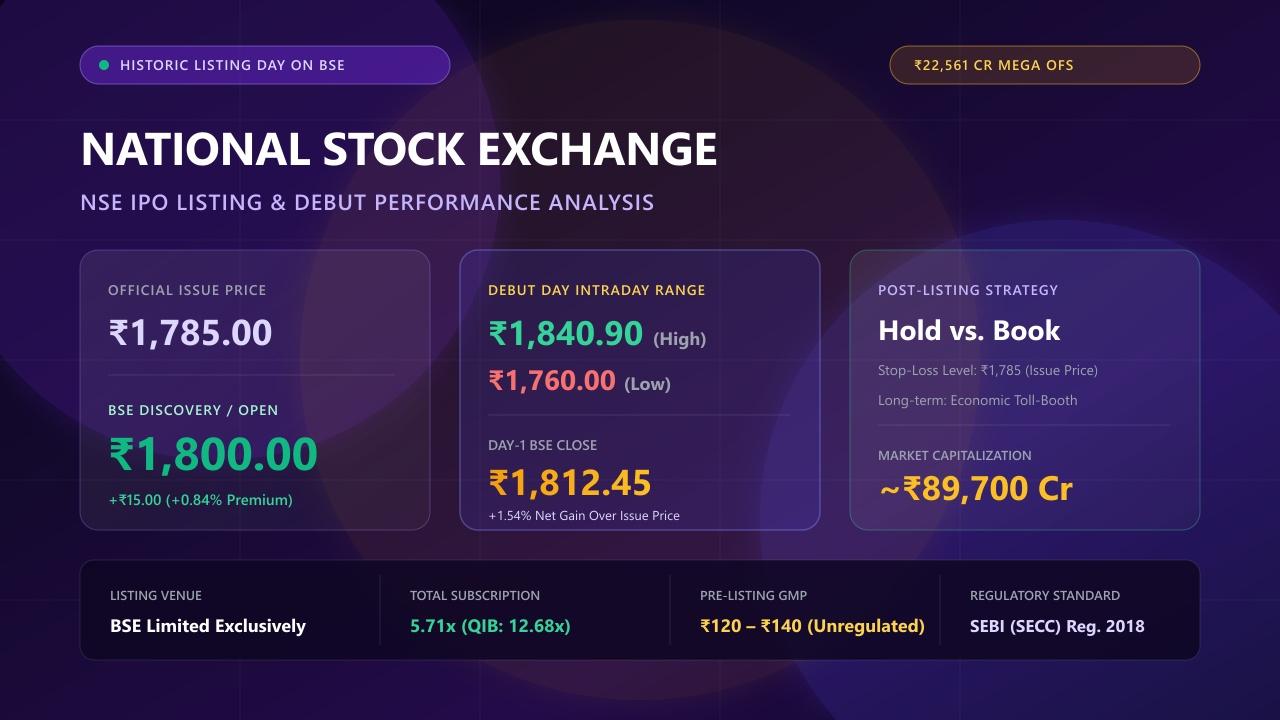
The equity shares of the National Stock Exchange of India Limited (NSE) commenced secondary market trading exclusively on BSE Limited on Thursday, September 24, 2026, following the successful completion of India's historic ₹22,561.57 Crore initial public offering. During the official pre-open discovery session on BSE, the scrip opened at ₹1,800.00 per share, delivering a modest debut premium of ₹15.00 or +0.84% over its upper issue price of ₹1,785.00. Throughout the volatile opening session, the stock registered an intraday high of ₹1,840.90 (+3.13%) and an intraday low of ₹1,760.00 (-1.40%) before settling the day at ₹1,812.45 (+1.54%). While the actual listing premium fell short of speculative pre-IPO grey market projections (₹120–₹140), institutional absorption of the 100% Offer for Sale (OFS) demonstrated solid depth, establishing an initial post-listing market capitalization of approximately ₹89,700 Crore.
The domestic capital markets etched a landmark chapter into financial history as equity shares of the National Stock Exchange of India Limited (NSE) officially debuted for trading on BSE Limited on Thursday, September 24, 2026. The listing successfully operationalized the secondary market culmination of India's historic ₹22,561.57 Crore public offering.
During the special 45-minute pre-open price discovery session on BSE, institutional orders settled the opening price of NSE at ₹1,800.00 per equity share, translating to a measured debut premium of ₹15.00 or +0.84% over the final issue price of ₹1,785.00. While short-term retail participants had anticipated double-digit opening surges based on unregulated grey market rumors, the market exhibited classic institutional absorption characteristic of mega-cap capital offerings.
Below is an institutional analysis of the listing day price action, the regulatory mechanics governing its exclusive BSE venue, valuation multiples against listed peer exchanges, and an actionable asset allocation framework for allotted investors.
| Listing Parameter | BSE Official Market Data | Regulatory & Editorial Context |
|---|---|---|
| Issuer Corporate Entity | National Stock Exchange of India Limited | World's largest derivatives exchange by contract volume |
| Final Public Issue Price | ₹1,785.00 per share | Priced at the upper limit of the ₹1,700–₹1,785 price band |
| BSE Pre-Open Discovery Price | ₹1,800.00 per share | Debut gain of +₹15.00 (+0.84% over issue price) |
| Debut Intraday High | ₹1,840.90 per share | +3.13% maximum intraday surge during mid-morning trade |
| Debut Intraday Low | ₹1,760.00 per share | Brief dip below issue price (-1.40%) amid early profit booking |
| Listing Day Closing Price | ₹1,812.45 per share | +1.54% net gain on Day 1 over issue price |
| Total Issue Size (100% OFS) | ₹22,561.57 Crore | 12,64,00,000 Equity Shares sold by existing shareholders |
| Post-Listing Market Capitalization | ~₹89,716 Crore | Solidifies NSE among India's top market infrastructure giants |
| Trading Exchange Venue | BSE Limited Exclusively | Mandated under SEBI (SECC) Regulations, 2018 |
1. Debut Price Action: Open, Intraday Range, and Day-1 Close
Trading in NSE equity shares opened on BSE under normal market conditions at 10:00 AM IST following price discovery. The market witnessed brisk two-way turnover as short-term leveraged applicants offloaded allocations while long-term domestic institutional investors (DIIs) and global mutual funds gradually accumulated institutional blocks.
After finding initial support at the ₹1,800 mark, buying momentum carried the stock to an intraday high of ₹1,840.90 (+3.13%) within the first ninety minutes of trade. A wave of mid-session supply temporarily pushed the price to a low of ₹1,760.00 (-1.40%), before sustained accumulation during the afternoon session anchored the stock to close comfortably in positive territory at ₹1,812.45 (+1.54%).
2. Listing Gains vs. Grey Market Expectations: A Reality Check
In the days leading up to the listing, unofficial market trackers had projected an estimated grey market premium (GMP) corridor of ₹120 to ₹140 per share, implying expected listing prices between ₹1,905 and ₹1,925 (+6.7% to +7.8%).
| Information Channel / Platform | Pre-Listing Indicated Quote | Projected Listing Price | Actual BSE Debut Price | Realized Listing Variance |
|---|---|---|---|---|
| InvestorGain Tracker (23 Sep) | ₹110 – ₹135 (GMP) | ₹1,895 – ₹1,920 | ₹1,800.00 | -5.2% below speculative expectation |
| IPOWatch Tracker (23 Sep) | ₹120 – ₹140 (GMP) | ₹1,905 – ₹1,925 | ₹1,800.00 | -5.8% below speculative expectation |
| Official BSE Trading Engine | Statutory Order Matching | ₹1,800.00 (Open) | ₹1,800.00 | +0.84% Actual Realized Gain |
Why the Debut Was Measured Rather Than Euphoric:
- Mega Supply Absorption: Offering ₹22,561.57 Crore in stock within a single window constitutes one of the largest liquidity events in Indian capital market history. Unlike small issues where tight float creates artificial supply crunches, large institutional sellers provided ample secondary liquidity.
- 100% Offer for Sale (OFS): Because the IPO comprised zero fresh capital injection, institutional valuation models priced the offering based strictly on existing earnings rather than pricing in immediate corporate expansion triggers.
- Institutional Bidding Realism: The Qualified Institutional Buyer (QIB) book, which was subscribed 12.68x, demonstrated that institutional capital bid aggressively for core ownership rather than speculative first-hour flip gains.
3. Regulatory Fact-Check: Why Did NSE List Exclusively on BSE?
One of the most frequently asked questions across the investor community is why the National Stock Exchange chose to list its shares on the Bombay Stock Exchange (BSE) rather than on its own platform.
The answer is grounded strictly in statutory Indian securities law. Under the Securities and Exchange Board of India (Stock Exchanges and Clearing Corporations) Regulations, 2018 (SECC Regulations), a recognized stock exchange is legally prohibited from self-listing:
- Elimination of Conflict of Interest: An exchange serves as a frontline regulator tasked with monitoring compliance, detecting insider trading, and halting trading in errant listed companies. If an exchange were listed on itself, commercial incentives to preserve its own share price could compromise rigorous self-surveillance.
- Cross-Listing Precedent: In 2017, BSE Limited listed its equity shares exclusively on the National Stock Exchange for the exact same statutory reason. Consequently, BSE oversees continuous regulatory compliance for NSE, while NSE oversees compliance for BSE.
Trade NSE & Blue-Chip Shares with Upstox
Now that NSE shares are actively trading on BSE, you can buy or sell individual shares without lot size restrictions. Open a free Demat account with Upstox for zero delivery brokerage and lightning-fast execution.
4. Fundamental Financial Fortress & Valuation Comparison
Beyond opening day fluctuations, NSE remains one of the most profitable financial infrastructure monopolies globally. The company's financial profile illustrates exceptional pricing power and cash flow generation:
| Operational & Financial Metric | NSE Restated Financials (FY26) | Editorial & Industry Commentary |
|---|---|---|
| Total Revenue from Operations | ₹14,780 Crore | Driven by transaction charges, colocation, and index licensing |
| Operating EBITDA | ₹10,642 Crore | Consistently maintaining operating margins above 70% |
| Profit After Tax (PAT) | ₹7,845 Crore | Robust net margin profile surpassing 50% |
| Return on Net Worth (RoNW) | 34.20% | Demonstrates extraordinary return generation on shareholder capital |
| Price-to-Earnings (P/E) at ₹1,812 | ~28.5x | Attractively priced relative to BSE Ltd's trading multiple (~42–45x) |
| Derivatives Market Share | ~93% | Unmatched liquidity network effect in benchmark Nifty contracts |
At its listing close of ₹1,812.45, NSE trades at approximately 28.5 times its trailing twelve-month earnings. Compared to BSE Limited, which trades in the secondary market at a P/E multiple between 42x and 45x, NSE's valuation provides comfortable downside support and long-term multiple expansion potential.
5. Investor Strategy: Hold for Compound Wealth or Book Profits?
Market participants holding allotted shares face an asset allocation decision based on their underlying investment timeframe:
For Short-Term Tactical Traders:
- Investors who participated solely for listing-day gains may consider taking partial profits given that the stock has delivered a modest gain.
- To protect capital against macroeconomic volatility, maintain a strict trailing stop-loss at the issue price of ₹1,785.00 on a daily closing basis. If the scrip trades above ₹1,820, trailing stops can be moved upward to break-even plus costs.
For Long-Term Core Portfolio Investors:
- Strong Structural Hold: NSE represents an indispensable institutional monopoly on India's financialization story. As retail participation, systematic investment plans (SIPs), algorithmic trading, and options turnover grow, NSE captures automated fee income without corresponding operational debt.
- Attractive Dividend Payouts: The exchange historically distributes a substantial portion of its net earnings as regular shareholder dividends, offering defensive yields during market downturns.
6. Regulatory Headwinds to Monitor
While the investment thesis remains robust, shareholders should track ongoing regulatory developments:
- SEBI Derivative Volume Rationalization: Regulatory reforms regarding increased contract lot sizes, mandatory intraday monitoring of position limits, and restrictions on weekly contract expiries could moderate hyper-growth in options turnover over the near term.
- BSE Competitive Inroads: BSE's revitalized Sensex and Bankex derivative contracts continue to capture market share, introducing healthy market competition into NSE's historical near-monopoly.
7. Statutory Offer Document & Regulatory References
This institutional coverage is compiled directly from certified primary regulatory filings:
- SEBI Red Herring Prospectus: Filed with the Registrar of Companies and cleared by SEBI under the ICDR Regulations.
- BSE Listing Notice & Trading Parameters: Circular No. 20260924 issued by BSE Limited confirming trading commencement under scrip code specifications.
- Registrar Allotment Reconciliation: Processed by MUFG Intime India Private Limited (formerly Link Intime India).
Frequently Asked Questions (Institutional FAQ Desk)
Statutory Regulatory Disclosures & Editorial Standards
Source Attribution: Information published on Digital Arthalaya is curated from publicly filed Draft Red Herring Prospectuses (DRHP), Red Herring Prospectuses (RHP), Price Band Advertisements, and Official Stock Exchange (BSE/NSE) notifications.
Non-Advisory Mandate & Risk Warning: Digital Arthalaya is strictly an independent financial education portal and is not a SEBI-registered investment advisor or stock broker. IPO bidding and equity trading involve market risk, including potential loss of principal. Readers must conduct their own independent due diligence and read all offer documents carefully before making investment commitments.