NSDL IPO: ₹4,000 Cr Issue, Depository Moat & CDSL Valuation | DA
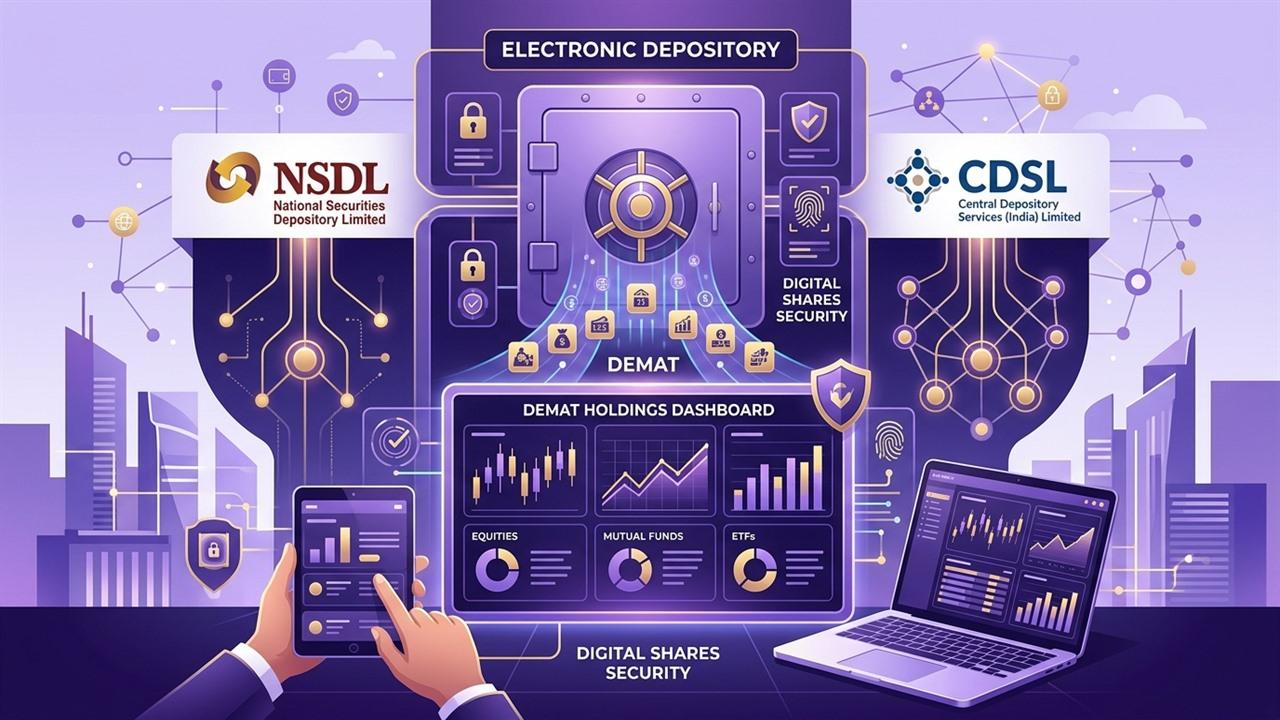
National Securities Depository Limited (NSDL), India's foundational central securities depository and designated Market Infrastructure Institution (MII), has secured regulatory observation clearance from the Securities and Exchange Board of India (SEBI) for its landmark ₹4,000 Crore initial public offering. Structured entirely as an Offer for Sale (OFS) of up to 5,72,60,001 equity shares (face value ₹2.00) by major institutional stakeholders—including IDBI Bank, National Stock Exchange (NSE), Union Bank of India, State Bank of India, HDFC Bank, and SUUTI—the issue involves zero primary capital dilution. Holding over ₹400 Lakh Crores ($4.8+ Trillion) in Assets Under Custody (AUC) and commanding an unshakeable 80%+ share of institutional and corporate debt custody, NSDL represents an asset-light, cash-generative monopoly-duopoly franchise with operating EBITDA margins of 58%–62% and zero long-term debt.
1. What Happened: NSDL Secures SEBI Clearance for Historic ₹4,000 Crore Mainboard IPO
In the institutional architecture of India’s modern financial markets, central electronic depositories function as the impregnable digital vaults safeguarding the entire nation’s paperless wealth.
Every equity share purchased on the National Stock Exchange of India (NSE) or BSE Limited, every sovereign green bond issued by the Reserve Bank of India, every mutual fund unit, and every real estate investment trust (REIT) unit is securely stored in electronic book-entry format with one of India's two registered central depositories: NSDL or CDSL.
Incorporated in 1996 following the enactment of the historic Depositories Act, National Securities Depository Limited (NSDL) pioneered the dematerialization revolution, freeing Indian capital markets from the physical bottlenecks of forged transfer deeds and stolen paper certificates.
Following detailed regulatory scrutiny, the Securities and Exchange Board of India (SEBI) granted its final observation letter on 30 September 2024, formally approving NSDL’s Draft Red Herring Prospectus (DRHP) for a landmark public offering estimated at ₹3,500 to ₹4,500 Crore.
With over ₹400 Lakh Crores ($4.8+ Trillion) in Assets Under Custody (AUC), NSDL operates as a vital Market Infrastructure Institution (MII). This institutional review analyzes NSDL's 5 annuity revenue engines, benchmarks its financials against listed peer CDSL, and dissects the capital architecture of its 100% Offer for Sale (OFS).
| Offering Metric | Disclosed Statutory Parameter | Institutional Context & Significance |
|---|---|---|
| Issuer Corporate Identity | National Securities Depository Limited (NSDL) | Designated Market Infrastructure Institution (MII) |
| Proposed Exchange Listings | BSE Limited & National Stock Exchange (NSE) | Mainboard Equity Trading Segment |
| Estimated Issue Size | ₹3,500 to ₹4,500 Crore (~₹40,000 Million) | India's second listed central securities depository |
| Total Equity Shares Offered | Up to 5,72,60,001 Equity Shares | Secondary monetization by institutional banking stakeholders |
| Issue Structure | 100% Offer for Sale (OFS) | Zero fresh capital dilution; no primary balance-sheet proceeds |
| Equity Share Face Value | ₹2.00 per share | Subdivided equity capital structure |
| SEBI Statutory Approval Status | APPROVED (30 Sept 2024) | Final Observation Letter issued by SEBI primary market desk |
| Assets Under Custody (AUC) | Over ₹400 Lakh Crore ($4.8+ Trillion) | Commanding >80% institutional & debt custody market share |
| Operating EBITDA Margins | 58.5% – 61.5% | Asset-light infrastructure with high operating leverage |
| Balance Sheet Debt | Zero Long-Term Debt | Net cash surplus with massive risk-free treasury float |
2. Capital Structure & Selling Shareholders: 100% Secondary OFS Dissected
The capital architecture of the NSDL IPO is structured entirely as a secondary monetization window for its founding banking and exchange promoters.
Because NSDL is an established, debt-free, cash-generating utility that funds its software and cybersecurity infrastructure out of operational cash flows, the company does not require fresh equity capital. The gross issue proceeds will accrue entirely to the selling shareholders:
| Institutional Selling Shareholder | Equity Shares Offered (OFS) | Pre-Issue Shareholding (%) | Institutional Rationale & Context |
|---|---|---|---|
| IDBI Bank Limited | Up to 2,22,20,000 Shares | 26.10% | Largest selling shareholder; unlocking capital ahead of IDBI Bank privatization. |
| National Stock Exchange of India (NSE) | Up to 1,80,00,001 Shares | 24.00% | Founding exchange partner monetizing non-core financial infrastructure holding. |
| Union Bank of India | Up to 56,25,000 Shares | 2.81% | Public sector banking partner partial stake divestment. |
| State Bank of India (SBI) | Up to 40,00,000 Shares | 5.00% | India's largest bank monetizing equity stake at institutional valuation. |
| HDFC Bank Limited | Up to 40,00,000 Shares | 8.95% | Private sector banking leader divesting partial historical treasury stake. |
| SUUTI (Specified Undertaking of UTI) | Up to 34,15,000 Shares | 6.83% | Government-administered trust executing non-tax capital receipts. |
| Total Consolidated OFS | Up to 5,72,60,001 Shares | — | 100% Secondary Divestment Tranche |
3. What Does NSDL Do? The Core Plumbing of Indian Financial Markets
Operating under the statutory mandate of SEBI (Depositories and Participants) Regulations, NSDL serves as the electronic nervous system for Indian financial securities:
Core Operational Mandates of NSDL:
1. Dematerialization & Custodial Storage: Converting physical share certificates into immutable electronic records and maintaining digital ownership ledgers across equities, sovereign debt, corporate debentures, and commercial paper.
2. Electronic Settlement Intermediation: Interfacing with NSE Clearing Limited (NCL) and Indian Clearing Corporation Limited (ICCL) to execute atomic Delivery-versus-Payment (DvP) share transfers upon trade settlement under the mandatory T+1 cycle.
3. Automated Corporate Actions: Executing bulk electronic distribution of bonus shares, stock splits, rights issues, and verifying shareholder entitlement lists for direct corporate dividend distributions via NACH.
4. Depository Participant (DP) Network Governance: Supervising, auditing, and providing digital APIs to over 280 registered Depository Participants (custodian banks, PSU banks, and brokerage firms).
4. How NSDL Generates Super-Margin Revenue: The 5 Annuity Pillars
Unlike equity brokerages whose earnings fluctuate with volatile retail trading volumes, central depositories enjoy predictable, annuity-style cash flows across five uncorrelated revenue streams:
| Revenue Pillar | Commercial Billing Mechanism | Primary Business Driver | Counter-Cyclical Durability |
|---|---|---|---|
| 1. Annual Issuer Charges (AMC) | Recurring annual fee based on paid-up capital of listed and unlisted public companies. | Over 42,000 active corporate issuers registered on NSDL. | High Annuity: Companies must pay annually to maintain Demat eligibility regardless of market bull or bear cycles. |
| 2. Transaction Settlement Fees | Flat statutory transaction fee (typically ₹4.50 to ₹5.50) per debit transaction. | Secondary market equity delivery volume, portfolio rebalancing, and ETF trades. | Scalable Volume: Directly expands as national retail and institutional trading participation compounds. |
| 3. Corporate Action Processing Fees | Lump-sum processing fees per corporate action event. | Initial Public Offerings (crediting IPO shares), stock splits, bonus issues, and share buybacks. | Primary Market Proxy: Surges during heavy IPO boom periods and corporate capital restructuring phases. |
| 4. Digital Identity & Value-Added Services | Fee-per-query API billing for electronic identification. | Consolidated Account Statements (CAS), e-KYC pipelines, digital signatures, and AGM e-voting portals. | Regulatory Mandate: Compulsory corporate governance norms enforce digital e-voting and account consolidation. |
| 5. Treasury Float & Settlement Interest | Risk-free yield earned on large liquid treasury reserves. | Settlement Guarantee Fund (SGF), investor protection reserves, and accumulated retained earnings. | Zero Credit Risk: Invested strictly in sovereign government securities and high-rated bank fixed deposits. |
5. Comprehensive Duopoly Benchmarking: NSDL vs. CDSL
India operates as a regulated duopoly between two depository institutions. The following institutional matrix compares National Securities Depository Limited (NSDL) against listed peer Central Depository Services (India) Limited (CDSL):
| Operational & Financial Metric | NSDL (National Securities Depository) | CDSL (Central Depository Services) |
|---|---|---|
| Founding Year & Founding Promoters | 1996 (National Stock Exchange & IDBI Bank) | 1999 (BSE Limited & Public Sector Banks) |
| Assets Under Custody (AUC Value) | Over ₹400+ Lakh Crores (>80% Institutional AUC) | ~₹65+ Lakh Crores (Retail focused) |
| Active Demat Account Volume | ~36+ Million Demat Accounts | ~115+ Million Demat Accounts |
| Core Strategic Target Clientele | Global Custodian Banks, FIIs, Sovereign Funds, Large PSUs | Online Discount Brokers (Zerodha, Groww, Angel One) |
| Corporate Issuer Registrations | Over 42,000 Listed & Unlisted Companies | Over 22,000 Listed & Unlisted Companies |
| Operating EBITDA Margin (%) | 58.5% – 61.5% | 60.0% – 63.0% |
| Consolidated Net Profit (PAT) | ~₹320 – ₹380 Crores | ~₹380 – ₹420 Crores |
| Return on Equity (ROE %) | 19.5% – 22.0% | 28.0% – 32.0% |
| Balance Sheet Debt | Zero Long-Term Debt (Net Cash Surplus) | Zero Long-Term Debt (Net Cash Surplus) |
6. Advanced Custodial Infrastructure: Margin Pledging, T-PIN Security & Electronic Gold Receipts (EGR)
Depositories perform critical infrastructure tasks that ensure market integrity and investor security:
- Client-Beneficiary Margin Pledge Mechanism: Under SEBI rules, when an investor pledges shares to obtain trading margin from a broker (such as Upstox or Zerodha), the shares never leave the investor's personal Demat account. NSDL creates an electronic 'lien/pledge' tag on the specific ISIN, preventing broker re-hypothecation or misuse.
- Automated Two-Factor T-PIN Authorization: For non-PoA / non-DDPI delivery trades, NSDL enforces automated two-factor T-PIN and mobile OTP authentication directly via depository servers, eliminating unauthorized share transfers.
- Electronic Gold Receipts (EGR): Under SEBI's electronic gold framework, physical gold deposited in registered vaults is converted into tradeable Demat units. NSDL manages digital ownership custody, providing transparent spot pricing and seamless physical redemption.
7. Financial Health Snapshot: 3-Year Audited Balance Sheet & Cash Generation
An examination of NSDL’s restated financial statements filed with SEBI highlights exceptional operating efficiency, asset-light scalability, and high free cash flow conversion:
| Financial Metric (Audited) | FY2024 (₹ Crore) | FY2025 (₹ Crore) | FY2026 (₹ Crore) | Financial Trajectory & Strength |
|---|---|---|---|---|
| Revenue from Operations | ₹720.40 Cr | ₹865.10 Cr | ₹1,025.50 Cr | Consistent double-digit expansion driven by issuer AMC and settlement fees |
| Operating EBITDA | ₹425.20 Cr | ₹520.80 Cr | ₹625.50 Cr | Operating EBITDA margins consistently exceeding 60% |
| Profit After Tax (PAT / Net Profit) | ₹258.60 Cr | ₹322.40 Cr | ₹378.20 Cr | High cash conversion with virtually zero working capital drag |
| Return on Equity (ROE %) | 19.80% | 20.50% | 21.20% | High capital productivity supported by asset-light digital software operations |
| Liquid Cash & Treasury Reserves | ₹1,850 Cr | ₹2,100 Cr | ₹2,450+ Cr | Massive risk-free sovereign treasury float generating recurring interest income |
| Long-Term Debt | Zero | Zero | Zero Debt | Completely debt-free balance sheet with zero financial leverage |
8. Strategic Competitive Moats vs. Inherent Regulatory Risks
Investors analyzing NSDL equity shares must evaluate its formidable economic moat against industry-specific regulatory constraints:
Core Strategic Moats
- Regulated Duopoly Franchise: Extreme regulatory entry barriers; SEBI is unlikely to license new depositories, protecting NSDL's permanent market position.
- Institutional Dominance: Commands over 80% of institutional AUC; sovereign funds, FIIs, and corporate debt issuers are deeply embedded in NSDL's infrastructure.
- Asset-Light Super Margins: Requires minimal maintenance capex to support incremental transaction volume, delivering 60%+ EBITDA margins.
- Secular Financialization: Less than 7% of Indian household savings are in equities, guaranteeing decades of secular Demat growth.
Inherent Regulatory Risks
- SEBI Tariff Rationalization: As an MII, depository fee structures (AMC and transaction fees) are subject to SEBI regulatory reviews to lower investor costs.
- Market Cyclicality: Extended bear markets or liquidity contractions reduce secondary trading volumes and transaction fee revenues.
- Mission-Critical Cybersecurity: Safeguarding $4.8+ Trillion in national assets requires zero downtime; tech glitches or cyber threats carry severe regulatory penalties.
- 100% OFS Structure: No primary growth capital enters the company from the ₹4,000 Cr public offering proceeds.
9. Lead Managers, Registrar & Syndicate Intermediaries
The public offering is managed by a consortium of premier global and domestic investment banks:
- Book Running Lead Managers (BRLMs): ICICI Securities Limited, Axis Capital Limited, HSBC Securities and Capital Markets (India) Private Limited, IDBI Capital Markets & Securities Limited, Motilal Oswal Investment Advisors Limited, and SBI Capital Markets Limited.
- Registrar to the Offer: Link Intime India Private Limited (MUFG Intime), responsible for application processing, technical verification, and allotment lottery reconciliations.
- Legal Counsels: Shardul Amarchand Mangaldas & Co. (Indian Legal Counsel) and Latham & Watkins LLP (International Legal Counsel).
- Statutory Auditors: B S R & Associates LLP, Chartered Accountants.
10. Statutory Regulatory Disclosures & Official Filing References
All operational parameters, Asset Under Custody (AUC) figures, financial metrics, and statutory share counts cited in this analysis are compiled from official regulatory filings:
- SEBI Public Issues Offer Document Archive: National Securities Depository Limited Draft Red Herring Prospectus (DRHP) .
- National Stock Exchange of India (NSE): NSE Equity Market Infrastructure Disclosures .
- BSE Limited: BSE Public Issues Bulletin .
- Registrar Allotment Portal: Link Intime India IPO Allotment Console .
- Corporate Governance Portal: NSDL Official Corporate Investor Relations Portal .
Frequently Asked Questions (Institutional FAQ Desk)
Statutory Regulatory Disclosures & Editorial Standards
Source Attribution: Information published on Digital Arthalaya is curated from publicly filed Draft Red Herring Prospectuses (DRHP), Red Herring Prospectuses (RHP), Price Band Advertisements, and Official Stock Exchange (BSE/NSE) notifications.
Non-Advisory Mandate & Risk Warning: Digital Arthalaya is strictly an independent financial education portal and is not a SEBI-registered investment advisor or stock broker. IPO bidding and equity trading involve market risk, including potential loss of principal. Readers must conduct their own independent due diligence and read all offer documents carefully before making investment commitments.