Hyundai Motor India IPO: ₹27,870 Cr Mega Issue Review, Valuation & Case Study | DA
Hyundai Motor India Limited (HMIL), the Indian subsidiary of South Korea's multinational automotive conglomerate Hyundai Motor Company (HMC), executed the largest initial public offering in the history of Indian capital markets, raising ₹27,870.16 Crore. The landmark public offering was conducted entirely as an Offer for Sale (OFS) of 14,21,94,700 equity shares (face value ₹2.00) at the upper price cap of ₹1,960.00 per share. Positioned as India's second-largest passenger vehicle manufacturer and leading auto exporter, Hyundai commands a high-margin product portfolio where SUVs (Creta, Venue, Exter) represent over 68% of domestic volumes, delivering exceptional Return on Equity (ROE > 28%) and operating EBITDA margins of 13.1%. The shares trade actively on BSE (Scrip: 544272) and NSE (Symbol: HYUNDAI).
1. What Happened: Hyundai Motor India Executes India’s Largest ₹27,870 Crore Initial Public Offering
Hyundai Motor India Limited (HMIL), the wholly owned subsidiary of South Korea's multinational automotive titan Hyundai Motor Company (HMC), created capital markets history by executing the largest initial public offering (IPO) ever recorded on Indian stock exchanges.
Raising an unprecedented ₹27,870.16 Crore, Hyundai’s public offering surpassed the previous record set by state-owned Life Insurance Corporation of India (LIC's ₹21,000 Crore issue in 2022) and marked the first multinational automaker listing on Indian bourses in over two decades since Maruti Suzuki's historic debut in 2003.
The public offering, which was subscribed 2.37 times overall led by massive global institutional demand, officially listed on the National Stock Exchange of India (NSE) under symbol HYUNDAI and BSE Limited under scrip code 544272 on 22 October 2024. With a market capitalization exceeding ₹1.5 lakh crore on debut, HMIL cemented its position as a core institutional portfolio pillar in India's expanding automotive manufacturing and consumer discretionary landscape.
| Historical Milestone | Official Calendar Date | Statutory & Market Event |
|---|---|---|
| Draft Red Herring Prospectus (DRHP) Filed | June 2024 | SEBI SCRUTINY |
| SEBI Observation Letter Issued | September 2024 | STATUTORY CLEARANCE |
| Anchor Investor Allocation (₹8,315 Cr) | Monday, 14 October 2024 | GLOBAL FUNDS COMMITTED |
| Public Bidding Window Opens | Tuesday, 15 October 2024 | BIDDING COMMENCED |
| Public Bidding Window Closes | Thursday, 17 October 2024 | 2.37X CONSOLIDATED |
| Basis of Allotment Finalization | Friday, 18 October 2024 | KFINTECH CONSOLE |
| Stock Exchange Listing Debut | Tuesday, 22 October 2024 | LISTED ON BSE & NSE |
2. Capital Structure & Offering Architecture: 100% Secondary OFS Dissected
The capital architecture of the Hyundai Motor India IPO was structured entirely as a secondary monetization tranche by its overseas parent:
- 100% Offer for Sale (OFS): The offering comprised 14,21,94,700 equity shares of face value ₹2.00 each, offloaded entirely by sole promoter Hyundai Motor Company (HMC), South Korea.
- Zero Fresh Capital Dilution: HMIL did not issue any new equity shares. Consequently, the company's paid-up equity share capital remained unchanged at 81,25,01,100 shares. The gross proceeds of ₹27,870.16 Crore accrued directly to the South Korean parent company after deducting applicable transaction taxes and issue expenses.
- Anchor Placement Strength: Prior to opening, HMIL allocated 4,24,24,410 equity shares to marquee institutional anchor investors at ₹1,960.00 per share, raising ₹8,315.30 Crore. Marquee sovereign participants included Government of Singapore (GIC), Abu Dhabi Investment Authority (ADIA), BlackRock, Fidelity, Baillie Gifford, and domestic mutual funds including SBI MF and HDFC MF.
| Offering Metric | Disclosed Statutory Parameter | Institutional Verification |
|---|---|---|
| Issuer Corporate Identity | Hyundai Motor India Limited (HMIL) | Passenger Vehicle OEM & Auto Exporter |
| Stock Exchange Tickers | BSE: 544272 | NSE: HYUNDAI | Mainboard Equity Trading Segment |
| Total Issue Value | ₹27,870.16 Crore (₹2,78,701.61 Million) | Largest IPO in Indian Market History |
| Total Equity Shares Offered | 14,21,94,700 Equity Shares | 17.50% Stake Diluted by Parent HMC |
| Post-Issue Promoter Holding | 82.50% retained by HMC (South Korea) | Compliant with SEBI 3-year MPS glide path |
| Equity Share Face Value | ₹2.00 per equity share | Subdivided equity share capital |
| Statutory Price Band | ₹1,865.00 to ₹1,960.00 per share | Discovered at Upper Cap of ₹1,960.00 |
| Minimum Bid Lot Size | 7 Equity Shares | Retail Commitment of ₹13,720 per lot |
| Qualified Institutional Buyers (QIB) | 50% of Net Offer (Anchor + Net QIB) | Subscribed 6.97x by Global & Domestic Funds |
| Non-Institutional Investors (NII) | 15% of Net Offer (sNII + bNII) | Subscribed 0.60x |
| Retail Individual Investors (RII) | 35% of Net Offer | Subscribed 0.50x |
3. The SUV Moat: How the Creta, Venue & Exter Redefined Indian Passenger Vehicle Margins
The defining operational moat of Hyundai Motor India is its decisive strategic transition toward premium Sports Utility Vehicles (SUVs). Over the past decade, Indian automotive buyers have transitioned away from budget entry hatchbacks in favor of high-riding, connected, feature-rich SUVs.
Hyundai pioneered this transformation by launching the first-generation Hyundai Creta in 2015. Today, the Creta stands as India’s highest-selling mid-size SUV, surpassing 1 million cumulative sales and commanding an unshakeable 30%+ segment market share.
While traditional volume leader Maruti Suzuki remains anchored to economy cars, Hyundai’s product portfolio is heavily skewed toward high-margin utility vehicles, driving superior Average Selling Prices (ASP) and double-digit operating EBITDA margins:
| Vehicle Segment | Flagship Models | Volume Contribution (%) | Primary Competitive Moat |
|---|---|---|---|
| Mid-Size & Premium SUVs | Creta, Alcazar, Tucson | 42.5% | Market-leading ASP (~₹14.5L–₹19L), Level-2 ADAS, panoramic sunroofs, and high customer brand loyalty. |
| Compact & Micro SUVs | Venue, Exter | 25.8% | High youth appeal, turbo-petrol options, connected BlueLink telematics, and high localized parts sourcing. |
| Sedans & Compact Cars | Verna, Aura | 16.2% | 5-star Bharat NCAP crash safety rating, turbo performance engines, and dominant commercial taxi fleet demand. |
| Premium Hatchbacks | i20, Grand i10 Nios, i20 N-Line | 14.5% | Sporty performance trims, multi-reflector headlamps, and premium urban city mobility. |
| Dedicated Electric Vehicles | Ioniq 5, Creta EV (Upcoming) | 1.0% | 800V ultra-fast charging architecture, localized Chennai battery pack assembly, and high brand halo effect. |
4. Manufacturing Capabilities: Sriperumbudur Mega-Complex & Talegaon Plant Expansion
Hyundai Motor India operates one of the most technologically advanced automotive manufacturing complexes in Asia. The company's operational strength rests on two state-of-the-art hubs:
A. Sriperumbudur Mega Manufacturing Facilities (Chennai, Tamil Nadu)
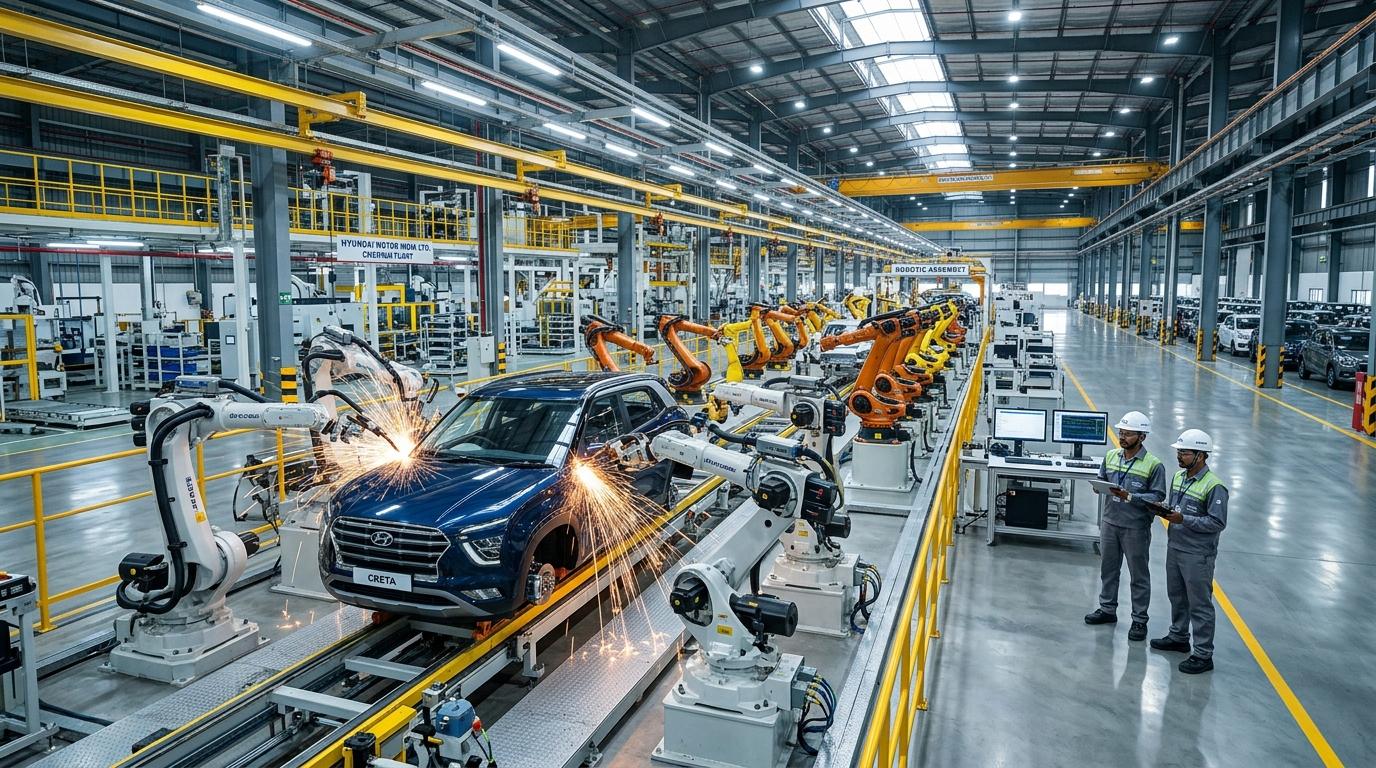
Spanning over 540 acres in the Sriperumbudur automotive corridor, HMIL operates two fully integrated mega plants with an installed annual manufacturing capacity of 824,000 units. The facility incorporates over 650 advanced high-precision industrial robots across the body weld and stamping shops, achieving over 90% automation in critical press and paint operations. The plant is supported by an adjacent dedicated vendor park housing tier-1 Korean and domestic suppliers, enabling an 85%+ component localization rate.
B. Talegaon Plant Acquisition (Pune, Maharashtra)
To resolve Chennai capacity bottlenecks without greenfield land acquisition delays, Hyundai completed the strategic acquisition of General Motors' manufacturing facility in Talegaon, Maharashtra. Following comprehensive re-tooling and modernization, the Talegaon facility adds an incremental 250,000 units of annual vehicle capacity, elevating Hyundai's aggregate Indian manufacturing output to over 1,074,000 vehicles per annum.
5. Comprehensive Financial & Valuation Benchmarking: Hyundai vs. Maruti Suzuki, Tata Motors & M&M
When evaluated against India's leading listed automotive OEMs, Hyundai Motor India commands superior Return on Equity (ROE) and profit conversion efficiency, justified by its premium product positioning:
| Financial & Valuation Metric | Hyundai Motor India (HMIL) | Maruti Suzuki India | Tata Motors (Consolidated) | Mahindra & Mahindra (Auto+Farm) |
|---|---|---|---|---|
| Consolidated Revenue (₹ Cr) | ₹69,829 Cr | ₹1,41,858 Cr | ₹4,37,928 Cr | ₹1,39,078 Cr |
| Operating EBITDA Margin (%) | 13.11% | 11.60% | 14.20% (JLR driven) | 14.50% |
| Net Profit / PAT (₹ Cr) | ₹6,060 Cr | ₹13,209 Cr | ₹31,807 Cr | ₹11,269 Cr |
| Return on Equity (ROE %) | 28.50% | 16.80% | 32.00% | 19.50% |
| SUV Volume Mix (%) | 68.30% | 53.20% | 65.00% | ~100.00% |
| Average Selling Price (ASP) | ~₹10,50,000 | ~₹6,80,000 | ~₹9,80,000 | ~₹14,20,000 |
| Price-to-Earnings (P/E Multiple) | ~26.0x | ~27.5x | ~10.5x | ~30.0x |
| Net Long-Term Debt Status | Net Cash Surplus | Net Cash Surplus | De-leveraging Debt | Conservative Debt |
6. Public Subscription Demand: Analyzing the Mega Issue Absorption
Absorbing an equity issue of ₹27,870 Crore represented an immense test of Indian stock market liquidity. During the subscription window from 15 to 17 October 2024, the issue closed with an overall subscription of 2.37 times.
The demand pattern was marked by a strong divergence between institutional and retail investors:
| Investor Bidding Category | Statutory Quota Allocation | Shares Offered | Final Subscription Multiple |
|---|---|---|---|
| Qualified Institutional Buyers (QIB) | 50% of Net Offer | 2,82,49,160 | 6.97x |
| Non-Institutional Investors (NII) | 15% of Net Offer | 2,11,86,870 | 0.60x |
| Retail Individual Investors (RII) | 35% of Net Offer | 4,94,36,030 | 0.50x |
| Employee Reservation Quota | 7,78,400 Shares | 7,78,400 | 1.74x |
| Consolidated Net Issue Total | 100% | 9,96,40,460 | 2.37x |
Why Retail Participation Was Subdued: While global sovereign funds and mutual funds aggressively secured long-term allocations (QIB 6.97x), retail investors were cautious due to the sheer size of the issue, the 100% OFS structure with zero primary balance-sheet infusion, and near-term cyclical slowing in domestic automobile showroom footfalls.
7. Corporate Governance & Royalty Structure: The 3.5% Parent Tech Royalty Agreement
A central focal point for institutional investors during the IPO roadshow was the contractual royalty arrangement between HMIL and South Korea's Hyundai Motor Company (HMC):
- Statutory Royalty Rate: Hyundai Motor India pays a 3.5% royalty fee on net domestic and export turnover to parent company HMC.
- Technological Value Exchange: In exchange for this royalty fee, HMIL receives comprehensive access to HMC's multi-billion-dollar global R&D ecosystem, including next-generation electric vehicle platforms (E-GMP), autonomous driving ADAS software, crash safety chassis engineering, BlueLink connected telematics, and global bulk raw material procurement discounts.
- Royalty Benchmark Comparison: The 3.5% royalty is comparable to standard multinational automotive arrangements in India (Maruti Suzuki pays ~3.5%–4.0% royalty to Suzuki Motor Corporation, Japan).
8. Electric Vehicle (EV) Transformation & Localized Battery Supply Chain
As India’s automotive landscape transitions toward zero-emission mobility, Hyundai has committed over ₹26,000 Crore over a 10-year period to anchor Tamil Nadu as its primary electric mobility manufacturing center:
- Localized Battery Pack Assembly: Constructing a dedicated battery pack assembly plant near Chennai with an initial annual capacity of 178,000 battery modules, significantly reducing EV cell packaging costs.
- High-Volume Localized EV Launches: Spearheading its mass-market EV expansion with the Hyundai Creta EV, engineered specifically for Indian thermal conditions with localized battery thermal management and high-efficiency air conditioning systems.
- Public Fast-Charging Infrastructure: Rolling out over 500 ultra-fast DC charging stations across key national highways and Tier-1/Tier-2 urban clusters to eliminate consumer range anxiety.
9. Strategic Competitive Strengths vs. Inherent Sectoral Risks
Investors analyzing Hyundai Motor India equity shares must balance its exceptional competitive moats against broader macroeconomic auto sector risks:
Core Strategic Strengths
- India's #1 Passenger Vehicle Exporter: HMIL exports vehicles to over 85 countries across Africa, Latin America, and Southeast Asia, generating natural foreign exchange hedging against raw material imports.
- Dominant High-Margin SUV Mix: With 68%+ of volume in SUVs, Hyundai commands higher realizations and superior pricing power over economy car OEMs.
- Debt-Free Operating Cash Flows: Consistently converts 80%+ of Net Profit into free operating cash flow, self-funding capital expenditure at Talegaon without debt.
- Massive Distribution Network: Over 1,360 sales touchpoints and 1,550 authorized workshops covering more than 1,000 cities across India.
Inherent Sectoral Risks
- Intense Competition in Compact SUVs: Rival domestic OEMs (Tata Motors, Mahindra, Maruti Suzuki) are aggressively launching competing SUV models with competitive pricing.
- 100% OFS Structure: No fresh growth capital was injected into the Indian corporate balance sheet from the ₹27,870 Cr issue proceeds.
- Automotive Demand Cyclicality: Vehicle sales are sensitive to interest rate hikes, inflation, fuel prices, and monsoon effects on rural purchasing power.
- Parent Tech Dependence: Continuous reliance on South Korea's HMC for core intellectual property and powertrain engineering blueprints.
10. Lead Managers, Registrar & Syndicate Intermediaries
The underwriting, book-building, and registry operations for this historic offering were managed by global and domestic investment banks:
- Book Running Lead Managers (BRLMs): Kotak Mahindra Capital Company Limited, Citigroup Global Markets India Private Limited, HSBC Securities and Capital Markets (India) Private Limited, J.P. Morgan India Private Limited, and Morgan Stanley India Company Private Limited.
- Registrar to the Offer: KFin Technologies Limited, responsible for application clearing, basis of allotment reconciliation, and depository share credits.
- Legal Counsels: Shardul Amarchand Mangaldas & Co. (Indian Law) and Latham & Watkins LLP (International Law).
- Auditors: S.R. Batliboi & Associates LLP, Chartered Accountants.
11. Statutory Regulatory Disclosures & Exchange Verification References
All financial parameters, subscription figures, allocation percentages, and operational capacities cited in this analysis are verified against public regulatory filings:
- BSE Limited Official Scrip Portal: BSE Equity Trading Bulletins (Scrip: 544272) .
- National Stock Exchange of India (NSE): NSE Equity Trading Console (Symbol: HYUNDAI) .
- SEBI Public Issues Offer Document Archive: Hyundai Motor India Limited Final Prospectus .
- Registrar Allotment Portal: KFin Technologies IPO Allotment Console .
- Corporate Investor Relations Desk: Hyundai Motor India Official Corporate Portal .
Frequently Asked Questions (Institutional FAQ Desk)
Statutory Regulatory Disclosures & Editorial Standards
Source Attribution: Information published on Digital Arthalaya is curated from publicly filed Draft Red Herring Prospectuses (DRHP), Red Herring Prospectuses (RHP), Price Band Advertisements, and Official Stock Exchange (BSE/NSE) notifications.
Non-Advisory Mandate & Risk Warning: Digital Arthalaya is strictly an independent financial education portal and is not a SEBI-registered investment advisor or stock broker. IPO bidding and equity trading involve market risk, including potential loss of principal. Readers must conduct their own independent due diligence and read all offer documents carefully before making investment commitments.