NSE & BSE Stock Market Holidays 2026: Trading Calendar & Timings | Digital Arthalaya
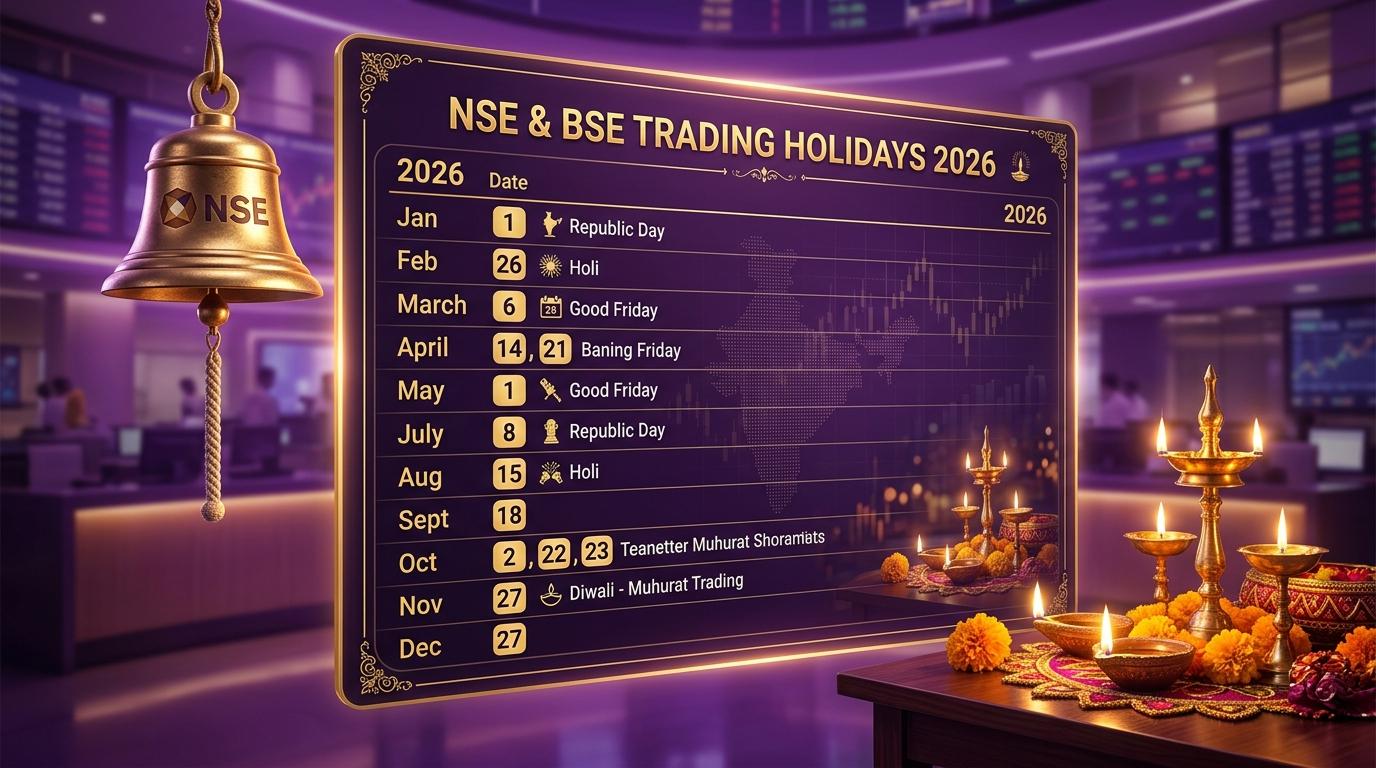
The National Stock Exchange (NSE) and Bombay Stock Exchange (BSE) observe 15 official trading holidays in 2026, alongside standard weekend closures. Key trading dynamics: Regular equity trading operates from 9:15 AM to 3:30 PM preceded by a 15-minute Pre-Open session. On select holidays, the Multi Commodity Exchange (MCX) operates a split schedule with morning closures and active evening sessions (5:00 PM to 11:30/11:55 PM). Under SEBI rules, if an options contract expiry falls on a holiday, it automatically prepones to the preceding business day. The annual Diwali Muhurat Trading session for Samvat 2083 will take place on Sunday, November 8, 2026.
For active intraday traders, positional options strategists, long-term retail investors, and institutional asset managers, maintaining an accurate schedule of stock exchange trading and bank clearing holidays is an essential operational requirement. Trading holidays directly impact open financial positions: they alter options Greeks by accelerating time decay (Theta), defer electronic T+1 rolling settlement cash payouts, advance weekly and monthly derivative expiry contracts, and dictate overnight margin maintenance requirements over three-day or four-day long weekends.
India's primary financial bourses—the National Stock Exchange of India (NSE) and the Bombay Stock Exchange (BSE)—operate standard trading operations five days a week, from Monday through Friday. Trading is suspended on national statutory holidays, significant cultural festivals, and standard weekends. This comprehensive 2026 institutional guide provides the official holiday master calendar across all asset classes (Cash Equities, Equity Derivatives, Currency Derivatives, and Commodities), breaks down session timings, explains clearing corporation settlement pipelines, and details the revered tradition of Diwali Muhurat Trading (Samvat 2083).
1. Standard Trading Session Architecture in India
On normal business days, trading activities across the National Stock Exchange (NSE) and the Bombay Stock Exchange (BSE) are structured into distinct, sequential operational windows mandated by the Securities and Exchange Board of India (SEBI):
| Trading Window | Timings (IST) | Segment & Operational Function |
|---|---|---|
| Pre-Open Order Entry | 9:00 AM – 9:08 AM | Orders can be entered, modified, or canceled. Absorbs overnight domestic and global news flow. |
| Pre-Open Price Discovery | 9:08 AM – 9:12 AM | Call Auction matching mechanism determines equilibrium opening prices; no order edits permitted. |
| Pre-Open Buffer | 9:12 AM – 9:15 AM | Buffer window facilitating smooth technical transition into continuous normal trading. |
| Normal Continuous Trading | 9:15 AM – 3:30 PM | Primary market window for Cash Equities, Equity F&O, and Currency Derivatives. |
| Post-Closing Session | 3:40 PM – 4:00 PM | Orders matched exclusively at the Volume-Weighted Average Closing Price (VWAP). |
| MCX Commodity Trading | 9:00 AM – 11:30 PM / 11:55 PM | Trading in bullion (Gold, Silver), base metals, and energy (Crude Oil, Natural Gas). |
2. Official NSE & BSE Stock Market Holidays 2026 Master Calendar
The following schedule represents the complete official roster of declared trading holidays across the Equity, Equity Derivatives (F&O), and Currency Derivatives segments on both the National Stock Exchange (NSE) and Bombay Stock Exchange (BSE) for calendar year 2026:
| Date | Day of Week | Holiday / Festival Name | NSE / BSE Equity | F&O Segment | MCX Commodity |
|---|---|---|---|---|---|
| 26 January 2026 | Monday | Republic Day | Closed | Closed | Closed (Full Day) |
| 17 February 2026 | Tuesday | Mahashivratri | Closed | Closed | Morning Closed / Evening Open |
| 03 March 2026 | Tuesday | Holi (Dhulivandan) | Closed | Closed | Morning Closed / Evening Open |
| 20 March 2026 | Friday | Id-ul-Fitr (Ramzan Id) | Closed | Closed | Morning Closed / Evening Open |
| 27 March 2026 | Friday | Ram Navami | Closed | Closed | Morning Closed / Evening Open |
| 03 April 2026 | Friday | Good Friday | Closed | Closed | Closed (Full Day) |
| 14 April 2026 | Tuesday | Dr. Baba Saheb Ambedkar Jayanti | Closed | Closed | Morning Closed / Evening Open |
| 01 May 2026 | Friday | Maharashtra Day / Labour Day | Closed | Closed | Morning Closed / Evening Open |
| 28 May 2026 | Thursday | Bakri Id (Id-ul-Zuha) | Closed | Closed | Morning Closed / Evening Open |
| 26 June 2026 | Friday | Muharram | Closed | Closed | Morning Closed / Evening Open |
| 02 October 2026 | Friday | Mahatma Gandhi Jayanti | Closed | Closed | Closed (Full Day) |
| 20 October 2026 | Tuesday | Dussehra (Vijay Dashami) | Closed | Closed | Morning Closed / Evening Open |
| 08 November 2026 | Sunday | Diwali Laxmi Pujan (Muhurat Trading) | Special 1-Hr Session | Special 1-Hr Session | Special 1-Hr Session |
| 10 November 2026 | Tuesday | Diwali Balipratipada | Closed | Closed | Morning Closed / Evening Open |
| 24 November 2026 | Tuesday | Gurunanak Jayanti | Closed | Closed | Morning Closed / Evening Open |
| 25 December 2026 | Friday | Christmas | Closed | Closed | Closed (Full Day) |
3. Weekend Holidays Falling on Saturdays & Sundays (2026)
Several major public holidays and religious festivals coincide with regular exchange weekend closures in 2026. Because stock markets are closed every Saturday and Sunday, no additional compensatory weekday trading closures are declared for these events:
| Date | Day of Week | Holiday / Festival Name | Exchange Status |
|---|---|---|---|
| 31 March 2026 | Tuesday | Mahavir Jayanti | Standard Trading Day (Regular Session) |
| 15 August 2026 | Saturday | Independence Day | Standard Weekend Closure |
| 08 November 2026 | Sunday | Diwali (Laxmi Pujan) | Special 1-Hour Evening Muhurat Session |
4. Deep-Dive: Diwali Muhurat Trading 2026 (Samvat 2083)
The sacred tradition of Muhurat Trading is a unique financial and cultural heritage of Dalal Street, dating back to 1957 on the Bombay Stock Exchange (BSE) and 1992 on the National Stock Exchange (NSE). Conducted on the auspicious evening of Diwali (Laxmi Pujan), this special 60-minute trading window marks the formal inauguration of the traditional Hindu financial calendar year, Samvat 2083.
Key Traditions of Muhurat Trading
1. Chopda Pujan & Ledger Consecration: Brokerage firms, proprietary desks, and traditional merchant families conduct ritual worship of fresh account ledgers (Chopda), seeking blessings from Goddess Lakshmi (Prosperity) and Lord Ganesha (Wisdom) for the coming financial year.
2. Auspicious Token Investments: Market participants refrain from aggressive intraday shorting or speculative churning. Instead, investors place symbolic buy orders in fundamentally robust blue-chip companies, large-cap index funds, or Sovereign Gold Bonds/Gold ETFs (Gold BeES) to hold as permanent family wealth.
3. Historic Bullish Bias: Across decades of historical data, the benchmark NIFTY 50 and S&P BSE SENSEX have closed in green territory during more than 80% of all Muhurat trading sessions, fueled by festive retail enthusiasm and symbolic institutional purchases.
4. Timings & Pre-Open Window: Exchange circulars formally announce the exact 60-minute window (typically between 6:00 PM and 7:15 PM IST) two weeks prior to Diwali, including an initial 8-minute pre-open price discovery phase.
5. MCX Commodity Trading Holiday Rules: Morning vs. Evening Sessions
Unlike equity exchanges which remain completely shut on designated holidays, the Multi Commodity Exchange (MCX) operates an intelligent dual-shift trading model designed to mirror global international commodity trading hubs:
How MCX Session Splitting Works
1. Morning Session (9:00 AM – 5:00 PM): On cultural holidays such as Mahashivratri, Holi, Ram Navami, Maharashtra Day, and Dussehra, domestic spot physical mandis and banking channels are shut. Consequently, MCX halts trading during the morning shift.
2. Evening Session (5:00 PM – 11:30 PM / 11:55 PM): At 5:00 PM IST, major international commodity exchanges—including the New York Mercantile Exchange (NYMEX), Commodity Exchange (COMEX), and London Metal Exchange (LME)—are in the middle of active daytime trading. To allow Indian domestic jewelers, metal importers, and hedge funds to manage global price shocks in Gold, Silver, Crude Oil, and Natural Gas, MCX reopens for full trading during the evening shift.
3. Full-Day National Closures: On three statutory national holidays—Republic Day (Jan 26), Good Friday (Apr 3), Gandhi Jayanti (Oct 2), and Christmas (Dec 25)—the MCX remains completely closed for both the morning and evening sessions.
6. T+1 Settlement Mechanics & Bank Clearing Holidays
India completed its monumental migration to a universal T+1 rolling settlement cycle in January 2023, making Dalal Street the fastest-settling major capital market in the world. However, market holidays introduce specific clearing delays that traders must anticipate:
A. Trading Holidays vs. Bank Clearing Holidays
An exchange trading holiday must not be confused with a commercial bank clearing holiday:
- Exchanges Open, Banks Closed (e.g., April 1 Annual Bank Closing): On April 1 each year, commercial banks close their customer counters to finalize annual accounts. The NSE and BSE remain fully open for trading. However, because bank RTGS/NEFT inter-bank clearing is restricted, stock settlement payouts and funds withdrawal requests are deferred to the following business day.
- Exchanges Closed, Banks Open: On regional or cultural holidays where commercial banks operate but exchanges are closed, trading is halted, but off-market depository transfers and UPI mandate setups can proceed.
B. The 3-Day Weekend Settlement Pipeline
When an exchange holiday falls on a Friday or a Monday, it creates a three-day weekend that alters standard T+1 settlement:
- If you purchase shares on Thursday and Friday is a declared market holiday, your trade does NOT settle on Friday. The settlement obligation shifts to Monday afternoon. The purchased shares will reflect in your Demat account as settled securities only on Monday evening.
- If you sell shares on Thursday, your 80% immediate margin credit may be usable for intraday trades on Thursday, but the remaining 20% sale proceeds and full bank withdrawal capability will become available only on Monday.
C. Impact on Mutual Fund SIPs & IPO Bidding
Trading holidays alter retail primary market operations:
- Mutual Fund SIP Execution: If your automated monthly SIP installment date falls on a market holiday or weekend, your bank account is debited on the next banking day, and mutual fund units are allotted at the official Net Asset Value (NAV) computed at the close of that next business day.
- IPO Bidding Timelines: Exchange electronic bidding networks for Mainboard and SME IPOs operate only between 10:00 AM and 5:00 PM on official exchange working days. No exchange bids can be submitted on holidays, although offline investor applications can be queued via broker mobile apps.
7. Derivatives (F&O) Expiry Preponement & Greek Risk Over Holidays
Trading holidays introduce profound volatility and structural shifts for options traders, futures participants, and algorithmic trading desks:
The Mandatory SEBI Expiry Preponement Rule
Under SEBI's Master Circular on Exchange-Traded Derivatives, if a scheduled contract expiry date (such as Thursday for NIFTY 50 monthly options or Wednesday for Bank Nifty weekly contracts) falls on a declared exchange trading holiday, the expiry date of that contract automatically prepones to the immediate preceding trading business day.
Example: If Thursday, May 28 (Bakri Id) is a market holiday, all derivative contracts originally scheduled to expire on Thursday will formally expire at 3:30 PM on Wednesday, May 27. Traders must adjust their roll-over calendar accordingly.
Options Greek Dynamics: The Holiday Theta Decay Phenomenon
Options pricing models (Black-Scholes) calculate time value continuously across every calendar second, not merely during market trading hours. Over a 3-day or 4-day holiday weekend:
- Accelerated Theta Erosion: Buyers of naked out-of-the-money (OTM) Call and Put options experience severe premium decay (Theta bleed). Three full days of time value evaporate without any market price movement.
- Options Sellers' Edge: Positional option sellers (strangle, straddle, and iron condor writers) collect significant time decay over long weekends, provided market opening prices on the subsequent business day remain within their breakeven ranges.
- Weekend Global Gap Risk: While domestic Indian bourses are closed on holidays like Good Friday or Maharashtra Day, global financial hubs—including Wall Street (US), London (UK), Frankfurt (Germany), and Tokyo (Japan)—continue continuous trading. Unanticipated geopolitical escalations, US Federal Reserve interest rate pronouncements, or crude oil shocks can trigger massive 200-to-400 point gap-up or gap-down openings when the NIFTY 50 reopens on Monday morning.
8. Placing Orders on Market Holidays: AMO & GTT Mechanics
Even when live market matching is suspended, modern retail trading platforms (such as Zerodha, Upstox, Groww, Angel One, and ICICI Direct) provide specialized order routing facilities:
A. After Market Orders (AMO)
An After Market Order allows investors to submit buy or sell orders outside standard market hours or during trading holidays. Brokers collect and validate AMO orders, verify available trading cash balances or depository holdings, and queue them on internal servers. At 9:00 AM on the immediate next business day, the broker's automated gateway transmits these orders into the stock exchange's Pre-Open order book for competitive price discovery.
B. Good-Till-Triggered (GTT) Orders
GTT orders are persistent, conditional trigger instructions that remain valid for up to one year. Because GTT triggers are monitored on the broker's cloud servers rather than the exchange order book, placing or modifying GTT stop-loss and target triggers on holidays functions seamlessly without exchange connectivity.
C. Depository Pledging & Unpledging Restrictions
While cash deposits via UPI 2.0 gateways are reflected in trading margins instantly 24/7, pledging shares from your Demat account to generate collateral trading margin cannot be settled on clearing holidays. Depository lien creations require CDSL/NSDL processing, which executes only on standard depository working days.
9. Essential Risk Management Checklist for Traders Over Long Weekends
To avoid catastrophic margin shortfalls, forced auto-square-offs, or unexpected overnight losses, disciplined traders follow this institutional long-weekend risk protocol:
- Convert Naked Positions to Defined-Risk Spreads: Never carry naked long or short options into a 3-day holiday weekend. Transform vulnerable positions into hedged spreads (such as Bull Call Spreads, Bear Put Spreads, or Iron Condors) where maximum loss is mathematically capped regardless of overnight global gaps.
- Account for Margin Trading Facility (MTF) Interest: If you utilize broker Margin Trading Facilities to hold leveraged equity delivery positions, remember that MTF interest (typically 15% to 18% annualized) accrues on a 365-day calendar basis. You are charged interest for Saturday, Sunday, and the holiday Monday! Factor this financing cost into your expected trade returns.
- Maintain a 30% Surplus Margin Buffer: Unfunded Mark-to-Market (MTM) debits from Friday's session can trigger broker peak margin penalty shortfalls. Ensure your trading account carries an idle cash buffer of at least 25% to 30% above peak margin requirements prior to the holiday market close.
- Plan Bank Fund Withdrawals in Advance: If you require liquidity for festive expenses during Diwali or Holi, initiate bank withdrawal requests at least two business days prior to the holiday. Withdrawing settled funds on a bank holiday will result in the payout remaining queued until the following working banking day.
10. Statutory Regulatory References & Official Frameworks
The operational schedules, trading hours, derivative contract expirations, and clearing mechanisms detailed in this guide are governed by statutory circulars issued by market regulators and licensed exchanges:
- National Stock Exchange of India (NSE India): Official master circular detailing trading holidays, special sessions, and clearing dates across Equity, F&O, and Currency segments at NSE Trading Holidays Portal.
- Bombay Stock Exchange (BSE India): Official holiday calendar, session timings, and clearing house schedules at BSE Holiday Calendar.
- Multi Commodity Exchange of India (MCX): Circulars establishing commodity market session splitting (morning vs. evening timings) and annual trading calendars at MCX India.
- Securities and Exchange Board of India (SEBI): Master Circular for Stock Exchanges and Clearing Corporations governing pre-open call auctions, contract expiry preponement, and disaster recovery drills at SEBI Legal Portal.
- Reserve Bank of India (RBI): Official calendar of public and commercial bank clearing holidays under the Negotiable Instruments Act at Reserve Bank of India.
Frequently Asked Questions (Institutional FAQ Desk)
Educational & Regulatory Disclosures
Source Attribution: This masterclass educational guide is produced strictly for investor awareness and capital markets literacy in alignment with SEBI Investor Education and Protection Fund (IEPF) guidelines.
Non-Advisory Mandate & Risk Warning: Digital Arthalaya is strictly an independent financial education portal and is not a SEBI-registered investment advisor or stock broker. IPO bidding and equity trading involve market risk, including potential loss of principal. Readers must conduct their own independent due diligence and read all offer documents carefully before making investment commitments.