Share Buyback Rules & Taxation in India (2026): Tender Offer vs Open Market, 15% Retail Quota & Section 2(22)(f) Rules
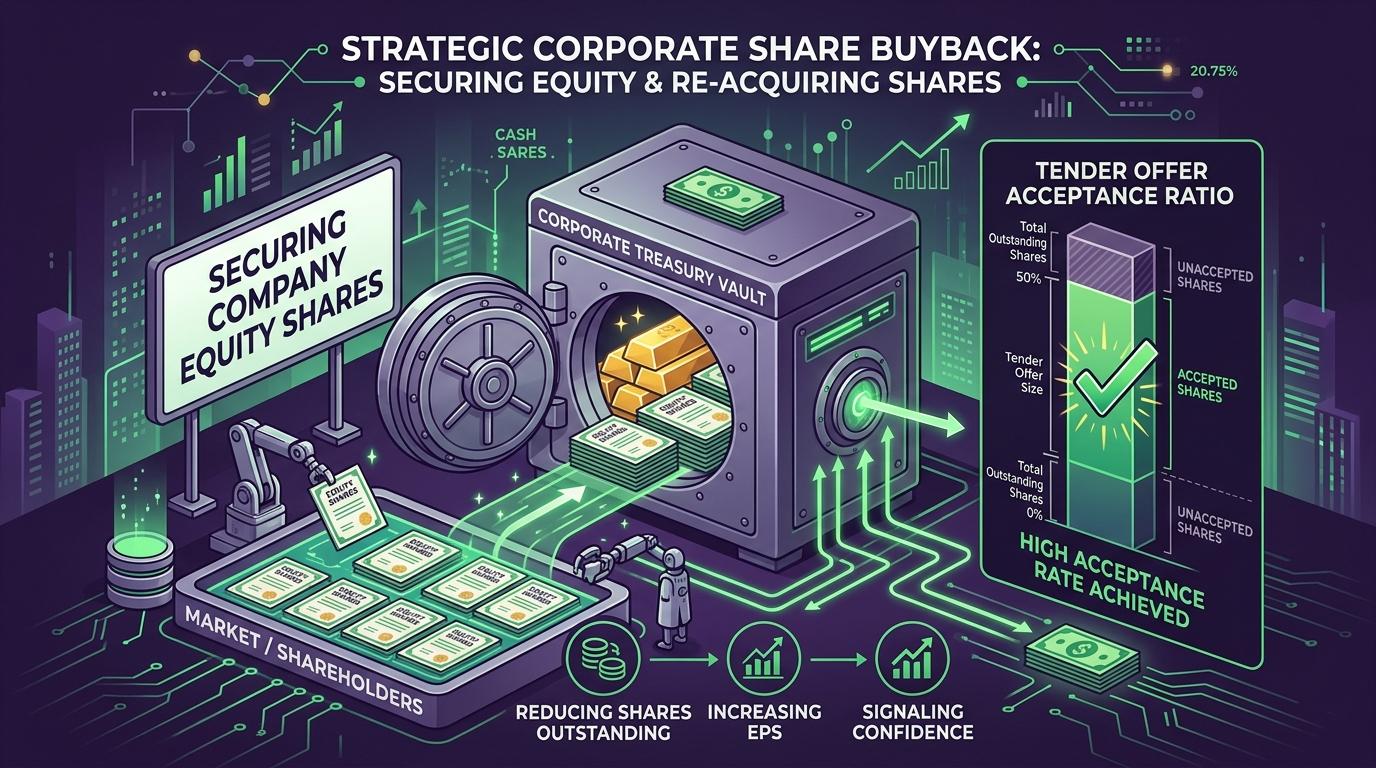
A corporate share buyback occurs when a cash-rich listed company repurchases its own shares from existing shareholders, effectively extinguishing equity and boosting Earnings Per Share (EPS). Under the Finance (No. 2) Act 2024, the taxation of Indian share buybacks underwent a historic transformation: effective 1 October 2024, the former 20% corporate buyback tax under Section 115QA was abolished. Instead, the gross buyback consideration is treated as a 'Deemed Dividend' under Section 2(22)(f), taxable in the hands of shareholders at their applicable marginal income tax slab rates, subject to 10% TDS under Section 194. Concurrently, the original cost of acquisition of tendered shares is recognized as an allowable Capital Loss (STCL or LTCL) under Section 70 and 71, which can be offset against current or future taxable capital gains.
When a listed corporate enterprise generates substantial operating cash flows but exhausts high-return internal reinvestment avenues, management faces a pivotal capital allocation decision: reinvest surplus cash into lower-return projects, hoard liquid treasury assets on the balance sheet, distribute cash via regular dividends, or repurchase its own equity shares through a Share Buyback.
For Indian retail and institutional investors, share buybacks have historically served as a premier tax-efficient vehicle for receiving surplus capital at an attractive premium over market price. However, with the enactment of the Finance (No. 2) Act 2024, India's buyback taxation architecture underwent its most profound restructuring in decades. Effective 1 October 2024, the former company-level 20% buyback tax under Section 115QA was abolished, shifting the tax incidence entirely onto individual shareholders under Section 2(22)(f) as deemed dividends, while creating an allowable capital loss mechanism for cost recovery.
In this comprehensive master guide, Digital Arthalaya provides an exhaustive breakdown of the legal mechanics, SEBI corporate governance frameworks, the 15% small shareholder reservation, step-by-step bidding protocols, and the mathematical implications of post-Budget 2024 taxation.
1. What is a Share Buyback? Capital Allocation and Corporate Rationale
A share buyback—also termed a share repurchase—is a corporate financial transaction wherein a listed company repurchases a designated percentage of its outstanding equity shares from existing shareholders using its distributable profits or securities premium reserve.
Once repurchased, Indian law strictly mandates that the repurchased shares cannot be held as treasury stock. Under Section 68(7) of the Companies Act, 2013, the company must physically or electronically extinguish and destroy the bought-back equity securities within 7 days of completion of the buyback. This permanent reduction in total outstanding share count drives critical financial enhancements:
- Earnings Per Share (EPS) Accretion: Because the company's net income is subsequently divided across a smaller pool of outstanding shares, EPS expands automatically, even without immediate operating earnings growth.
- Return on Equity (ROE) & Capital Efficiency: By deploying unproductive cash sitting in low-yielding bank deposits to reduce equity capital, the company's Return on Equity ($ROE = \text{Net Income} / \text{Shareholders' Equity}$) and Return on Capital Employed (ROCE) improve substantially.
- Undervaluation Signaling: Corporate management possess superior visibility into the firm's forward cash flows and competitive advantages. When a board authorizes a buyback at a significant premium to the prevailing market price, it signals to the wider capital market that the company's intrinsic value is materially underappreciated.
- Defensive Promoter Consolidation: When non-promoter public shareholders tender their shares, the overall public equity base shrinks. Consequently, the promoter group's relative ownership percentage expands proportionally without requiring promoters to inject personal capital, strengthening defense against hostile takeovers (subject to SEBI's 75% maximum promoter holding ceiling).
2. Statutory Corporate Governance Framework: Companies Act, 2013
In India, corporate buybacks are strictly regulated under Sections 68, 69, and 70 of the Companies Act, 2013, read alongside the Companies (Share Capital and Debentures) Rules, 2014:
- Permissible Sources of Funds (Section 68(1)): A company may finance its buyback exclusively out of:
- Its accumulated free reserves;
- Its securities premium account; or
- The proceeds of the issue of any shares or other specified securities (provided no buyback is financed from the proceeds of an earlier issue of the same kind of shares).
- Statutory Size Limits (Section 68(2)):
- Board Resolution Route: The Board of Directors can independently authorize a buyback of up to 10% of the total paid-up equity capital and free reserves of the company.
- Special Resolution Route: Any buyback exceeding 10% up to the statutory ceiling of 25% of the aggregate paid-up capital and free reserves requires shareholder approval via a special resolution passed through postal ballot or electronic voting.
- Total Share Limit: The buyback cannot exceed 25% of the total number of outstanding equity shares in that financial year.
- Debt-to-Equity Solvency Test (Section 68(2)(d)): Post-buyback, the ratio of aggregate secured and unsecured debts owed by the company must not exceed twice (2:1) the paid-up capital and free reserves ($Debt / Equity \le 2.0$).
- Cooling-Off Period (Section 68(8)): Once a buyback is concluded, the company is legally barred from making a fresh issue of the same kind of shares within a period of 6 months (except by way of bonus shares or conversion of existing warrants/ESOPs). Furthermore, a company cannot announce another buyback within a 1-year cooling-off window from the closure of the preceding buyback.
3. SEBI Buyback Routes: Tender Offer vs. Open Market
Under the SEBI (Buy-Back of Securities) Regulations, 2018, a listed issuer can execute a repurchase through two primary operational mechanisms:
| Operational Parameter | Tender Offer Mechanism (Preferred Route) | Open Market Purchase via Stock Exchange |
|---|---|---|
| Offer Price Mechanism | Fixed Price: Set at a fixed premium (e.g. ₹4,500 vs. ₹3,800 market price) | Variable Ceiling: Repurchases at prevailing market prices up to a maximum price |
| Participation Eligibility | All shareholders holding shares on the official Record Date | Anonymous secondary market sellers executing normal trading terminal sell orders |
| Small Shareholder (Retail) Quota | Mandatory 15% Reservation | No Quota / No Reservation |
| Execution Duration | Fixed tender bidding window (typically 5 working days) | Spans across several months (phased out by SEBI) |
| Capital Certainty | Company is legally obligated to accept committed quota | Company can utilize minimum 75% of earmarked buyback capital |
| Regulatory Direction | Universal Industry Standard: 100% promoted by SEBI | Phased Out: SEBI circular mandates sunsetting open market route |
Due to transparency concerns where companies failed to utilize 100% of declared open-market funds, SEBI mandated the progressive phase-out of the open-market purchase route, establishing the Tender Offer Mechanism as the institutional benchmark for corporate India.
4. The 15% Small Shareholder (Retail) Reservation
One of the most lucrative structural advantages created by SEBI for retail investors is the Small Shareholder Quota codified under Regulation 6 of the SEBI Buy-Back Regulations:
- Definition of a Small Shareholder: A shareholder who holds equity shares whose aggregate market value—calculated on the basis of the closing market price on the recognized stock exchange with the highest trading volume on the Record Date—does not exceed ₹2,00,000 (Rupees Two Lakhs).
- Mandatory 15% Carve-Out: The company must reserve either:
- 15% of the total number of securities proposed to be bought back; or
- The number of securities to which small shareholders are entitled as per their holding ratio;
- Retail Arbitrage Mechanics: Because general institutional investors (holding portfolios > ₹2 Lakhs) cannot participate in the small shareholder pool, retail investors enjoy a substantially higher Entitlement Ratio and Acceptance Ratio. In historical buybacks by IT giants like TCS, Wipro, and Infosys, retail acceptance ratios have frequently ranged between 30% and 100%, enabling astute retail investors to capture attractive short-term arbitrage spreads.
5. The Post-Budget 2024 Tax Paradigm Shift: Section 2(22)(f) Deemed Dividend
For over a decade, Indian corporate buybacks enjoyed a unique tax status. Under Section 115QA of the Income Tax Act, the distributing company paid an effective 23.296% corporate buyback tax (20% base tax + 12% surcharge + 4% cess) directly to the government, and the proceeds were entirely tax-free in the hands of the shareholder under Section 10(34A).
However, the Finance (No. 2) Act, 2024 completely abolished this mechanism for all buybacks executed on or after 1 October 2024, aligning buybacks with the dividend taxation framework:
| Statutory Parameter | Pre-1 October 2024 Regime (Abolished) | Post-Budget 2024 Regime (Current Law) |
|---|---|---|
| Governing Tax Section | Section 115QA & Section 10(34A) | Section 2(22)(f) & Section 194 |
| Tax Paying Entity | Distributing Company (23.296% Flat Tax) | Individual Shareholder |
| Tax Rate Applicable | Nil for Shareholder (Exempt) | Shareholder's Marginal Income Tax Slab Rate (Up to 39%) |
| Tax Deducted at Source (TDS) | No TDS | 10% TDS under Section 194 (Threshold: ₹5,000 for residents) |
| Treatment of Purchase Cost | Absorbed in corporate tax computation | Recognized as an Allowable Capital Loss (STCL / LTCL) |
| Impact on Low-Income Investors | Disadvantaged (Incurred indirect 23.3% tax drag) | Highly Favorable: Taxed at 0%, 5%, or 10% slab rates |
| Impact on HNIs & Corporates | Highly Advantageous (23.3% vs. 39% slab) | Less Attractive: Taxed at highest marginal rate of 35.88% - 39% |
6. Capital Loss Setoff Mechanism under Section 70 and Section 71
Under the amended Income Tax provisions, while the entire gross consideration received from the buyback is taxed as income from other sources (deemed dividend), the Cost of Acquisition (original purchase price) of the tendered shares does not disappear. Instead, the law treats the tendering of shares as a disposition where the Full Value of Consideration for Capital Gains computation is deemed to be NIL.
Consequently, the investor generates an artificial Capital Loss exactly equal to the original purchase cost of the tendered shares:
Capital Loss = Full Value of Consideration (₹0) - Cost of Acquisition
This statutory capital loss provides immense strategic tax shielding under Sections 70 and 71 of the Income Tax Act:
- Short-Term Capital Loss (STCL): If the tendered shares were held for 12 months or less, the purchase cost is classified as an STCL. Under Section 70, an STCL can be set off against both Short-Term Capital Gains (STCG) and Long-Term Capital Gains (LTCG) across all asset classes (equities, mutual funds, real estate, gold).
- Long-Term Capital Loss (LTCL): If the shares were held for more than 12 months, the purchase cost is classified as an LTCL. Under Section 70, an LTCL can only be set off against Long-Term Capital Gains (LTCG).
- 8-Year Carry-Forward: If the investor does not possess sufficient capital gains in the current financial year to absorb the capital loss, the unabsorbed loss can be carried forward for up to 8 consecutive Assessment Years, provided the income tax return (ITR) is filed on or before the statutory due date under Section 139(1).
7. Comprehensive Mathematical Case Study: How Post-2024 Taxation Actually Works
To understand the interplay between the Deemed Dividend tax and the Capital Loss setoff, consider an illustrative real-world scenario:
| Step | Transaction Parameter | Numerical Value |
|---|---|---|
| 1 | Original Shares Purchased (100 shares @ ₹3,000/share) | ₹3,00,000 Total Cost of Acquisition |
| 2 | Company Announces Buyback Offer Price | ₹4,000 per share |
| 3 | Shares Successfully Tendered & Accepted | 100 shares |
| 4 | Gross Buyback Proceeds (100 shares × ₹4,000) | ₹4,00,000 |
| 5 | Taxable Deemed Dividend under Sec 2(22)(f) | ₹4,00,000 (Taxed at investor's slab rate) |
| 6 | TDS Deducted by Company (10% under Sec 194) | ₹40,000 (Directly credited to Form 26AS / AIS) |
| 7 | Net Cash Received in Bank Account | ₹3,60,000 |
| 8 | Capital Loss Generated (₹0 Consideration - ₹3,00,000 Cost) | -₹3,00,000 (Allowable STCL or LTCL) |
| 9 | Tax Shield Value of Capital Loss (against 20% STCG / 12.5% LTCG) | ₹37,500 to ₹60,000 in saved taxes |
As demonstrated, while high-income investors face upfront slab-rate dividend taxation, investors with active capital gains across their broader portfolio can utilize the substantial capital loss to offset significant tax liabilities on profitable stock or real estate transactions.
8. Step-by-Step Guide: How to Tender Shares in a Buyback via Stockbroker
Participating in a tender offer buyback is entirely digital and executed through your stockbroker's depository interface:
- Check Record Date Eligibility: You must hold the shares in your Demat account at the end of trading hours on the company's official Record Date. Under India's T+1 settlement cycle, you must purchase shares at least one trading day prior to the record date.
- Receive Tender Form & Entitlement Letter: Following the record date, the registrar (e.g. Link Intime or KFintech) emails an official Tender Form disclosing your exact Number of Shares Held and your confirmed Entitlement Quantity.
- Access Broker Corporate Actions Portal:
- Zerodha: Log in to Console → Portfolio → Corporate Actions → Select Buyback → Enter bid quantity.
- Upstox: Open app → Account → Corporate Actions → Select issue → Click Apply.
- Groww: Profile → All Orders → IPO & Corporate Actions → Buybacks.
- Authorize CDSL / NSDL Demat Debit: Enter your 6-digit CDSL T-PIN and enter the OTP received on your mobile to authorize the electronic transfer of shares to the clearing corporation's escrow pool.
- Fund Settlement & Return of Unaccepted Shares: On the settlement date, the consideration for accepted shares is credited directly to your primary bank account, while any unaccepted shares are released from the lien and returned back into your active Demat portfolio.
9. Strategic Investor Considerations & Risk Audit
Before tendering shares in a corporate buyback, institutional portfolio managers evaluate three crucial risk parameters:
- Acceptance Ratio Uncertainty: If you purchase shares specifically for arbitrage immediately prior to the record date, a lower-than-anticipated acceptance ratio leaves you holding residual shares. If the share price corrects post-buyback closure, capital losses on residual shares can erode the arbitrage profit made on accepted shares.
- Opportunity Cost of Tendering: Once shares are tendered during the bidding window, they are locked in escrow and cannot be traded or sold on the exchange screen. If the broader market rallies significantly during the 7-day settlement period, you surrender liquidity.
- Tax Slab Optimization: For investors in the 30% to 39% marginal tax brackets who do not have offsetting capital gains, tendering in buybacks creates immediate ordinary income tax liabilities. Such investors may achieve superior post-tax returns by holding the shares long-term and realizing gains under the concessional 12.5% LTCG regime instead.
10. Statutory Regulatory References & Official Frameworks
Corporate buyback regulations, tender offer protocols, and taxation rules in India are governed by the following statutory regulatory statutes:
- Companies Act, 2013 (Sections 68, 69, 70): Statutory corporate law framework governing buyback authorization, reserve utilization, and post-buyback capital restructuring via the Ministry of Corporate Affairs (MCA) Portal.
- SEBI (Buy-Back of Securities) Regulations, 2018: Comprehensive regulatory directives prescribing tender offer procedures, 15% small shareholder reservations, and disclosure standards on the SEBI Buy-Back Regulations Archive.
- Finance (No. 2) Act, 2024 & Income Tax Act, 1961: Governing statutory amendments introducing Section 2(22)(f) Deemed Dividend taxation and capital loss provisions documented by the Income Tax Department of India.
- National Stock Exchange of India (NSE) & BSE Corporate Actions Console: Official platforms for monitoring live public issue buyback schedules and bidding windows via NSE India.
Frequently Asked Questions (Institutional FAQ Desk)
Educational & Regulatory Disclosures
Source Attribution: This masterclass educational guide is produced strictly for investor awareness and capital markets literacy in alignment with SEBI Investor Education and Protection Fund (IEPF) guidelines.
Non-Advisory Mandate & Risk Warning: Digital Arthalaya is strictly an independent financial education portal and is not a SEBI-registered investment advisor or stock broker. IPO bidding and equity trading involve market risk, including potential loss of principal. Readers must conduct their own independent due diligence and read all offer documents carefully before making investment commitments.