Rights Issue Meaning & How to Apply: Complete RE & ASBA Guide | DA
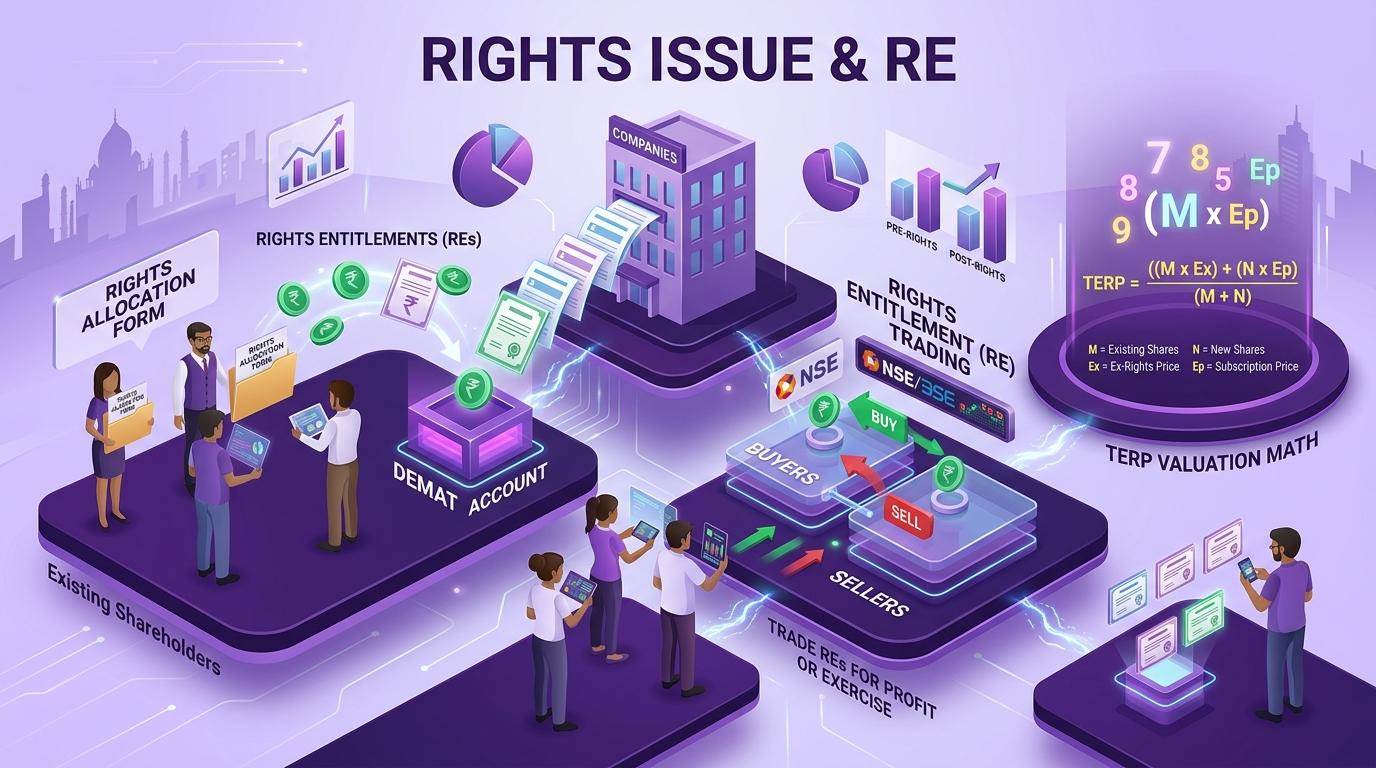
A Rights Issue is a secondary capital raising mechanism under Section 62(1)(a) of the Companies Act, 2013 and SEBI ICDR Regulations, inviting existing shareholders on a record date to purchase new shares at a discounted offer price. Eligible investors receive dematerialized Rights Entitlements (RE) in their Demat accounts under a temporary ISIN. Shareholders have three actionable choices: (1) Apply for discounted rights shares via Net Banking ASBA or UPI (up to ₹5 Lakh limit); (2) Sell/renounce REs on the NSE/BSE BE series order book for cash; or (3) Renounce off-market. Inaction causes complete forfeiture of RE value and permanent equity dilution. Exchange-traded RE sale proceeds are taxed as Short-Term Capital Gains (STCG) at 20% under Section 111A following the Finance (No. 2) Act, 2024.
When a listed corporation on the National Stock Exchange (NSE) or Bombay Stock Exchange (BSE) requires substantial secondary capital to fund multi-thousand-crore manufacturing expansions, acquire strategic corporate competitors, or deleverage its corporate balance sheet, it frequently executes a Rights Issue. Notable Indian corporate giants—including Reliance Industries (₹53,125 Crore landmark rights issue), Bharti Airtel, Tata Motors, L&T Finance, and Suzlon Energy—have raised tens of thousands of crores through this pre-emptive corporate action.
However, many retail shareholders are surprised when temporary securities ending with the suffix "-RE" (e.g., RELIANCE-RE, AIRTEL-RE, or TATACHEM-RE) suddenly appear in their Demat portfolios. If an investor does not understand the regulatory framework governing Rights Entitlements (REs), these instruments will permanently expire worthless on the issue closing date, causing irreversible dilution of ownership and financial capital loss. This comprehensive 2026 guide provides an exhaustive institutional breakdown of Rights Issues, explains the mathematical mechanics of Theoretical Ex-Rights Price (TERP), details how to trade REs on the stock exchange, outlines the post-Finance Act 2024 taxation rules, and provides a step-by-step Net Banking ASBA application walkthrough.
1. What is a Rights Issue? Corporate Mechanics & Legal Purpose
Under Section 62(1)(a) of the Companies Act, 2013 and the Securities and Exchange Board of India (Issue of Capital and Disclosure Requirements) Regulations, 2018 (SEBI ICDR Regulations), a Rights Issue is a secondary capital raising mechanism wherein an already-listed company offers new equity shares to its existing equity shareholders. This offer is made strictly in proportion to the number of shares held by each investor on a designated Record Date.
The foundational corporate governance principle underpinning rights issues is the doctrine of Pre-emptive Rights (First Right of Refusal). Corporate law mandates that before a public company dilutes equity ownership by issuing shares to external third parties, it must first offer those shares to existing shareholders. This guarantees that long-term investors can protect their proportionate voting power and ownership interest against unwanted dilution.
Why Listed Companies Choose Rights Issues Over Other Routes
1. Maintaining Shareholder Loyalty Through Discounted Pricing: Rights issues are priced at a substantial discount (typically 15% to 40% below the prevailing market price). This provides a tangible, direct financial reward for loyal shareholders who support the company's growth vision.
2. Rapid Balance Sheet Deleveraging: Capital-intensive infrastructure, energy, and telecom enterprises frequently issue rights to retire expensive debt obligations. For example, Suzlon Energy utilized its landmark rights issue proceeds to systematically reduce bank borrowings, fundamentally strengthening its debt-to-equity ratio.
3. Faster Timelines & Lower Underwriting Costs: Unlike a public Follow-on Public Offer (FPO) which requires nationwide marketing, distributor commissions, and intensive public roadshows, a rights issue targets an existing, KYC-verified shareholder base. Under SEBI's reformed fast-track framework, procedural timelines have been compressed toward a target 23 working days turnaround from Board approval to listing.
4. Fair Ownership Preservation: If all existing shareholders subscribe to their full entitlement, the promoter and public ownership percentages remain identical before and after the issue.
2. Understanding Rights Entitlements (RE): The Demat Security You Cannot Ignore
Prior to January 2020, rights entitlements existed as cumbersome physical paper forms (Composite Application Forms or CAFs), making renunciation difficult for retail investors. To modernize primary and secondary markets, SEBI issued Circular SEBI/HO/CFD/DIL2/CIR/P/2020/13, introducing **Dematerialized Rights Entitlements (REs)**.
Under this electronic architecture, Rights Entitlements are distinct financial instruments possessing the following statutory characteristics:
- Automatic Depository Credit: You do not need to apply to receive REs. If you own shares on the Record Date (settled in your Demat account under India's mandatory T+1 settlement cycle), the registrar calculates your entitlement based on the declared ratio (e.g., 1:4 or 2:7) and credits the REs directly into your Demat account before the issue opens.
- Dedicated Ticker & Temporary ISIN: Depositories (NSDL and CDSL) assign a temporary International Securities Identification Number (ISIN) to the entitlement. The instrument trades on the NSE and BSE order book with an
-REsuffix (for instance,RELIANCE-REorAIRTEL-RE). - Trade-to-Trade (BE Segment) Settlement: REs trade strictly in the Trade-to-Trade segment (Series BE on NSE). This mandates 100% upfront delivery. You cannot buy REs on intraday margin, short sell them, or square off positions intraday.
- Strict Trading Window: The RE trading window commences on the day the Rights Issue opens and closes approximately 3 to 4 working days prior to the official issue close date. After this trading window closes, REs cannot be bought or sold on the exchange.
3. The Three Choices for a Shareholder: What Must You Do?
When you discover `-RE` securities credited to your Demat account, taking no action is a critical mistake. Every shareholder has exactly three legitimate courses of action:
| Action Choice | Execution Channel | Cash Flow Impact | Portfolio & Dilution Outcome |
|---|---|---|---|
| Option 1: Exercise (Apply for Rights Shares) | Submit bid via Net Banking ASBA or UPI mandate before issue closes. | Cash Outflow (Rights Issue Price × Number of Shares). | Zero dilution. New equity shares credited to Demat at a discount. |
| Option 2: Renounce on Market (Sell RE on Exchange) | Execute regular Sell order for the `-RE` ticker during open trading window. | Cash Inflow (Net sale proceeds credited to trading balance). | Cash compensates for dilution. Shareholding percentage modestly decreases. |
| Option 3: Renounce Off-Market | Submit physical/electronic Delivery Instruction Slip (DIS/e-DIS) via CDSL/NSDL. | Direct settlement between buyer and seller outside exchange. | Buyer receives REs and applies via ASBA; seller receives agreed consideration. |
| FATAL MISTAKE: Do Nothing (Lapse) | Ignore the notification and take zero action. | ₹0 cash received (Total capital loss of RE value). | REs vanish permanently. Parent shares dilute in value on ex-date! |
The Mathematical Cost of Inaction
Why is "doing nothing" disastrous? When a company issues shares at a discount, the expanded share capital automatically causes the stock price to adjust downward on Dalal Street. If you do not exercise your REs to acquire the cheap shares, or sell your REs on the stock exchange to pocket the cash value of that discount, you suffer a double loss: your ownership stake is permanently diluted, and the market value of your existing shares decreases without any compensating cash inflow.
4. The Mathematics: TERP, RE Fair Value & Dilution Formulas
Institutional market participants determine whether a Rights Issue is financially lucrative by calculating two core mathematical formulas:
1. Theoretical Ex-Rights Price (TERP) Formula
The Theoretical Ex-Rights Price (TERP) represents the fair equilibrium market price of a stock on the Ex-Rights Date after accounting for the influx of new capital and shares:
TERP = [(Existing Shares × Current Market Price) + (Rights Shares × Rights Issue Price)] / (Existing Shares + Rights Shares)
Institutional Numerical Example:
- Company: XYZ Enterprises Ltd.
- Current Pre-Rights Market Price (CMP): ₹200 per share
- Rights Entitlement Ratio: 1:4 (1 new share for every 4 existing shares held)
- Rights Issue Offer Price: ₹100 per share (a 50% discount to CMP)
Let us calculate the TERP for an investor holding 4 shares:
TERP = [(4 × ₹200) + (1 × ₹100)] / (4 + 1) = (₹800 + ₹100) / 5 = ₹900 / 5 = ₹180 per share
On the Ex-Rights Date, the market price of XYZ Enterprises will mathematically adjust downward from ₹200 to approximately ₹180 per share.
2. Intrinsic Fair Value of the Rights Entitlement (RE)
The theoretical baseline value of a Rights Entitlement when traded on the NSE or BSE order book is the difference between the stock's current market price and the rights issue price:
Theoretical RE Intrinsic Value = Current Market Price (CMP) - Rights Issue Price
Using our example above: Theoretical RE Price = ₹200 - ₹100 = ₹100 per RE.
Alternatively, relative to the post-adjustment TERP: Theoretical RE Price = TERP - Rights Price = ₹180 - ₹100 = ₹80 per RE.
In live trading, market forces of liquidity, demand, and volatility cause the RE to trade around this band. If the RE trades substantially below intrinsic value, arbitrageurs purchase REs and subscribe via ASBA to capture listing gains.
5. Comparative Matrix: Rights Issue vs. Bonus Shares vs. Stock Split vs. FPO
Retail investors often confuse Rights Issues with other corporate equity actions. The following comparison clarifies how capital, share count, and ownership metrics behave across different corporate events:
| Action Parameter | Rights Issue | Bonus Issue | Stock Split | Follow-on Public Offer (FPO) |
|---|---|---|---|---|
| Investor Payment | Yes (Discounted price) | Zero (100% Free shares) | Zero (Subdivides shares) | Yes (Market price band) |
| Company Cash Inflow | Yes (Fresh equity capital) | No (Capitalizes free reserves) | No cash inflow | Yes (Fresh public equity) |
| Eligible Audience | Record-date shareholders only | Record-date shareholders only | Record-date shareholders only | All public market investors |
| Tradable Right | Yes (RE trades on exchange) | No tradable intermediate right | No tradable intermediate right | No tradable entitlement |
| Dilution Risk | High if shareholder does nothing | Zero (All holdings scaled up) | Zero (Proportionate split) | Dilutes existing investors |
6. How to Apply for Rights Issue Online via Net Banking ASBA (Step-by-Step)
Unlike regular IPOs that are easily accessed via broker mobile apps (Zerodha, Upstox, Groww), most broker trading consoles do not support direct Rights Issue bidding because SEBI mandates that the application must be verified through the investor's Self-Certified Syndicate Bank (SCSB) under the Application Supported by Blocked Amount (ASBA) mechanism.
Here is the exact step-by-step procedure to apply online using Net Banking ASBA across India's leading banks (HDFC Bank, ICICI Bank, State Bank of India, Kotak Mahindra Bank, Axis Bank):
Universal ASBA Application Walkthrough
- Step 1: Log in to Net Banking: Access your bank's desktop net banking portal using your Customer ID and secure password. (Ensure you use a bank account registered under the exact same PAN as your Demat account).
- Step 2: Locate the ASBA / IPO Section:
- HDFC Bank: Go to
Transact > IPO & Rights Issue Application > Apply Online. - ICICI Bank: Go to
Investments & Insurance > Invest Online > IPO & Rights Issue (ASBA). - SBI: Navigate to
e-Services > e-IPO & Rights Issue (ASBA). - Kotak Mahindra: Go to
Investments > ASBA > Apply for Rights Issue. - Axis Bank: Navigate to
Investments > IPO & Rights Issue.
- HDFC Bank: Go to
- Step 3: Select the Active Rights Issue: Identify the company's corporate name from the live issue list. Verify the Issue Open Date, Close Date, and Offer Price per share.
- Step 4: Enter Depository Credentials:
- Select Depository: CDSL or NSDL.
- Enter your 16-digit Demat Account Number: For CDSL, enter the 16-digit BO ID. For NSDL, enter the 8-character DP ID (starts with
IN) followed by your 8-digit Client ID. - Confirm your PAN card number.
- Step 5: Enter Bid Quantity (Entitlement & Additional Shares):
- Enter the number of rights shares you wish to apply for.
- You can apply for your exact credited RE quantity, or apply for Additional Rights Shares beyond your entitlement.
- The portal automatically computes the total application amount (
Quantity × Issue Price).
- Step 6: Authorize Fund Lien & Submit: Accept the terms and conditions and authenticate via SMS/email OTP. The funds are immediately placed under a bank lien (blocked). You continue to earn regular savings bank interest on the blocked amount until the allotment is finalized!
Applying via UPI ASBA Mechanism (₹5 Lakh Limit)
Under SEBI Circular SEBI/HO/CFD/DIL2/CIR/P/2022/45, retail investors can also apply for rights issues through stock broker portals or syndicate intermediaries using the Unified Payments Interface (UPI):
- Mandate Ceiling: The per-transaction UPI limit for ASBA applications is ₹5,00,000 (₹5 Lakh).
- Execution: After entering your bid on the broker's corporate action interface, submit your registered UPI ID.
- Mandate Approval: Open your UPI app (BHIM, Google Pay, PhonePe, Paytm), locate the pending mandate notification from the clearing corporation/bank, and authenticate using your UPI PIN prior to the issue close cutoff (usually 5:00 PM on the closing date).
- Above ₹5 Lakh Applications: High-Net-Worth Individuals (HNIs) applying for more than ₹5 Lakh cannot use UPI and must strictly use Net Banking ASBA.
Can Non-Shareholders Apply for a Rights Issue?
Yes! Even if you did not hold shares on the Record Date, you can still participate. You simply purchase the company's `-RE` securities on the NSE or BSE order book during the open RE trading window. Once the REs settle into your Demat account, you log into Net Banking ASBA and submit an application using the exact same steps outlined above. Remember: simply buying and holding REs in your broker app will not deliver equity shares; you must submit an ASBA bid and pay the rights issue price before the issue closes.
7. Partly-Paid Shares & Call Money Notices: The Tranche Mechanism
In large rights issues—such as Reliance Industries' mega rights issue—companies do not always demand 100% of the funds upfront. Instead, they structure the issue as Partly-Paid Equity Shares:
- Application Money: Investors pay an initial installment upon application (e.g., 25% of the offer price).
- Separate Exchange Listing: Once allotted, these shares trade under a dedicated partly-paid ticker (e.g.,
RELIANCEPP) with their own market price reflecting the paid-up portion. - First & Final Call Notices: Months later, the Board issues an official "Call Money Notice" requiring holders to pay the balance tranches (e.g., 25% first call and 50% final call) before a strict deadline.
- Default & Forfeiture Warning: If an investor fails to pay the call money within the stipulated period, the company charges penal interest and reserves the statutory right under the Articles of Association to permanently forfeit the shares. Forfeited shares are cancelled, and the investor loses all previously paid capital!
8. Statutory Income Tax Rules on Rights Issues & RE Trading
Navigating a rights issue involves specific tax implications under the Income-tax Act, 1961, as amended by the Finance (No. 2) Act, 2024:
Statutory Taxation Architecture
1. Tax on Sale of Rights Entitlements (REs) on the Exchange:
- Cost of Acquisition (CoA): Under Section 55(2)(aa) of the Income-tax Act, the Cost of Acquisition of an RE received from the company is statutory ₹0 (NIL).
- Capital Gains Classification: The holding period of an RE is measured in days, qualifying the transaction as Short-Term Capital Gains (STCG).
- Applicable Tax Rate: Following the Finance (No. 2) Act, 2024 amendments effective July 23, 2024, listed equity securities sold on recognized stock exchanges with Securities Transaction Tax (STT) paid are taxed under Section 111A at 20% (previously 15%). The entire gross sale consideration is taxable without indexation.
2. Tax on Off-Market Renunciation:
- If REs are renounced off-market via depository transfer slips (where no STT is paid on the exchange), the gains do not qualify for Section 111A concessional rates and are taxable at the investor's applicable personal income tax slab rate.
3. Tax on Eventual Sale of Allotted Rights Shares:
- Cost of Acquisition: The cost basis of newly allotted rights shares equals the actual Rights Issue Price paid (plus any amount paid to purchase REs from the open market, if applicable).
- Holding Period Commencement: The holding period begins strictly from the Date of Allotment of the rights shares, NOT the original purchase date of the parent company shares.
- Tax Slabs: If held for over 12 months, gains qualify as Long-Term Capital Gains (LTCG) taxed at 12.5% under Section 112A (for cumulative annual gains exceeding ₹1.25 Lakh). If held for 12 months or less, gains are taxed at 20% STCG under Section 111A.
9. Critical Mistakes to Avoid During a Rights Issue
To protect your capital and ensure seamless allotment, avoid these five widespread retail pitfalls:
- Missing the RE Trading Closure Date: Many investors assume RE trading remains open until the rights issue closing date. In reality, RE trading closes 3 to 4 working days earlier. If you wait until the final two days to sell your REs, the trading ticker will already be suspended, leaving you unable to sell on the exchange.
- Assuming Demat REs Will Automatically Convert: Merely holding `-RE` securities in your Zerodha, Upstox, or Groww account does NOT deliver shares. If you do not submit an ASBA bid and block funds, the REs will be deleted on the issue closing date with ₹0 value.
- Applying from a Third-Party Bank Account: SEBI strictly enforces the PAN-match rule for ASBA and UPI applications. The bank account used to block funds must belong to the primary Demat account holder. Bids submitted using a spouse's, relative's, or third-party bank account will be automatically rejected during depository verification.
- Neglecting to Check Fractional Entitlements: If your shareholding does not yield an exact round number of rights shares under the entitlement ratio, the fractional entitlement is aggregated by the registrar and sold in the open market, with net proceeds distributed to eligible shareholders via ECS bank credit.
- Failing to Pay Partly-Paid Call Notices: If you acquire partly-paid rights shares and fail to honor subsequent call notices, the company can forfeit your shares, resulting in a total loss of your initial investment.
10. Statutory Regulatory References & Official Frameworks
The operational procedures, entitlement crediting, and payment gateways governing Rights Issues in India are anchored in official statutory enactments and regulatory circulars:
- Securities and Exchange Board of India (Issue of Capital and Disclosure Requirements) Regulations, 2018 (ICDR Regulations): Master statutory regulations governing rights issues, letter of offer disclosures, fast-track eligibility, and entitlement timelines. Available on the SEBI Official Portal.
- SEBI Circular on Dematerialized Rights Entitlements (SEBI/HO/CFD/DIL2/CIR/P/2020/13): Landmark circular establishing electronic crediting of REs and secondary market trading mechanisms.
- Companies Act, 2013 (Section 62): Statutory company law governing pre-emptive rights of existing shareholders, special resolution requirements, and equity capital expansion at the Ministry of Corporate Affairs (MCA) Portal.
- Income-tax Act, 1961 (Sections 55(2)(aa), 111A, and 112A): Legislative provisions governing zero cost of acquisition for REs, 20% STCG on exchange transactions, and 12.5% LTCG on equity shares following the Finance (No. 2) Act, 2024 at the Income Tax Department Portal.
- National Stock Exchange (NSE) & Bombay Stock Exchange (BSE): Operating guidelines detailing Trade-to-Trade (Series BE) trading parameters, circuit filters, and settlement rules for Rights Entitlements at NSE India and BSE India.
Frequently Asked Questions (Institutional FAQ Desk)
Educational & Regulatory Disclosures
Source Attribution: This masterclass educational guide is produced strictly for investor awareness and capital markets literacy in alignment with SEBI Investor Education and Protection Fund (IEPF) guidelines.
Non-Advisory Mandate & Risk Warning: Digital Arthalaya is strictly an independent financial education portal and is not a SEBI-registered investment advisor or stock broker. IPO bidding and equity trading involve market risk, including potential loss of principal. Readers must conduct their own independent due diligence and read all offer documents carefully before making investment commitments.