Reliance Power Share: Zero-Debt Turnaround & Green Energy Shift (2026) | DA
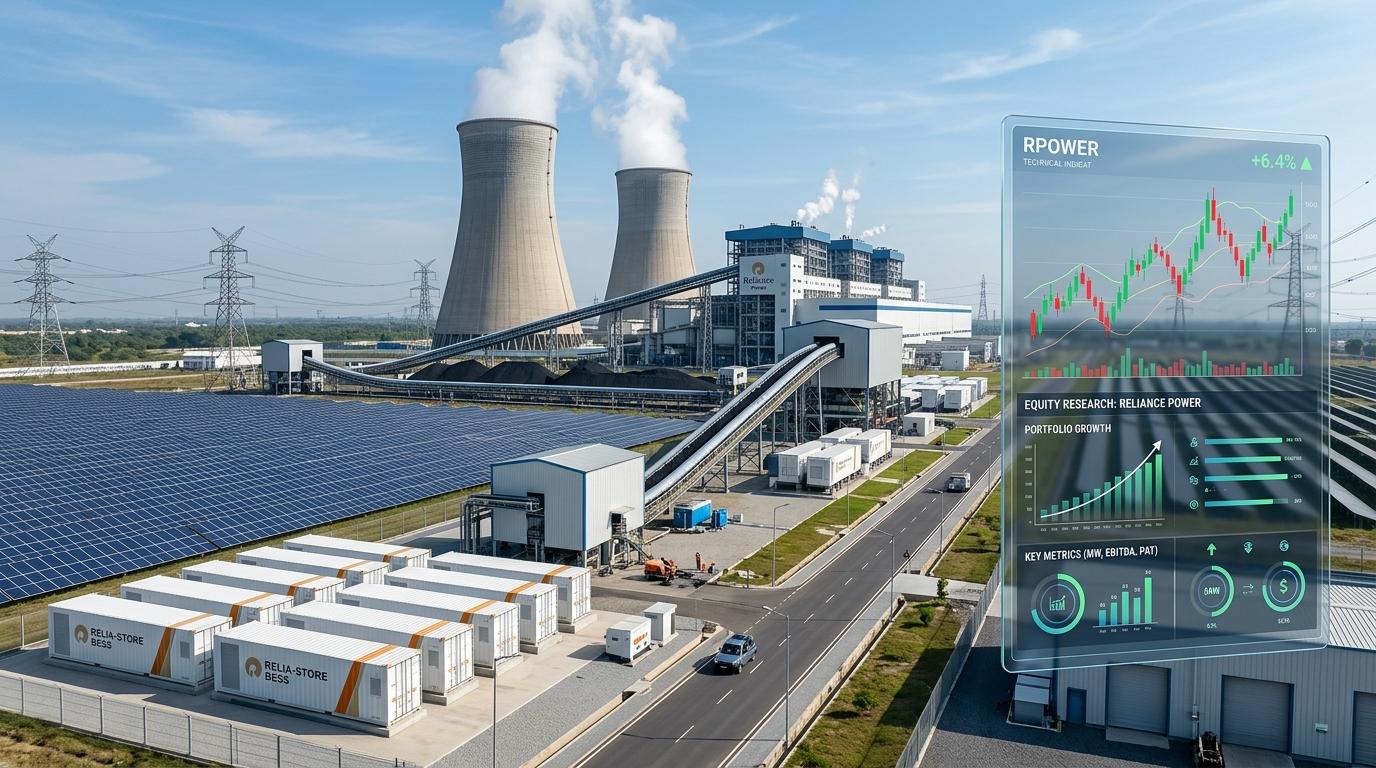
Reliance Power Limited (NSE: RPOWER) operates a robust 5,945 MW utility generation base anchored by the 3,960 MW pit-head supercritical Sasan UMPP in Madhya Pradesh. Key turnaround metrics: Sasan maintains an industry-leading 85%–92% Plant Load Factor (PLF) with low-cost captive coal delivered via conveyor belt. The company has extinguished 100% of its standalone debt with commercial lenders, while remaining consolidated debt is safely ring-fenced at the SPV level supported by ₹1,900+ Crore in annual operating EBITDA. Future growth vectors include utility-scale Battery Energy Storage Systems (BESS) and cross-border solar and hydro developments in Bhutan.
Reliance Power Limited (NSE: RPOWER / BSE: 532939), a prominent private power generation enterprise and part of the Reliance Group, stands as one of the most widely followed corporate turnaround stories in the Indian infrastructure universe. Following a protracted period of severe balance-sheet distress inherited from the hyper-aggressive, debt-financed thermal power expansion cycle of 2008–2014, the company has executed a disciplined financial and operational restructuring.
Anchored by the world-class operational performance of its 3,960 MW Sasan Ultra Mega Power Project (UMPP) in Madhya Pradesh, the successful elimination of 100% of its standalone bank debt, and an aggressive forward pivot into utility-scale Battery Energy Storage Systems (BESS) and cross-border solar-hydro developments in Bhutan, Reliance Power has recaptured the attention of retail and institutional market participants. This comprehensive 2026 institutional guide provides an objective, research-backed dissection of Reliance Power's generation assets, evaluates captive coal pit-head economics, analyzes the balance-sheet deleveraging roadmap, benchmarks operational metrics against power majors (NTPC, Tata Power, JSW Energy), and outlines core regulatory risks.
1. Operating Asset Architecture: The 6,000 MW Power Generation Base
Reliance Power controls an operational generation portfolio of approximately 5,945 MW (~6.0 Gigawatts) diversified across baseload supercritical thermal assets and operating renewable installations:
| Power Generation Asset | Installed Capacity | Fuel & Technology Type | Location & PPA Off-Taker Structure |
|---|---|---|---|
| 1. Sasan Ultra Mega Power Project (UMPP) | 3,960 MW (6 × 660 MW) | Pit-head Supercritical Coal (Captive Mines) | Singrauli, MP (14 Discoms across 7 states under 25-yr PPAs). |
| 2. Rosa Thermal Power Plant | 1,200 MW (4 × 300 MW) | Subcritical Pulverized Coal | Shahjahanpur, UP (100% contracted to UPPCL under cost-plus PPA). |
| 3. Butibori Power Plant | 600 MW (2 × 300 MW) | Coal-Fired Thermal | Nagpur, Maharashtra (Under strategic restructuring). |
| 4. Operational Renewable Assets | 145 MW | Solar CSP & Wind Energy | 100 MW Solar CSP (Dhursar, Rajasthan) + 45 MW Wind (Sangli, MH). |
2. Sasan UMPP: The Crown Jewel & Captive Coal Moat
The 3,960 MW Sasan UMPP in Singrauli, Madhya Pradesh, is the operational centerpiece of Reliance Power's enterprise value and one of the largest integrated pit-head coal-fired power plants in the world. Sasan possesses three structural competitive moats:
| Operating Parameter | Value / Operational Performance | Strategic Economic Implication |
|---|---|---|
| Gross Generating Capacity | 3,960 MW (6 Supercritical Units of 660 MW) | Massive economies of scale; supercritical boiler thermal efficiency. |
| Captive Coal Mine Reserves | Moher & Moher-Amlohri Coal Blocks | Zero dependence on Coal India e-auctions; 100% fuel security. |
| Fuel Delivery Mechanism | Dedicated Overland Automated Conveyor Belt | Zero railway freight charges; insulates Sasan from logistics cost inflation. |
| Variable Fuel Generation Cost | Under ₹1.40 per kWh (Industry Lowest) | Discom merit-order dispatch priority; guaranteed 24/7 baseload evacuation. |
| Average Plant Load Factor (PLF) | 85.0% to 92.0% Consistently | Significantly outperforms the national thermal PLF average of ~68%. |
| PPA Off-Take Security | 25-Year Binding PPAs with 14 State Discoms | Guaranteed capacity charge recovery across MP, UP, Punjab, Haryana, Rajasthan. |
Because Sasan is located directly at the pit-head of its captive coal blocks, coal is transported directly from mine pits into plant boiler bunkers via automated conveyor belts. This completely bypasses the costly railway freight tariffs of Indian Railways, enabling Sasan to generate electricity at an ultra-low variable cost. Consequently, state power dispatch centers consistently place Sasan at the very top of their Merit Order Despatch (MOD) rankings, ensuring continuous baseload off-take year-round.
3. India's Thermal Baseload Supercycle & Grid Stability Directives
India's rapid industrialization under Make in India, nationwide electrification, and soaring peak air conditioning demand during summer heatwaves have propelled national peak electricity demand beyond 250 Gigawatts (GW). While the country is adding substantial solar capacity, renewable generation is intermittent: solar plants generate 0 MW during the evening peak demand hours of 7:00 PM to 10:00 PM.
Why Supercritical Thermal Power Remains Irreplaceable
1. Grid Inertia & Frequency Stability: Massive spinning rotors in heavy supercritical thermal turbines provide essential physical rotational inertia that stabilizes the alternating current (AC) frequency of the national electrical grid against renewable generation spikes.
2. Section 11 Directives by Ministry of Power: To prevent blackouts, the Central Government has repeatedly invoked Section 11 of the Electricity Act, mandating all thermal generating stations to operate at peak capacity availability and maintain statutory 30-day coal inventories.
3. Late Payment Surcharge (LPS) Rules: Under the Ministry of Power's landmark LPS regulations, state distribution companies (Discoms) must clear monthly generation bills on time or face automated disconnection from the national power exchange, securing operating cash flow realization for IPPs like Reliance Power.
4. The Corporate Turnaround: Deleveraging and Debt Settlement Roadmap
The defining structural catalyst behind the re-rating of Reliance Power has been management's systematic execution of debt resolution agreements:
Key Milestones in Reliance Power's Debt Clearance
1. Standalone Zero-Debt Milestone: Through disciplined operational cash flow deployment and structured One-Time Settlements (OTS), Reliance Power settled 100% of its legacy debt obligations with leading commercial banks and Asset Reconstruction Companies—including CFM ARC, ICICI Bank, Axis Bank, DBS Bank, and IDBI Bank—achieving standalone net-debt zero status.
2. Preferential Equity Infusions: The company bolstered its net worth through preferential equity warrant issuances subscribed by promoter entities and institutional investors, providing fresh growth capital to participate in new clean energy auctions.
3. Ring-Fenced Project SPV Debt: Remaining consolidated debt is tied strictly to operating Special Purpose Vehicles (principally Sasan Power Limited). This debt is non-recourse to the parent holding company and is autonomously serviced by regular monthly tariff cash flows under 25-year PPAs.
4. Robust EBITDA Generation: Consolidated annual operating EBITDA consistently exceeds ₹1,900+ Crore, generating strong operating cash flows that comfortably cover all ring-fenced interest and principal amortization commitments.
5. Comprehensive Peer Benchmarking: Reliance Power vs. Power Sector Majors
The following institutional matrix benchmarks Reliance Power against prominent listed utilities on the Indian stock market (NTPC Limited, Tata Power, and JSW Energy):
| Operational & Financial Metric | Reliance Power (NSE: RPOWER) | NTPC Limited | Tata Power Company | JSW Energy |
|---|---|---|---|---|
| Operational Generation Capacity | ~5,945 MW (~6.0 GW) | ~76,000 MW (~76 GW) | ~14,700 MW (~14.7 GW) | ~13,300 MW (~13.3 GW) |
| Flagship Thermal PLF (%) | 88.5% – 92.0% (Sasan UMPP) | 76.5% – 78.5% | ~68.0% | ~72.0% |
| Consolidated Annual Revenue | ~₹7,800 – ₹8,300 Crore | ~₹1,81,000 Crore | ~₹62,000 Crore | ~₹11,500 Crore |
| Consolidated Operating EBITDA | ~₹1,850 – ₹2,100 Crore | ~₹52,000 Crore | ~₹11,200 Crore | ~₹5,400 Crore |
| Standalone Leverage Status | Net-Debt Zero (Standalone) | Leveraged (PSU Capex) | Moderate Leverage | Moderate Leverage |
| Primary Fuel Architecture | 100% Pit-Head Captive Coal (Sasan) | Captive Coal + Coal India FSA | Imported Coal + Domestic FSA | Imported Coal + Domestic FSA |
6. Green Energy Transformation: BESS & International Clean Energy
Having stabilized its core thermal cash generation, Reliance Power is executing a structured clean energy transformation roadmap:
A. Battery Energy Storage Systems (BESS)
The company is actively bidding for utility-scale stand-alone BESS projects (such as SECI's 500 MW / 1,000 MWh tenders). Utility-scale storage facilities absorb low-cost solar electricity during daytime hours and discharge it during evening peak demand periods, enabling Reliance Power to capture attractive peak power market tariffs and provide ancillary grid frequency stabilization services.
B. The Kingdom of Bhutan Clean Energy Joint Venture
Reliance Power entered into a landmark strategic partnership with the Royal Government of Bhutan's commercial arm (Druk Holding and Investments) to co-develop 1,270 MW of clean energy assets:
- 500 MW Utility Solar PV: Harnessing high solar irradiation in Bhutan's mountainous valleys to supply daytime green electricity.
- 770 MW Chamkharchhu-I Hydroelectric Project: A run-of-the-river hydroelectric power station designed to generate clean, firm baseload electricity that can be wheeled into India's national grid during peak industrial demand periods.
C. Co-Located Solar PV at Existing Thermal Complexes
Reliance Power possesses significant surplus contiguous land surrounding its Sasan and Rosa thermal power complexes. By installing co-located ground-mounted solar PV systems on this unutilized land, the company can wheel green power through its existing 765 kV and 400 kV extra-high-voltage transmission switchyards without incurring heavy fresh substation transmission capital expenditures.
7. High-Voltage Grid Evacuation Infrastructure (ISTS & PGCIL Connectivity)
A vital operational asset for any utility-scale generator is unconstrained power evacuation infrastructure. Sasan UMPP is directly connected to the Inter-State Transmission System (ISTS) operated by Power Grid Corporation of India Limited (PGCIL):
- Evacuation is executed through dual 765 kV double-circuit and 400 kV high-voltage transmission lines connecting directly to regional pooling substations in Vindhyachal and Satna.
- This robust transmission backbone allows power generated at Sasan to flow seamlessly across state boundaries into the Northern and Western regional grids, preventing line congestion bottlenecks even during peak summer demand seasons.
8. Key Investment Risks, Regulatory Bottlenecks & Litigation
An institutional equity evaluation must account for ongoing regulatory and operating risks:
Key Operational & Legal Headwinds
1. Discom Counterparty Financial Health: Although the LPS rules have accelerated bill collections, state electricity boards in Uttar Pradesh, Rajasthan, and Punjab carry significant accumulated distribution losses. Billing disputes or regulatory tariff deferrals can create working capital volatility.
2. Captive Coal Mining Compliance & Capex: Operating the Moher and Moher-Amlohri open-cast coal mines requires continuous environmental clearances, overburden removal capital expenditure, heavy machinery maintenance, and strict adherence to Directorate General of Mines Safety (DGMS) norms.
3. Regulatory Tariff Compensation Petitions: Reliance Power has several tariff compensation appeals pending before the Central Electricity Regulatory Commission (CERC) and the Appellate Tribunal for Electricity (APTEL) regarding statutory change-in-law compensation (such as GST rate revisions and environmental emission control norms). The procedural timelines for these legal appeals are inherently extended.
9. Valuation Framework & Investment Checklist for Long-Term Investors
When analyzing Reliance Power's long-term investment case, market participants should evaluate the enterprise across three fundamental parameters:
- Asset Replacement Cost vs. Enterprise Value: Constructing a new 4,000 MW supercritical coal-fired pit-head power station today would require over ₹36,000 to ₹40,000 Crore in capital expenditure (exceeding ₹9–₹10 Crore per MW) and take 6 to 8 years to permit and build. Reliance Power's existing operating generation assets trade at a substantial discount to theoretical greenfield replacement costs.
- Free Cash Flow Yield & Debt Amortization: With annual operating EBITDA exceeding ₹1,900+ Crore, monitor whether Sasan's project-level debt amortizes steadily year after year, systematically transferring enterprise value from debt holders to equity shareholders.
- Execution of the BESS & Bhutan Pipeline: Track regulatory PPA execution and financial closures for the Bhutan hydro-solar projects and SECI storage tenders to verify that the green energy transformation is translating into tangible revenue-generating assets.
10. Statutory Regulatory References & Official Frameworks
The operational schedules, generation metrics, tariff frameworks, and debt settlements referenced in this guide are grounded in official regulatory statutes:
- Central Electricity Regulatory Commission (CERC): Multi-year tariff regulations, Sasan UMPP tariff adoption orders, and change-in-law petitions at the CERC Official Portal.
- Ministry of Power (Government of India): National Electricity Policy directives, Section 11 generation orders, and Late Payment Surcharge (LPS) rules at the Ministry of Power.
- Central Electricity Authority (CEA): Monthly thermal power generation, plant load factor (PLF), and coal stock monitoring reports at Central Electricity Authority.
- National Stock Exchange of India (NSE India): Official financial disclosures, corporate shareholding patterns, and announcements for RPOWER.
- Bombay Stock Exchange (BSE India): Audited annual financial statements and corporate debt settlement disclosures for BSE Scrip Code 532939 at BSE India.
- Solar Energy Corporation of India (SECI): Tender specifications and bid awards for utility-scale standalone Battery Energy Storage Systems (BESS) at SECI Portal.
Frequently Asked Questions (Institutional FAQ Desk)
RPOWER, selecting Cash and Carry (CNC / Delivery), and executing their buy order.
Educational & Regulatory Disclosures
Source Attribution: This masterclass educational guide is produced strictly for investor awareness and capital markets literacy in alignment with SEBI Investor Education and Protection Fund (IEPF) guidelines.
Non-Advisory Mandate & Risk Warning: Digital Arthalaya is strictly an independent financial education portal and is not a SEBI-registered investment advisor or stock broker. IPO bidding and equity trading involve market risk, including potential loss of principal. Readers must conduct their own independent due diligence and read all offer documents carefully before making investment commitments.