NSE Unlisted Share Price: Valuation, Pre-IPO Buying & Taxes (2026) | DA
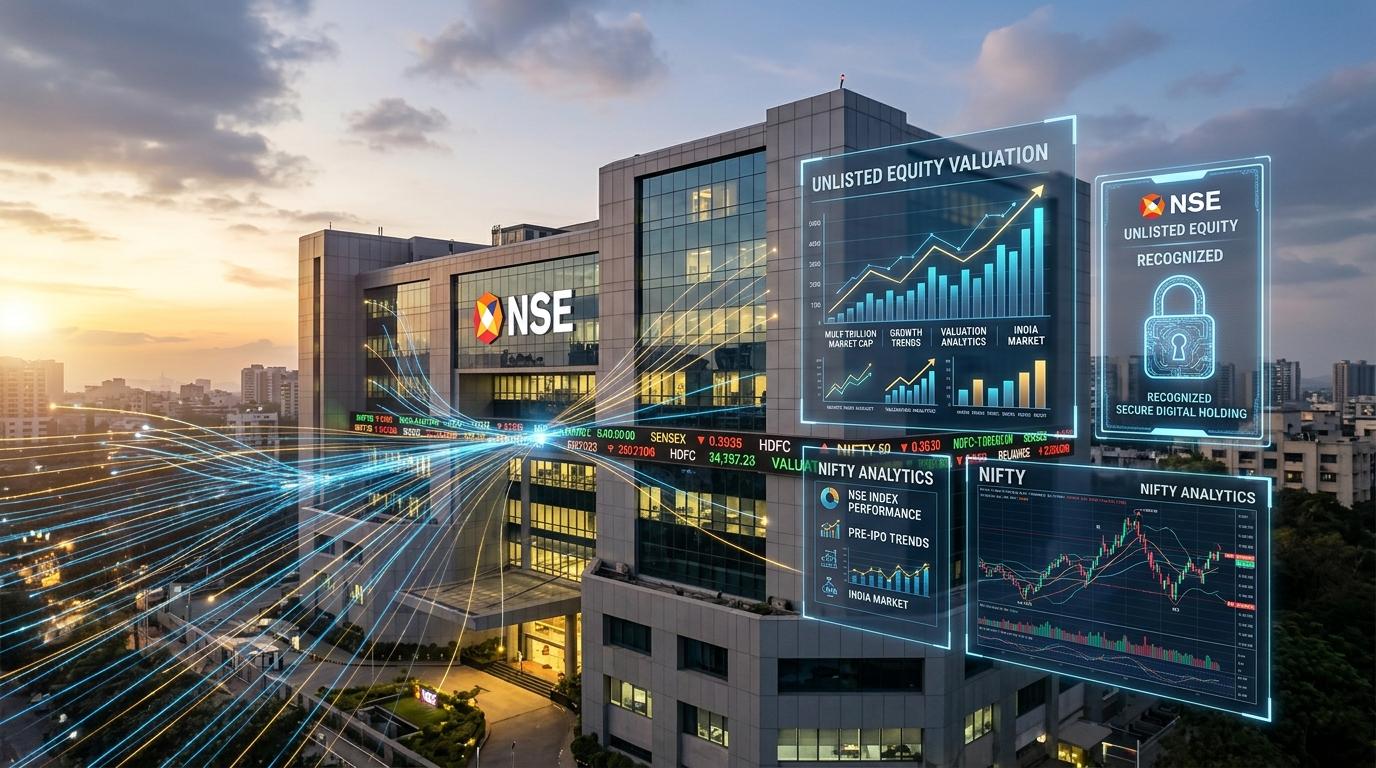
The National Stock Exchange of India Limited (NSE) commands an unassailable financial monopoly with a 93% cash market share and ~99% equity derivatives share, generating exceptional 70%+ operating EBITDA margins. Traded actively in the pre-IPO unlisted market at an implied valuation between ₹3.5 Lakh Crore and ₹4.5+ Lakh Crore, NSE shares offer investors ownership in India's premier digital financial utility. Key pre-IPO parameters: shares are acquired via off-market DIS/e-DIS transfer into buyer Demat accounts. Under post-Budget 2024 tax rules, unlisted shares require a 24-month holding period for a 12.5% LTCG tax rate (STCG is taxed at marginal slab rates). Furthermore, under SEBI ICDR regulations, all pre-IPO shares carry a mandatory 6-month lock-in post-listing.
The National Stock Exchange of India Limited (NSE India) is the undisputed beating heart of modern Indian capitalism. Established in November 1992 to democratize capital market access, dismantle regional exchange cartels, and introduce electronic screen-based trading, the NSE has grown into the world's largest derivatives exchange by contract trading volume and the fourth-largest equity exchange globally by cash market trades.
Yet, despite its overwhelming hegemony over Dalal Street's daily capital flows, the National Stock Exchange itself remains an unlisted corporation. For years, retail investors, family offices, and institutional asset managers have traded NSE shares in the private over-the-counter (OTC) pre-IPO market, seeking equity ownership in what many consider the most profitable digital tollway in emerging markets. This comprehensive 2026 institutional guide provides an exhaustive dissection of NSE's unlisted share price, analyzes its corporate valuation multiples against domestic peer BSE Limited (NSE: BSE) and global exchanges, breaks down the landmark 4:1 bonus issue, walks through the off-market Demat buying process, demystifies post-Budget 2024 unlisted capital gains taxation, and explains the critical SEBI 6-month post-listing lock-in rule.
1. The Monopolistic Business Moat: How NSE Prints High-Margin Cash
To understand why the National Stock Exchange trades at premium unlisted valuations, one must examine its business architecture. The NSE is not an ordinary financial services firm; it operates as an essential, quasi-sovereign digital financial utility possessing an extraordinary economic moat:
The Five High-Margin Revenue Engines of NSE India
1. Transaction & Clearing Fees: The primary revenue driver. Every single purchase and sale of equity cash shares, index futures, stock options, and currency derivatives generates a statutory transaction fee for NSE and clearing fees for its wholly-owned clearing arm, NSE Clearing Limited (NCL). Because exchange software operating costs are largely fixed, incremental turnover scales with near-zero marginal cost, generating operating EBITDA margins exceeding 70% to 75%.
2. Co-Location Server Rack Lease Rentals: High-frequency algorithmic trading firms (HFTs) and institutional prop desks pay substantial annual fees to place their dedicated low-latency trading servers physically inside the NSE data center in Bandra-Kurla Complex (BKC), Mumbai, securing multi-crore recurring infrastructure revenues.
3. Market Data Feeds & Telemetry Subscriptions: Global financial terminals (Bloomberg, Refinitiv, FactSet) and retail broker apps pay continuous subscription royalties to access NSE's real-time tick-by-tick (TBT) level-1, level-2, and level-3 order book data feeds.
4. Index Licensing & Royalties (NSE Indices): Asset management companies (AMCs) running index mutual funds, exchange-traded funds (ETFs), and structured products pay ongoing index licensing fees to track benchmark indices like the Nifty 50, Nifty Bank, and Nifty Next 50.
5. Treasury Income on Clearing Settlement Guarantee Funds (SGF): NSE Clearing holds tens of thousands of crores in member margin collateral and core settlement funds, earning massive, risk-free interest and treasury yields on cash and sovereign securities.
Unrivaled Domestic Market Dominance
While the century-old Bombay Stock Exchange (BSE) staged an impressive derivatives revival, the NSE maintains command over ~92%–94% of total cash equity turnover and approximately ~98%–99% of total equity index and stock derivatives volume. This immense liquidity creates an unbreakable network effect: institutional investors trade on NSE because that is where the deepest liquidity resides, and retail brokers route client orders to NSE to minimize execution slippage.
2. Financial Performance & The 4:1 Bonus Issue Impact
The financial statements of NSE India resemble an elite technology platform rather than a traditional public sector utility. Over the past five financial years, the exchange has demonstrated extraordinary compounding across top-line revenue, operating EBITDA, and net earnings:
| Financial Metric (Standalone / Cons.) | FY22 | FY23 | FY24 | FY25 – FY26E |
|---|---|---|---|---|
| Consolidated Operating Revenue | ₹8,313 Cr | ₹11,856 Cr | ₹14,780 Cr | ₹17,500 – ₹19,200 Cr |
| Operating EBITDA Margin (%) | 71.4% | 73.8% | 74.5% | 72.0% – 75.0% |
| Consolidated Profit After Tax (PAT) | ₹5,198 Cr | ₹7,356 Cr | ₹8,306 Cr | ₹9,500 – ₹11,000 Cr |
| Basic EPS (Post-4:1 Bonus Adjusted) | ~₹21.00 | ~₹29.70 | ~₹33.55 | ~₹38.50 – ₹44.00 |
| Annual Dividend Payout Ratio (%) | ~45% | ~50% | ~55% | 50% – 60% Regular Payout |
The Structural Impact of the 4:1 Bonus Issue
In mid-2024, the board of directors of NSE India approved a historic 4:1 bonus issue (issuing 4 free bonus equity shares for every 1 existing share held). This corporate action had profound consequences for pre-IPO investors:
- Share Multiplier: A pre-IPO investor holding 100 shares saw their Demat holding expand to 500 shares.
- Price Normalization: Prior to the bonus, NSE unlisted shares traded at heavy price tags between ₹6,000 and ₹6,500 per share, requiring large minimum lot ticket sizes (often ₹3 to ₹5 Lakhs). Following the 4:1 bonus adjustment, the theoretical price per share recalibrated to the ₹1,200 to ₹1,600 range, dramatically lowering the entry barrier for retail wealth builders and expanding unlisted trading liquidity.
3. Unlisted Valuation Breakdown: Market Cap & Peer Multiples
To assess whether NSE's unlisted share price is attractively priced or overvalued, analysts benchmark its valuation against listed global financial market operators and domestic competitor BSE Limited:
| Exchange Entity | Listing Status | Market Cap (₹ / $ Equivalent) | Trailing P/E (x) | Operating EBITDA Margin | Core Market Position |
|---|---|---|---|---|---|
| NSE India (Unlisted) | Unlisted / Pre-IPO | ₹3,60,000 – ₹4,40,000 Cr | 32x – 38x | 74.5% | #1 Derivatives Volume globally; 93% Indian Cash Share. |
| BSE Limited (NSE: BSE) | Publicly Listed (NSE) | ~₹65,000 – ₹75,000 Cr | 50x – 65x | ~45.0% – 52.0% | Oldest Asian exchange; expanding derivatives market share via Sensex/Bankex. |
| CME Group (NASDAQ: CME) | Publicly Listed (US) | ~$80 Billion | 24x – 27x | ~68.0% | World's largest financial derivatives exchange (interest rates, commodities). |
| Nasdaq Inc. (NASDAQ: NDAQ) | Publicly Listed (US) | ~$40 Billion | 28x – 32x | ~52.0% | Premier tech exchange & financial software analytics provider. |
Valuation Insight: In the unlisted market, NSE trades at a trailing Price-to-Earnings (P/E) multiple of roughly 32x to 38x. Remarkably, this represents a 30% to 40% valuation discount compared to its listed competitor BSE Limited (which has frequently traded above 50x–60x P/E multiples during peak market rallies). This valuation gap exists primarily because unlisted shares lack instant exchange liquidity and carry regulatory IPO timing uncertainty.
4. The Long-Awaited IPO: SEBI NOC & Cross-Listing on BSE
Why has India's largest exchange remained unlisted for over a decade? The delay traces back to the historic algorithmic co-location investigation initiated by the Securities and Exchange Board of India (SEBI) in 2015:
- Co-Location Regulatory Inquiries: Allegations that certain high-frequency brokerages secured preferential early access to NSE's secondary server tick feeds led to years of forensic audits, legal appeals, and regulatory investigations before SEBI and the Securities Appellate Tribunal (SAT).
- Legal Resolution & Corporate Governance Overhaul: Over recent years, NSE has settled key regulatory proceedings, reconstituted its board of directors with eminent public interest directors, enhanced systemic cyber-security protocols, and formally approached SEBI for a No Objection Certificate (NOC) to submit its Draft Red Herring Prospectus (DRHP).
- The Cross-Listing Mandate: Under Regulation 45 of the SEBI (Stock Exchanges and Clearing Corporations) Regulations, a recognized stock exchange is legally prohibited from self-listing its shares on its own trading platform to avoid conflicts of interest. Therefore, when the IPO launches, NSE equity shares will list and trade exclusively on the Bombay Stock Exchange (BSE).
5. Step-by-Step Walkthrough: How to Buy NSE Unlisted Shares in India
Unlike listed stocks that are bought with a single click inside broker apps, purchasing unlisted pre-IPO shares follows an off-market depository transfer process governed by SEBI and depository regulations:
The 4-Step Off-Market Demat Purchase Protocol
Step 1: Engage an Established Institutional Pre-IPO Broker: Connect with a reputable, verified unlisted share platform or institutional dealer. Confirm the negotiated purchase price per share and minimum order ticket size (typically 50 to 100 shares post-bonus).
Step 2: Submit Demat Client Master Report (CMR): Provide a digitally signed Client Master Report (CMR) issued by your depository participant (such as Upstox, Zerodha, or Groww). The CMR officially confirms your Beneficiary Owner ID (BO ID), DP ID, PAN card, and bank account linkage in NSDL or CDSL.
Step 3: Transfer Funds via Official Banking Channels: Transfer the exact purchase consideration directly to the authorized corporate bank account of the unlisted dealer via RTGS or NEFT. Never execute cash or unverified third-party transfers.
Step 4: Depository Off-Market Transfer via DIS / e-DIS: The seller executes an off-market transfer using a Delivery Instruction Slip (DIS) or electronic e-DIS (via NSDL Speed-e or CDSL Easiest). Within 24 to 48 hours (T+1 to T+2 days), the shares of National Stock Exchange of India Limited (ISIN: INE118A01012) are credited directly into your personal Demat account.
How to Verify Ownership: Once transferred, log into your depository portal (NSDL IDeAS or CDSL Easiest) or open your broker application. Under your Demat portfolio holdings, you will see "NATIONAL STOCK EXCHANGE OF INDIA LTD" listed with your confirmed quantity and ISIN.
6. Statutory Taxation of Unlisted Shares (Post-Budget 2024 Framework)
Investing in unlisted pre-IPO shares carries fundamentally different tax rules compared to listed equity stocks. The Finance Act 2024 (Budget 2024) established a comprehensive statutory framework for unlisted capital gains:
| Taxation Parameter | Unlisted Pre-IPO Shares (NSE) | Publicly Listed Equities (Post-IPO) |
|---|---|---|
| Long-Term Qualifying Holding Period | More than 24 Months | More than 12 Months |
| Long-Term Capital Gains (LTCG) Rate | 12.5% Flat Rate (No Indexation) | 12.5% on gains exceeding ₹1.25 Lakh |
| Short-Term Holding Period Threshold | 24 Months or Less | 12 Months or Less |
| Short-Term Capital Gains (STCG) Rate | Taxed at Investor's Marginal Slab Rate (Up to 30%+) | Flat 20% Rate (Section 111A) |
| Securities Transaction Tax (STT) | Zero STT on Off-Market Transfer | Applicable on all exchange trades |
Crucial Tax Takeaway: If you buy NSE unlisted shares and sell them before the 24-month mark in the unlisted market, your profits are added to your total income and taxed at your personal slab rate (which can exceed 39% for high-net-worth individuals). Therefore, unlisted shares are strictly designed for long-term patient capital held past the 24-month threshold to enjoy the lower 12.5% LTCG rate.
7. The SEBI 6-Month Pre-IPO Lock-In Rule Explained
A common misconception among beginner investors is the belief that they can purchase unlisted shares a few weeks prior to an IPO and immediately sell them on commercial listing morning to capture a 50% listing-day pop. Under Indian securities law, this is strictly prohibited.
Regulation 17 of SEBI (ICDR) Regulations: Pre-IPO Lock-In
• Mandatory 6-Month Freeze: The entire pre-issue capital of an unlisted company held by non-promoter equity shareholders is subject to a statutory 6-month lock-in period from the date of commercial stock exchange listing.
• Depository Electronic Freeze: NSDL and CDSL automatically place an electronic freeze flag on pre-IPO shares in your Demat account upon listing. You cannot sell, transfer, or pledge these shares on the exchange until the exact 6-month anniversary of the listing date.
• Post-Lock-In Liquidity: Once the 6-month statutory lock-in expires, the depository automatically removes the restriction flag, converting your holdings into fully tradeable, liquid shares on BSE.
8. Key Investment Risks & Downside Scenarios
While the business model of NSE is arguably the most dominant monopoly in India, equity buyers in the unlisted market must confront distinct structural risks:
- Secondary Market Illiquidity: Unlisted shares do not trade on a continuous electronic limit-order book with millisecond execution. If you need urgent liquidity during a broader market crash, finding an off-market buyer willing to purchase your specific lot size can take days or weeks.
- Regulatory Margin & Derivatives Interventions: A substantial portion of NSE's revenue originates from options transaction charges. Regulatory measures by SEBI—such as increasing weekly index option lot sizes, rationalizing contract expiries, or revising institutional STT rates—can temporarily moderate overall derivative turnover and dampen earnings growth.
- IPO Gestation Uncertainty: Although informal market chatter often predicts an imminent IPO, final public offering timelines depend entirely on formal regulatory clearance from SEBI. Investors must be prepared to hold their shares for multiple years without a confirmed listing date.
9. Investment Verdict: Is Buying NSE in the Unlisted Market Worth It?
For disciplined long-term wealth creators, owning shares of the National Stock Exchange of India represents a pure proxy on the secular expansion of Indian capital markets. With less than 8% of India's population currently participating in equity markets, long-term structural tailwinds—including the financialization of household savings, systematic SIP inflows, and corporate capital formation—guarantee multi-decade growth for exchange infrastructure.
Strategic Portfolio Allocation: Because unlisted shares carry secondary illiquidity and the mandatory 6-month pre-IPO lock-in, financial planners recommend treating NSE unlisted equity as a satellite wealth-building allocation (limiting exposure to 5% to 10% of your overall equity portfolio) with an intended investment horizon of at least 3 to 5 years.
10. Statutory Regulatory References & Official Frameworks
The operational statistics, corporate governance policies, depository transfer protocols, and capital gains tax rules referenced in this guide are grounded in statutory regulatory enactments:
- Securities and Exchange Board of India (SEBI): SEBI (Stock Exchanges and Clearing Corporations) Regulations, 2018 and SEBI (Issue of Capital and Disclosure Requirements) Regulations, 2018 at SEBI Official Portal.
- Income Tax Department (Government of India): Statutory capital gains tax provisions under Section 112 (Unlisted Equities) and Finance Act 2024 revisions at Income Tax Department.
- National Stock Exchange of India (NSE India): Audited annual financial statements, quarterly investor reports, and corporate governance filings at NSE India Official Website.
- Bombay Stock Exchange (BSE India): Comparative financial results and exchange trading statistics for BSE Scrip 540065 at BSE India.
- National Securities Depository Limited (NSDL): Guidelines on off-market Demat transfers, DIS slips, and Speed-e execution at NSDL Portal.
- Central Depository Services (India) Limited (CDSL): Easiest electronic transfer system and Beneficiary Owner ID verification at CDSL Official Portal.
Frequently Asked Questions (Institutional FAQ Desk)
INE118A01012. Investors should always verify this exact ISIN on their depository statement (NSDL or CDSL) to ensure authenticity.
Educational & Regulatory Disclosures
Source Attribution: This masterclass educational guide is produced strictly for investor awareness and capital markets literacy in alignment with SEBI Investor Education and Protection Fund (IEPF) guidelines.
Non-Advisory Mandate & Risk Warning: Digital Arthalaya is strictly an independent financial education portal and is not a SEBI-registered investment advisor or stock broker. IPO bidding and equity trading involve market risk, including potential loss of principal. Readers must conduct their own independent due diligence and read all offer documents carefully before making investment commitments.