Future of Indian Stock Market: 2030–2047 Growth Drivers, Megatrends & Risks
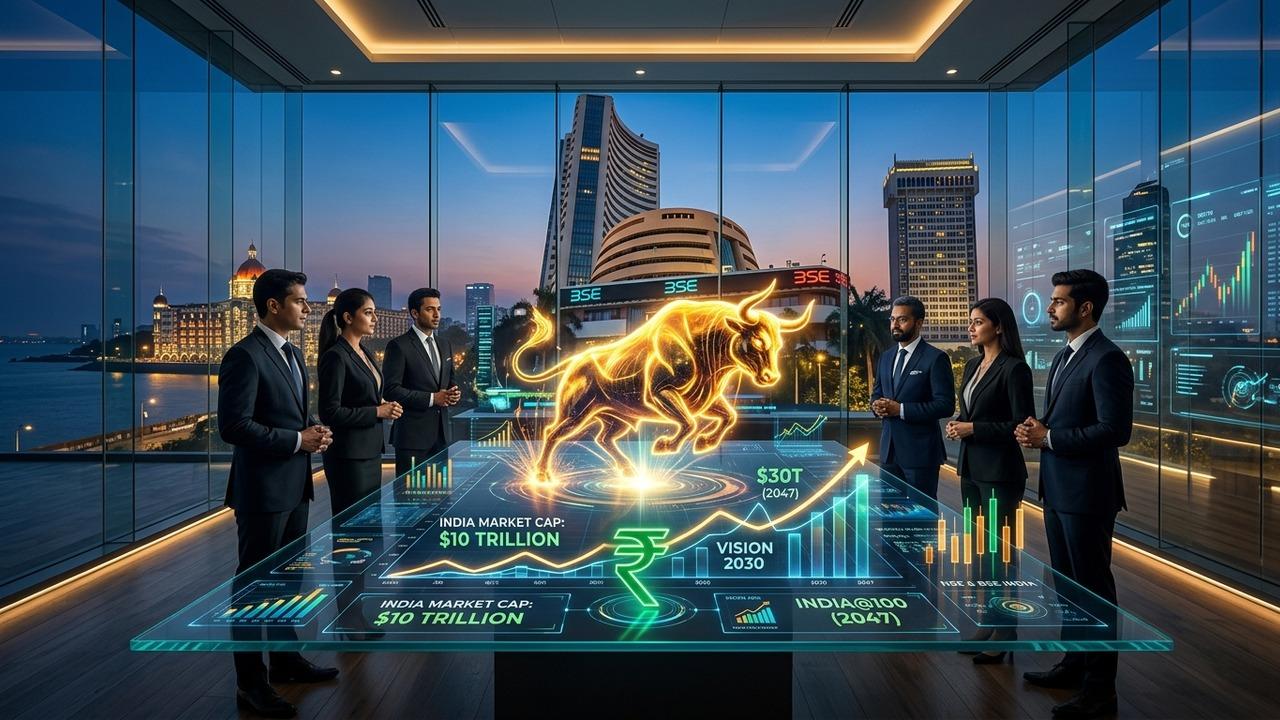
The Indian stock market stands at the threshold of a historic, multi-decade expansion, progressing from its current $5.2 Trillion market capitalization toward an estimated $10 Trillion by 2030 and upwards of $30 Trillion by the centenary of independence in 2047 (Viksit Bharat). Unlike previous market cycles that depended almost exclusively on erratic Foreign Portfolio Investor (FPI) capital flows, Dalal Street's modern trajectory is anchored by five irreversible structural catalysts: (1) an unprecedented domestic financialization revolution powered by monthly mutual fund SIP inflows exceeding ₹24,000 Crore, (2) an inflection in per capita GDP crossing $3,000 that historically shifts household savings from physical gold and real estate into productive equity assets, (3) massive capital expenditure across five high-conviction sunrise sectors—renewable green energy, semiconductor and electronics manufacturing (EMS), defense indigenization, high-speed rail logistics, and digital fintech, (4) global supply chain diversification under the 'China+1' paradigm accompanied by India's weighting climbing beyond 20% in the MSCI Emerging Markets Index, and (5) world-class regulatory clearing infrastructure pioneered by SEBI, including universal T+1 settlement, optional T+0 instant clearing, and proposed retail fractional ownership.
For more than a century, global financial historians viewed the Indian stock market through the lens of emerging-market volatility—an exotic bourse susceptible to erratic monsoons, imported crude oil shocks, and sudden capital flight whenever foreign institutional investors withdrew liquidity. Today, that obsolete paradigm has been permanently dismantled.
Anchored by a resilient domestic economy compounding at 6.5% to 7.0% real GDP growth, India's combined equity market capitalization across the National Stock Exchange (NSE) and the Bombay Stock Exchange (BSE) has crossed $5.2 Trillion (~₹435 Lakh Crore). Having overtaken Hong Kong to solidify its position as the fourth-largest stock market in the world, Dalal Street is now narrowing the gap with Japan and the United States.
Yet, seasoned institutional economists recognize that India's current valuation represents merely the prologue to a much larger economic transformation. As the nation targets becoming a $7 Trillion nominal economy by 2030 and a fully developed nation by the centenary of its independence in 2047 (Viksit Bharat), the Indian stock market is primed to scale toward a $10 Trillion market capitalization by 2030 and upwards of $30 Trillion by 2047.
This comprehensive treatise analyzes the structural growth drivers, demographic tailwinds, sunrise manufacturing sectors, technological clearing innovations, and systemic risks that will govern the future of the Indian stock market over the next two decades.
1. Decadal Projections: The $10 Trillion March to Viksit Bharat 2047
In equity market valuation, national market capitalization historically mirrors or exceeds nominal Gross Domestic Product (GDP)—a relationship famously popularized as the Buffett Indicator (Market Cap-to-GDP Ratio). In rapidly industrializing economies with high corporate profit shares, the equity market typically trades between 100% and 130% of nominal GDP.
The comparative matrix below outlines the projected decadal evolution of India's macroeconomic and capital market metrics from the 2026 baseline toward 2047:
| Macroeconomic & Market Metric | Current Baseline (2026) | Projected Milestone (2030) | Centenary Vision (2047 Viksit Bharat) | Underlying Structural Catalyst |
|---|---|---|---|---|
| Nominal GDP ($ Trillion) | ~$4.10 Trillion | ~$7.00 Trillion | ~$28.00 – $32.00 Trillion | Compounding real growth of 6.5%+ with disciplined inflation |
| Equity Market Cap ($ Trillion) | ~$5.20 Trillion | ~$9.50 – $10.50 Trillion | ~$30.00 – $35.00 Trillion | Earnings CAGR of 12%–14% and ongoing corporate IPO listings |
| Market Cap-to-GDP Ratio | ~126% | ~135% – 145% | ~110% – 120% | Deepening of corporate bond markets and public equity floats |
| Monthly Domestic SIP Inflow | ~₹24,500 Crore | ~₹50,000 Crore | ~₹1,50,000+ Crore | Formalization of household savings across Tier-2/Tier-3 towns |
| Registered Demat Accounts | ~16.5 Crore | ~28.0 – 30.0 Crore | ~65.0+ Crore | 100% paperless smartphone onboarding and universal financial literacy |
| MSCI Emerging Markets Weight | ~20.5% | ~25.0% – 28.0% | ~35.0%+ | Automated passive index reweighting and global asset reallocation |
2. Structural Driver 1: The Domestic Financialization Revolution & The "SIP Tsunami"
Historically, emerging market equities suffered from an acute vulnerability known as the "FII Dependency Syndrome". Whenever the US Federal Reserve raised interest rates or global geopolitical crises triggered risk-off sentiment, Foreign Institutional Investors (FIIs) aggressively sold Indian shares, precipitating sharp domestic market corrections.
Over the past half-decade, this structural vulnerability has been decisively neutralized by India's domestic retail financialization revolution:
- The Counter-Cyclical SIP Shield: Under the oversight of the Association of Mutual Funds in India (AMFI), monthly Systematic Investment Plan (SIP) contributions have crossed ₹24,500 Crore per month (translating to over ₹2.9 Lakh Crore in sticky domestic capital annually). Even during periods of intense foreign portfolio liquidation, domestic institutional investors (DIIs) systematically absorb selling pressure, creating an impenetrable liquidity floor under Indian equity valuations.
- The Untapped Savings Reservoir: Despite having over 16.5 Crore Demat accounts, direct equity investments still account for less than 8.5% of total Indian household financial wealth, compared to more than 55% in the United States and 22% in China. As domestic capital shifts from gold and bank fixed deposits into mutual funds and equities, domestic liquidity will remain a self-reinforcing compounding engine.
- Retirement & Pension Capital Inflows: Long-term institutional pools, including the Employees' Provident Fund Organisation (EPFO) and the National Pension System (NPS), continuously mandate higher equity allocations, injecting patient, multi-decade capital into index constituents.
Position Your Portfolio for Dalal Street's Next Decade with Upstox
Participate in India's structural economic growth with 100% digital onboarding. Open a free Demat account on Upstox to invest in Nifty 50 Index ETFs, blue-chip leaders, and primary market IPOs with zero account opening fees and zero equity delivery brokerage.
3. Structural Driver 2: Demographics & The Per Capita Income J-Curve
Demographic trajectories are the most predictable determinants of long-term capital market performance. While developed Western economies and East Asian nations (such as Japan, South Korea, and China) confront rapidly aging workforces and demographic contraction, India possesses the world's most advantageous demographic profile:
- The Demographic Dividend: India's median age is approximately 28.4 years, with over 65% of the population situated within the peak productive working-age bracket (15 to 64 years). This demographic window will remain wide open through the late 2040s, providing millions of productive workers, digital consumers, and capital accumulators.
- The $3,000 Per Capita Inflection Point: In development economics, when a nation's Gross Domestic Product per capita crosses the $3,000 to $4,000 threshold, consumer spending undergoes a fundamental qualitative transformation. Below $2,500, household income is consumed by non-discretionary necessities (food, shelter, basic healthcare). Once per capita income breaches $3,000, discretionary surplus income surges exponentially.
- Historical Global Precedent: When Japan crossed $3,000 per capita in the early 1970s, its stock market expanded tenfold over the subsequent 15 years. South Korea replicated this identical trajectory in the late 1980s, followed by China in the mid-2000s. India is entering this exact inflection zone between 2025 and 2030.
4. Structural Driver 3: The 5 Sunrise Mega-Sectors Powering Dalal Street
The leadership of the Indian stock market over the coming 15 to 20 years will not simply mirror the legacy sectors of the past. While banking, IT services, and fast-moving consumer goods (FMCG) will remain foundational pillars, incremental wealth creation will be led by five capital-intensive sunrise themes backed by government production-linked incentives (PLI) and global capex shifts:
| Sunrise Mega-Sector | Multi-Decade Secular Growth Catalyst | Government Policy / Regulatory Enabler | Key Sub-Segments & Beneficiaries |
|---|---|---|---|
| 1. Green Energy & Power Transmission | Transition toward 500 GW non-fossil capacity by 2030, green hydrogen, and electric vehicle (EV) charging grids. | National Green Hydrogen Mission, solar PLI subsidies, and interstate transmission waivers. | Solar/wind power generation, power grid transmission lines, battery energy storage systems (BESS). |
| 2. Semiconductor & Electronics (EMS) | Global supply chain diversification, local silicon fabrication, and domestic smartphone/laptop manufacturing. | ₹76,000 Crore India Semiconductor Mission (ISM) and modified electronic manufacturing schemes. | Commercial silicon fabs, outsourced semiconductor assembly and test (OSAT), PCB assembly, consumer electronics contract manufacturing. |
| 3. Defense Indigenization & Exports | Phased import embargo lists, modernization of armed forces, and expanding defense export targets to global allies. | Defense Acquisition Procedure (DAP) mandating 60%+ indigenous content, defense industrial corridors. | Precision aerospace engineering, unmanned aerial vehicles (drones), naval shipbuilding, radar and missile guidance systems. |
| 4. High-Speed Railways & Logistics | Dedicated freight corridors, complete track electrification, Vande Bharat fleet expansion, and modern multi-modal logistics parks. | PM Gati Shakti National Master Plan, National Rail Plan 2030, dedicated logistics infrastructure policies. | Prestressed concrete railway sleepers, rolling stock fabrication, track renewal automation, container freight terminals. |
| 5. Digital Commerce & Financialization | Digital Public Infrastructure (UPI, ONDC, Account Aggregator), expanding formal credit access to MSMEs and underserved consumers. | RBI Digital Lending Guidelines, Default Loss Guarantee (DLG) regulatory framework, SEBI fintech sandboxes. | Digital payment gateways, algorithmic credit platforms, health-tech ecosystems, automated wealth management platforms. |
5. Structural Driver 4: Global Supply Chains & The "China+1" Realignment
The geopolitical reordering of international commerce following the post-pandemic supply chain disruptions and escalating Sino-American trade tensions has permanently elevated India's strategic value for global corporations:
- The "China+1" Diversification Mandate: Multinational corporations across North America, Europe, and East Asia are systematically mitigating concentration risk by diversifying manufacturing facilities outside of mainland China. India—with its massive domestic consumer market, English-speaking engineering talent pool, stable rule of law, and competitive corporate tax rates (15% for new manufacturing units)—is the premier recipient of this global capital relocation.
- Rising Weight in Global Benchmarks: Passive exchange-traded funds (ETFs) and sovereign wealth funds benchmark their asset allocation against global indices, most notably the MSCI Emerging Markets Index. India’s weighting in the MSCI EM index has surged from ~8.1% in early 2020 to over 20.5% in 2026, narrowing the historical gap with China. As Indian companies continue to list and free-float market capitalizations expand, India's weighting is projected to surpass 25% by 2030, automatically mandating tens of billions of dollars in passive foreign equity inflows.
- Inclusion in Global Sovereign Bond Indices: India's formal integration into JPMorgan's Government Bond Index-Emerging Markets (GBI-EM) and Bloomberg bond indices attracts stable debt inflows, strengthening the Indian Rupee (INR) and lowering sovereign borrowing costs, which directly benefits corporate balance sheets.
6. Technological & Market Microstructure Evolution: T+0 to Fractional Ownership
The operational framework through which Indian shares are traded, cleared, and settled represents the gold standard of global securities architecture. While leading Western bourses still navigate legacy settlement lags, the Securities and Exchange Board of India (SEBI) and domestic clearing corporations are pioneering next-generation technological innovations:
- Instantaneous T+0 Settlement: Following the successful nationwide implementation of T+1 rolling settlement in 2023, SEBI launched operational pilots for instantaneous T+0 settlement on select highly liquid equities. Under T+0, funds and shares are transferred concurrently in real time, completely eliminating overnight counterparty settlement risk and accelerating portfolio turnover.
- Fractional Share Investing Framework: Under traditional Indian company law, investors cannot purchase fractions of an equity share. With several premium corporate shares (such as MRF, Page Industries, and Bosch) trading between ₹30,000 and ₹1,50,000 per share, high nominal share prices present an artificial psychological barrier for young retail investors. SEBI’s expert working groups have proposed a statutory framework to enable fractional equity ownership, allowing beginners to invest as little as ₹100 into ultra-high-priced blue-chip enterprises.
- Digital Public Infrastructure & Smart ODR: Integrating Aadhaar-linked DigiLocker e-KYC, 1-click UPI ASBA IPO blocking, and the SEBI SMART ODR (Online Dispute Resolution) portal ensures that retail investors resolve grievances electronically within statutory timelines, building enduring retail trust in capital markets.
7. Systemic Risks & Realities: What Could Challenge the Indian Bull Run?
No objective, institutional assessment of the Indian capital market is complete without an unsparing analysis of systemic risks. While the multi-decade structural trajectory remains exceptionally robust, investors must remain vigilant regarding four potential headwind vectors:
- Crude Oil & Energy Import Vulnerability: India imports approximately 85% of its crude oil requirements. A severe geopolitical escalation in the Middle East that pushes global crude prices persistently above $100–$110 per barrel would widen the current account deficit, exert downward pressure on the Indian Rupee, and accelerate imported inflation.
- Valuation Exuberance in Mid- and Small-Cap Segments: Persistent retail liquidity inflows occasionally drive valuations in micro-cap and SME shares to unsustainable multiples, far detached from underlying earnings fundamentals. Periodic regulatory interventions by SEBI (such as enhanced surveillance measures and mandatory stress tests for small-cap mutual funds) are designed to prevent speculative asset bubbles.
- Climate & Monsoon Volatility: Although the contribution of agriculture to total GDP has declined to ~15%, erratic monsoon distributions directly influence rural consumer purchasing power and food inflation, which in turn dictates the Reserve Bank of India's (RBI) monetary policy stance.
- Global Recessionary Spills: Protracted economic slowdowns or commercial real estate contractions in the United States and the European Union could dampen export demand for Indian IT services, specialty chemicals, and pharmaceuticals.
8. The Long-Term Investor's Playbook: How to Position for 2030–2047
For an individual investor seeking to compound life-changing wealth over the next 10 to 20 years, capitalizing on India's growth requires psychological discipline and strategic asset allocation, not short-term speculative trading:
- Anchor in Core Index Funds (The 60% Core): Allocate 60% of your equity portfolio to broad, low-cost index exchange-traded funds tracking the NIFTY 50 and NIFTY Next 50. This guarantees automated participation in the nation's 100 largest corporate champions with expense ratios below 0.10%.
- Target High-Conviction Sunrise Megatrends (The 30% Satellite): Allocate 30% toward market leaders in the structural capex themes: power grid infrastructure, defense manufacturing, semiconductor supply chains, and digital credit distributors.
- Maintain Opportunistic Cash / Liquid Debt (The 10% Dry Powder): Keep 10% in high-quality liquid funds or short-term debt instruments. When global geopolitical panics trigger temporary 10% to 15% market corrections, use this dry powder to aggressively accumulate high-ROCE compounders at discounted valuations.
- Strictly Avoid Speculative Leveraged Derivatives: Internalize SEBI's empirical warning: 93% of retail derivative traders lose their capital. The true wealth of the Indian equity market belongs to long-term business owners, not intraday gamblers.
Frequently Asked Questions (Institutional FAQ Desk)
Educational & Regulatory Disclosures
Source Attribution: This masterclass educational guide is produced strictly for investor awareness and capital markets literacy in alignment with SEBI Investor Education and Protection Fund (IEPF) guidelines.
Non-Advisory Mandate & Risk Warning: Digital Arthalaya is strictly an independent financial education portal and is not a SEBI-registered investment advisor or stock broker. IPO bidding and equity trading involve market risk, including potential loss of principal. Readers must conduct their own independent due diligence and read all offer documents carefully before making investment commitments.