BHEL Share: ₹1.35L Cr Order Book & Thermal Supercycle (2026) | DA
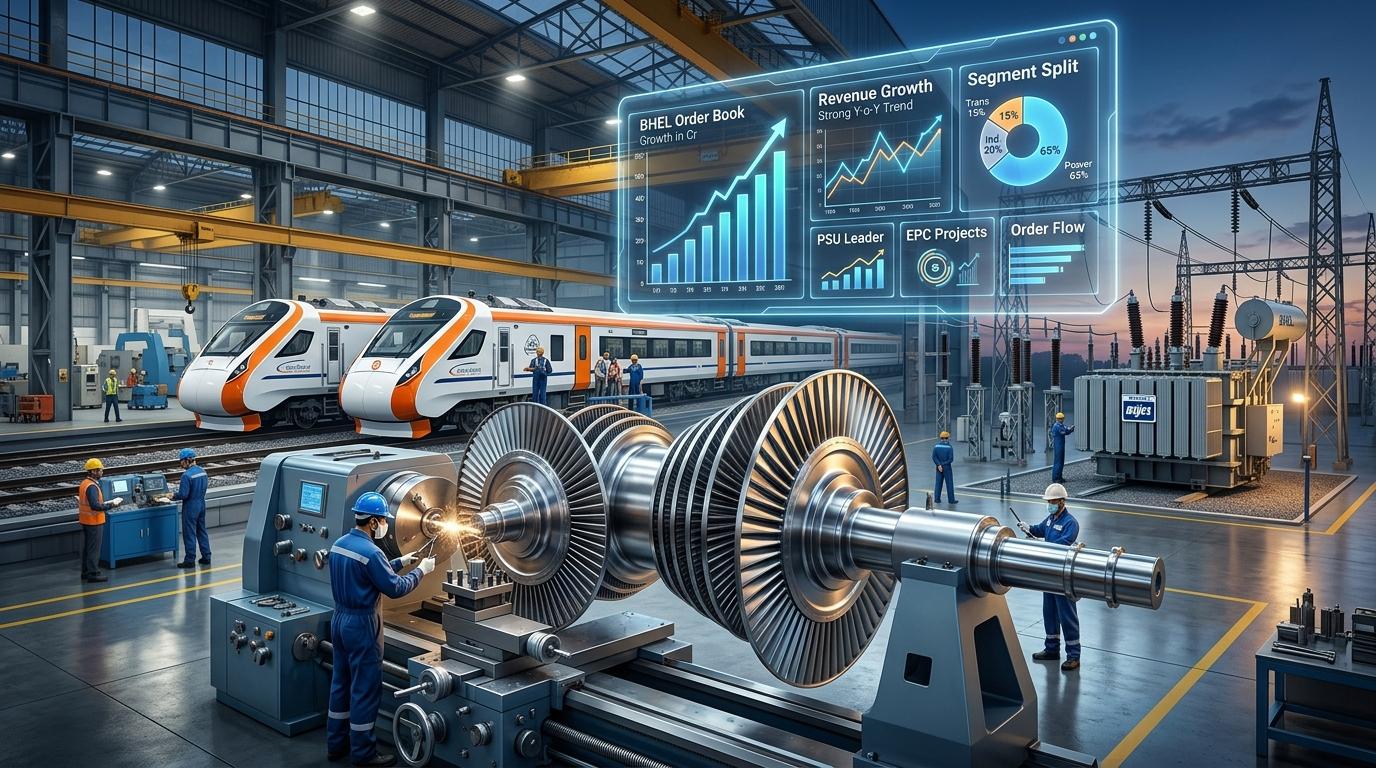
Bharat Heavy Electricals Limited (NSE: BHEL), India's premier Maharatna engineering conglomerate, has staged a historic operational turnaround. Key institutional pillars: Anchored by the Central Electricity Authority's (CEA) directive to build 80 GW of new supercritical thermal power by 2032 and restrictions on Chinese imports, BHEL commands a dominant 65%–70%+ domestic market share. Its confirmed order book has crossed an unprecedented ₹1,35,000+ Crore, powered by mega PSU orders from NTPC and DVC, 80 Vande Bharat sleeper trainsets with Titagarh (plus a 35-year maintenance annuity), and NPCIL 700 MWe nuclear steam generators. As annual execution scales toward ₹40,000 Crore, operating leverage is set to expand EBITDA margins from 3% toward 12%+.
Bharat Heavy Electricals Limited (NSE: BHEL / BSE: 500103), India's premier Maharatna heavy engineering and power equipment manufacturing conglomerate, has staged one of the most powerful corporate turnarounds in the capital goods universe. With a distinguished industrial heritage spanning over six decades under the administrative control of the Ministry of Heavy Industries, BHEL has engineered, manufactured, and installed more than 53% of India's total utility power generation capacity (exceeding 195,000 MW across thermal, hydro, gas, and nuclear domains).
Following nearly a decade of stagnant domestic capital expenditure—during which power equipment ordering collapsed and BHEL grappled with under-absorbed plant overheads—the enterprise has entered a multi-year industrial supercycle. Catalyzed by the Government of India's statutory mandate to construct 80 GW of new coal-based supercritical thermal capacity by 2032 to ensure 24/7 grid stability, alongside landmark diversification into Vande Bharat sleeper trainsets, 700 MWe nuclear steam generators, and naval defence hardware, BHEL has accumulated an unexecuted order backlog surpassing ₹1,35,000+ Crores. This comprehensive 2026 institutional guide provides an exhaustive dissection of BHEL's segmental order book, analyzes the mathematics of operating leverage margin expansion, benchmarks performance against capital goods majors (L&T, Siemens Energy, Thermax), and evaluates long-term equity valuation.
1. The 80 GW Thermal Power Supercycle & BHEL's Domestic Moat
India's peak electrical power demand has shattered historic milestones, surging past 250 Gigawatts (GW) driven by manufacturing expansion under Make in India, rural electrification, and soaring residential air-conditioning loads during extreme summer heatwaves. While India is aggressively building out solar capacity, transmission operators discovered a hard thermodynamic reality: solar farms produce 0 MW during the critical evening peak hours of 7:00 PM to 10:00 PM.
To avoid catastrophic grid collapses, the Central Electricity Authority (CEA) and Ministry of Power revised India's National Electricity Plan, officially mandating the construction of 80 GW of new coal-fired thermal generation capacity by 2031–2032:
Three Pillars of BHEL's Domestic Thermal Moat
1. Strict Public Procurement Restrictions on Imports: Following cyber-security and national security directives issued by the Ministry of Power, power equipment imports from nations sharing land borders with India (specifically Chinese OEMs) are strictly barred from participating in central and state power tenders. This leaves BHEL as the primary qualified domestic vendor possessing the scale to build multi-gigawatt thermal boiler and turbine islands.
2. Domestic Market Share Exceeding 65%–70%: BHEL commands an overwhelming market share in the supply of heavy Boiler-Turbine-Generator (BTG) packages, allowing it to dictate pricing discipline and capture healthy gross margins.
3. Mega PSU Turnkey EPC Contract Wins: Central power generation giants have awarded mega-contracts to BHEL on a turnkey Engineering, Procurement, and Construction (EPC) basis, including NTPC Singrauli (2 × 800 MW), NTPC Lara (2 × 800 MW), NTPC Talcher (2 × 660 MW), Damodar Valley Corporation Koderma (2 × 800 MW), and NLC India Talabira (3 × 800 MW).
2. Segmental Breakdown of BHEL's ₹1.35+ Lakh Crore Order Book
BHEL's unexecuted order backlog has expanded by more than 50% year-on-year, reaching an unprecedented ₹1,35,000+ Crore. Crucially, the composition of this backlog is diversified across strategic national sectors:
| Business Vertical | Order Backlog (₹ Cr) & Share | Flagship Contracted Projects & Products | Strategic Growth Drivers |
|---|---|---|---|
| 1. Power Generation (Thermal & Hydro) | ~₹98,000+ Cr (72%) | 660 MW & 800 MW Supercritical Boilers, Steam Turbines, FGD Green Emission Units. | 80 GW national thermal capacity additions; strict ban on foreign equipment imports. |
| 2. Railways & Urban Mobility | ~₹20,500+ Cr (15%) | 80 Vande Bharat Sleeper Trainsets (with Titagarh), 6,000 HP Electric Locomotives. | Modernization of long-distance passenger travel; 35-year life-cycle maintenance annuity. |
| 3. Defence & Aerospace | ~₹9,500+ Cr (7%) | 76mm Super Rapid Gun Mounts (SRGM), Warship Gas Turbines, Space Solar Cells. | Ministry of Defence Positive Indigenisation Lists; Indian Navy fleet expansion. |
| 4. Nuclear Power (NPCIL) | ~₹8,000+ Cr (6%) | 700 MWe Pressurized Heavy Water Reactor (PHWR) Steam Generators & Turbines. | India's fleet-mode expansion of 10 indigenous 700 MWe nuclear power reactors. |
With an aggregate order backlog exceeding ₹1,35,000 Crore against trailing revenues of ~₹24,000–₹26,000 Crore, BHEL boasts an exceptional Order-to-Sales ratio of 5.5x, providing rock-solid revenue visibility for the next five years.
3. Operating Leverage Inflection: How Profitability Compounds
In heavy industrial engineering, fixed manufacturing overheads (depreciation of heavy machinery, specialized factory tooling, technical engineering salaries, and administrative expenses) remain largely constant whether a factory runs at 40% capacity or 85% capacity. Understanding this operating leverage inflection is the single most critical analytical key to forecasting BHEL's net profit growth:
The Mathematics of BHEL's Operating Leverage Surge
• The Trough Phase (FY19–FY23): When annual revenue execution hovered between ₹20,000 Crore and ₹23,000 Crore, BHEL's massive fixed costs absorbed nearly all gross profits. Operating EBITDA margins collapsed to a depressed 1.5% to 3.5%, resulting in negligible net earnings.
• The Inflection Phase (FY25–FY27E): As execution of the ₹1,35,000+ Crore order book accelerates, annual revenues are projected to scale from ₹25,000 Crore towards ₹38,000 to ₹42,000+ Crore. Because fixed overheads are already absorbed, every incremental ₹100 of top-line revenue delivers disproportionately higher operating profit.
• EBITDA Margin Expansion: Operating EBITDA margins are poised to expand from sub-3% levels toward 10.0% to 13.5%+, triggering exponential growth in reported profit after tax (PAT) and Return on Capital Employed (ROCE).
4. Railways Transformation: The Vande Bharat Sleeper Consortium
In one of the most prestigious commercial contracts awarded by Indian Railways, a consortium comprising BHEL (52% lead partner) and Titagarh Rail Systems (48%) secured an order to manufacture 80 Vande Bharat sleeper trainsets (1,280 passenger coaches):
- Upfront Manufacturing Revenue: The capital manufacturing contract is valued at approximately ₹9,600 Crore, with trainsets designed for semi-high-speed operating velocities of 160 km/h to replace conventional Rajdhani Express trains.
- The 35-Year Maintenance Annuity Moat: Crucially, the contract includes a binding 35-year comprehensive life-cycle maintenance agreement valued at nearly ₹15,000 Crore. Maintenance contracts carry high operating profit margins and generate steady, inflation-indexed quarterly cash flows spanning three and a half decades.
- Indigenous Propulsion & TCMS: BHEL's electronics division in Bengaluru and traction plant in Bhopal manufacture the advanced traction converters, auxiliary transformers, and Train Control Management Systems (TCMS), ensuring deep domestic value addition under Make in India.
5. Clean Energy & Industrial Diversification: Hydrogen & Coal Gasification
While thermal power provides the primary revenue engine, BHEL is commercializing advanced green engineering technologies to secure a decades-long industrial future:
A. Surface Coal Gasification JV with Coal India (CIL)
India possesses the world's fifth-largest coal reserves, but domestic coal contains high ash content (35%–45%). BHEL formed a dedicated joint venture with Coal India Limited to construct a commercial surface coal gasification plant in Lakhanpur, Odisha. Using BHEL's proprietary pressurized fluidized bed gasification technology, the plant converts domestic high-ash coal into synthetic syngas to manufacture ammonium nitrate fertilizer feedstock, reducing India's expensive chemical import bill.
B. Pumped Storage Hydropower (PSP) Turbines
To support India's 500 GW renewable grid integration, utilities require massive energy storage solutions. BHEL is India's pioneer in engineering reversible Francis pump-turbines. During off-peak daytime hours, these machines utilize cheap surplus solar electricity to pump water into elevated reservoirs, instantaneously reversing at sunset to generate dispatchable hydroelectric power during evening peak demand.
C. Clean Air Flue Gas Desulphurization (FGD) Retrofits
Under statutory environmental emission standards issued by the Ministry of Environment, Forest and Climate Change (MoEFCC), all operating coal power plants must install Flue Gas Desulphurization (FGD) systems to eliminate sulphur dioxide (SO2) emissions. BHEL has secured over ₹25,000 Crore in FGD retrofit orders, establishing an environmental engineering division with high execution velocity.
6. Manufacturing Footprint & Heavy Industrial Infrastructure
BHEL operates 16 state-of-the-art manufacturing divisions supported by an extensive network of specialized regional engineering centers:
| Manufacturing Center | Core Engineering Focus & Equipment | Annual Capacity & Technical Capabilities |
|---|---|---|
| 1. Haridwar (Uttarakhand) | Heavy Electrical Equipment (HEEP): Large steam & gas turbines, generators, exciter sets. | Manufactures massive supercritical 800 MW steam turbine rotors and hydro generators. |
| 2. Tiruchirappalli (Tamil Nadu) | High-Pressure Boilers: Supercritical boiler drums, waterwalls, high-pressure industrial valves. | India's largest boiler manufacturing complex; produces piping capable of 600°C steam. |
| 3. Bhopal (Madhya Pradesh) | Transformers, Switchgear, Traction Motors, Hydro Turbines, Nuclear components. | Produces 765 kV ultra-high-voltage transformers and Vande Bharat traction equipment. |
| 4. Hyderabad (Telangana) | Heavy Power Equipment (HPEP): Industrial gas turbines, centrifugal compressors, pumps. | Supplies vital gas compressors and turbines for oil refineries, fertilizer plants, and navy. |
| 5. Jhansi (Uttar Pradesh) | Electric Locomotives, Diesel-Electric Shunters, Instrument Transformers. | Specialized rolling stock assembly division supporting Indian Railways freight corridors. |
7. Comprehensive Peer Benchmarking: BHEL vs. Capital Goods Majors
The following institutional matrix benchmarks BHEL against leading capital goods and engineering peers on the Indian stock exchange (Larsen & Toubro, Siemens Energy India, and Thermax):
| Financial & Operating Metric | BHEL Limited (NSE: BHEL) | Larsen & Toubro (L&T) | Siemens Energy India | Thermax Limited |
|---|---|---|---|---|
| Unexecuted Order Book (₹ Cr) | ₹1,35,000+ Cr (Record High) | ₹4,75,000+ Cr | ~₹38,000 Cr | ~₹11,000 Cr |
| Thermal BTG Market Share | 65% – 70%+ (Domestic Dominance) | Selective EPC (L&T-MHI) | Gas Turbines & Grid | Industrial Boilers |
| Consolidated Annual Revenue | ~₹24,000 – ₹27,500 Crore | ~₹2,21,000 Crore | ~₹21,000 Crore | ~₹9,300 Crore |
| EBITDA Margin Trajectory | Inflecting from 3% toward 12%+ | 10.5% – 11.5% | 13.0% – 14.5% | 8.5% – 9.2% |
| Order-to-Sales Visibility | 5.5x Multi-Year Revenue Cover | 2.2x | 1.8x | 1.2x |
8. Strategic Defence Indigenisation: Powering the Indian Navy
BHEL is a key strategic partner under the Ministry of Defence's Positive Indigenisation Lists, manufacturing critical systems for the armed forces:
- 76mm Super Rapid Gun Mounts (SRGM): BHEL's heavy equipment unit in Haridwar is the sole licensed domestic manufacturer of the Oto Melara 76/62 SRGM naval gun. Installed as the primary naval artillery weapon on virtually every frontline stealth frigate, guided-missile destroyer, and corvette in the Indian Navy, BHEL handles all ongoing ammunition upgrades and barrel refurbishments.
- Marine Propulsion & Gas Turbines: Engineering indigenous naval gas turbines, main reduction gearboxes, and auxiliary propulsion systems to replace foreign naval components.
- Aerospace Grade Solar Cells for ISRO: BHEL's electronic systems facility in Bengaluru manufactures space-grade solar cells and satellite battery systems deployed on ISRO's Polar Satellite Launch Vehicle (PSLV) missions and deep space exploration probes.
9. Key Business Risks, Execution Gestation & Working Capital
An institutional equity evaluation must account for cyclical capital goods sensitivities:
Key Operational Headwinds to Monitor
1. Extended Execution Gestation & Liquidated Damages: Mega thermal power stations take 36 to 48 months to manufacture, deliver, and commission on site. Any civil engineering delays, land acquisition bottlenecks, or boiler erection disputes can trigger contractual delay penalties (Liquidated Damages) that compress project profitability.
2. Working Capital & Debtor Receivable Cycles: While orders from central PSUs (like NTPC) are financially secure, contracts with state electricity boards (SEBs) have historically suffered from extended payment realization cycles. BHEL must maintain tight cash flow discipline to avoid ballooning trade receivables.
3. Raw Material Commodity Price Escalation: Boiler manufacturing requires thousands of tons of high-grade alloy steel plates, seamless steel tubing, and copper. If raw material prices surge unexpectedly, fixed-price project components could experience margin compression if contractual price escalation clauses do not provide full indexation.
10. Statutory Regulatory References & Official Frameworks
The operational statistics, thermal capacity roadmaps, public procurement circulars, and financial disclosures detailed in this institutional guide are anchored in official statutory enactments:
- Central Electricity Authority (CEA): National Electricity Plan (Generation 2022–2032) mandating 80 GW thermal additions at Central Electricity Authority.
- Ministry of Heavy Industries (Government of India): Administrative policies, PSU governance, and capital goods capital allocation guidelines at Ministry of Heavy Industries.
- Ministry of Power: Public Procurement (Preference to Make in India) Orders restricting cyber-sensitive power equipment imports at Ministry of Power.
- National Stock Exchange of India (NSE India): Official financial disclosures, corporate shareholding patterns, and announcements for BHEL.
- Bombay Stock Exchange (BSE India): Audited annual financial statements and quarterly results for BSE Scrip Code 500103 at BSE India.
- Nuclear Power Corporation of India Limited (NPCIL): Fleet-mode indigenous 700 MWe PHWR reactor supplier notifications at NPCIL Portal.
Frequently Asked Questions (Institutional FAQ Desk)
BHEL, selecting Delivery (CNC), and executing their buy order.
Educational & Regulatory Disclosures
Source Attribution: This masterclass educational guide is produced strictly for investor awareness and capital markets literacy in alignment with SEBI Investor Education and Protection Fund (IEPF) guidelines.
Non-Advisory Mandate & Risk Warning: Digital Arthalaya is strictly an independent financial education portal and is not a SEBI-registered investment advisor or stock broker. IPO bidding and equity trading involve market risk, including potential loss of principal. Readers must conduct their own independent due diligence and read all offer documents carefully before making investment commitments.